PART 7
Every great people invests in its history. You have great European nations who made it their business to reclaim, restore and reconstitute the history of their classical civilization, that is, the one which they claim is their classical civilization which is Greek and Roman.
At every turn in American civilization you are lead back to what people call the roots of western civilization as a way of getting a bearing on what is taking place now. For example, why would people spend so much time and put so much resources into maintaining Greco-Roman architecture as a part of federal buildings? Why would people put so much energy and resources into developing institutions like the Smithsonian Institute to save the history of its people? Why would people spend so much time teaching Greek and Latin in schools, even those people who had no direct connection to Greek and Latin? For example, the Greco-Roman world had already passed before the British world came into being and yet the British people claim the Greeks and the Romans as their cultural ancestors, because it is important for people to have this kind of cultural and historical rooted-ness. If it is important for the Europeans, Asians and others, it is equally important for Africans and Black people.
But Black people are connected to that people who were responsible for laying the foundation for everybody else on the planet.
That is true, and from that point of view, it ought to be a source of pride. Originally the focus was in countering some of the negative images that were shown at the very beginning of this presentation, those racists images that had been presented and the manipulation of those images, by providing true images not only of ancient Africans but also of contemporary African-Americans, by putting the true images next to those negative images to help counter the damage that was done.
But there was something even more important. Merely to deny the lie was not enough, because when you dig deeply enough into African cultural traditions, what you discover is that African people have made statements about the great questions concerning human life and have provided leadership in thinking about ways to improve the human condition. Now if that is true, then we deserve to give as much attention to that as we do to the study of Aristotle, Kant and all the others who some people think are the great thinkers of the world. Africans had just as much and even a longer time to contribute to questions even more profound.
For example, for an African to have in their tradition the oldest text book in the world - the book of Ptahotep - which can be obtained and read in English, and not to even know that it exists is to be denied a vital part of their heritage. To have this type of book which, like the ones in schools taught how to live right in your tradition and not to know it and not to ever ponder on it is to be poverty stricken.
What happens to a group of people that is always consuming the history of another people?
The same thing that happens to a sheep dog happens to this group of people. The dog that herds sheep for a master is a dog that was raised in a pen not with dogs but with sheep, that's how you train this dog. You must put that dog in a pen so that it can nurse on a sheep mother. Then it grows up thinking of itself as a sheep but it has all the mental and physical powers of a dog. It is amenable then to the training of its owner, to be taught to perform actions that are un-dog like. It will even see its brothers and sisters as its enemy even though it came from the same litter with those brothers and sisters, because of a peculiar kind of programming that is necessary in order to alienate this dog from himself.
How can Black parents today resist rather than simply react to the attempts to de-Africanize Black people?
The most important thing that can be done right now on this score is to immerse ourselves in the knowledge, and this means the parents as well as the leaders and members of the organizations that socialize our people in this study, as opposed to just teaching the children. The parents must be immersed in this kind of knowledge and information, and once they know that, they will make the right decisions for their children. This will therefore act as an effective counter to the kinds of images that have been presented about Black people.
When you look at all of the suffering that Black people have experienced during and after slavery, we ought to do something great with our so called emancipation. What do you think is possible for Black people in this country, in terms of an independent, social, and cultural process?
The development of an independent socialization process is possible and that's important. We can go to public schools etc., but any group that is really successful carves out niches during which time it feeds its own cultural and social tradition. It is the groups that fail to do that who allow their individual members to grow up with feelings of isolation, lack of purpose, lack of a sense of direction, lack of motivation and a vulnerability to someone else who has gotten their act together. So this challenge should be taken by having the churches take on the extra task, establish a library, establish cultural classes, have the fraternities and sororities and various orders do the same thing, so that this part of our soul and mind that is not now being fed by the standard institutions of society or that are being fed negative things, can be augmented and in some cases overcome, so that we have the positive orientation to our lives which we ought to have.
What does much of this history say about the reference to allegiance? When President Reagan sent the military into Grenada and we witnessed Black soldiers in essence fighting against Black people, what does this history say in regard to this?
It is quite clear that the American foreign policy is an ethnic one because it has been developed by an ethnic group for the benefit of that ethnic group which developed it. In other words, Black people have no participation in the development of American foreign policy for the most part. It is basically pro-European which is what you would expect as seen by the soft position of the government on South Africa is a case in point. They must be looked at as kith and kin, because the same rules that make you arm contras to fight in Nicaragua and cause you to proclaim that you are going in to establish democracy, should have made you take arms up to go in and take down the government of South Africa during the apartheid period. But they went into Grenada, Iraq and wherever else those places are that were struck with those very rules, but could not seem to draw the mental or moral courage to confront South Africa. They could not even pass economic or any type of sanctions, so this clearly shows it to be an ethnic foreign policy. Therefore if there is ethnic protection going on then we as Black people also have to be ethnically oriented as well.

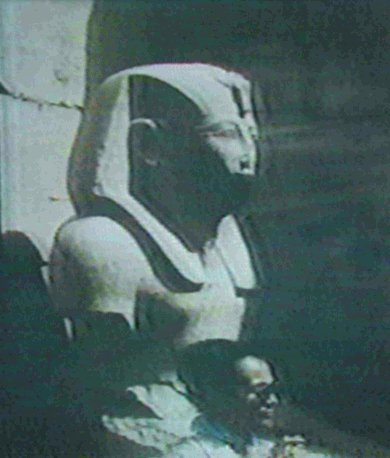
Here is one of the most famous queens though not the first woman to rule. Egypt had another two or three women who had Horus names and became independent rulers, but Hatshepsut was the most famous and just to show her African-ness, in the first image, there is a woman standing in profile against the carving of Hatshepsut.
She actually developed a temple in the Valley of the Kings and was the only queen to do so.
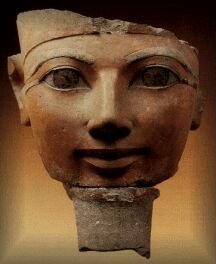
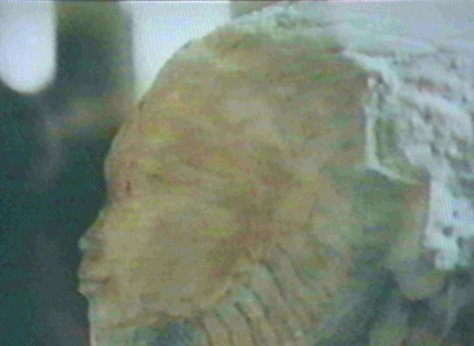
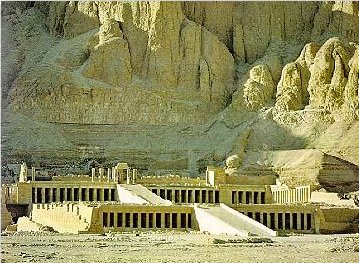
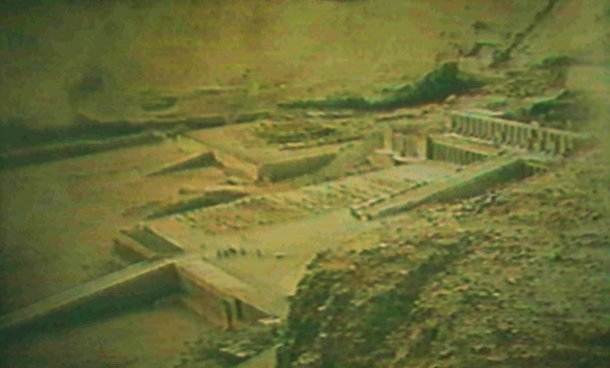
This is the last architect of that temple who is called Senenmut, and you can see that he looks like the others of the Nile Valley.
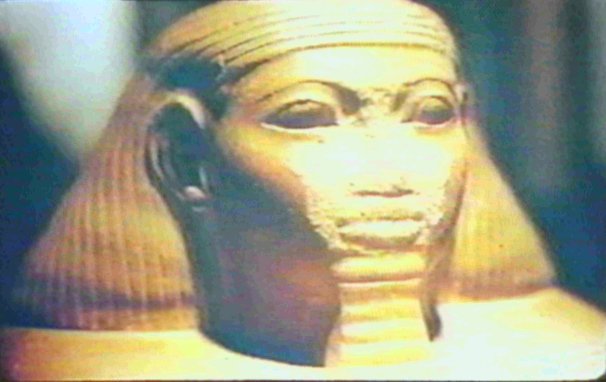
. What would your message be to Black parents then regarding African history?
That full freedom requires the restoration of memory, the reclamation of identity, the redevelopment of culture, the control of socialization, the accumulation of wealth and the destruction of segregation. That should be our road map, in other words, the things that were done will have to be reversed and we have to be conscious of it just as it was consciously done. We must be conscious in reversing those things that were done that caused our degradation. Naturally there will be certain cultural forms that people love which may have to be sacrificed in order to reproduce their own for the benefit that may accrue to individuals.
What you are below is an actual carving of the mother of Hatshepsut with the God Amon (Amen/Amun). Now in order that you can see this since it is dark, a sketch is used so that it can be seen the way it really is.
You are looking at Amon on the left and Hatshepsut's mother on the right. This image is one of the many times when the virgin birth story was told, in other words, almost every pharaoh or king and frequently the gods talked about the virgin birth. This is one of the actual renditions of the Immaculate Conception.
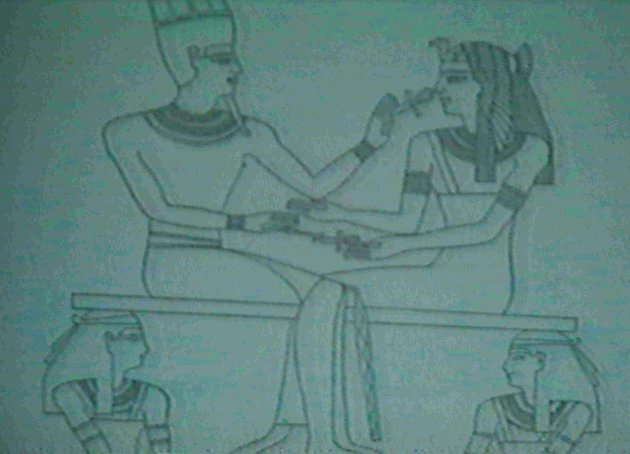
This was given a European touch to it because what actually was on the wall compared to what is on the sketch was given free reign by the artist, so that is not actually a true copy of what was on the wall. It is merely a sketch that helps us see what could not be seen from that photograph.
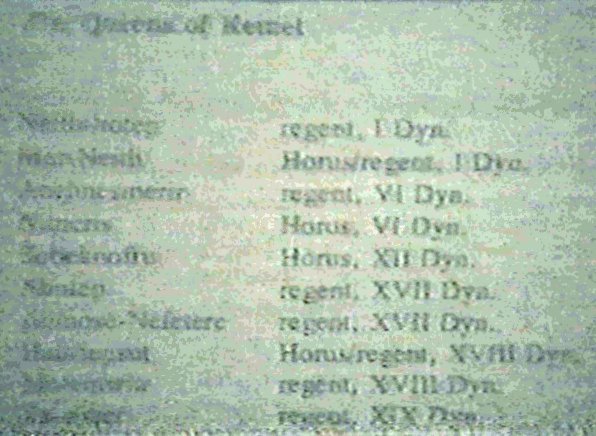
Copied from one of the articles in the journal of African civilization is this list of African queens from Egypt, and you will notice that they start with the first dynasty and go all the way down to the 19th dynasty. Each of the queens has a name which appears on the left, but what is important is that on the right the word Regent or Horus name appears.
If a queen had a Horus name, it meant that she ruled in her own right because every king had a Horus name. So if you see the name Horus opposite the queen, it meant that she was not merely someone who stood in for her husband, but that she was one who actually ruled in her own right. This is important because some people say that Hatshepsut was the first queen in history but she was not as you can see from this list, because there were other queens who had Horus names before her.
Horus referred to the God who was called by that name whose actual name in Kemetic was Heru, but Horus was a part of that holy family of Asar, Aset and Heru. Kings then identified themselves with Horus, so they would have their real name and also a Horus name, much like having a Christian name for example, that is, names being associated with the Disciples of Christ. So a person would change their name when converting to Christianity to a name like John, Mark, James, Mathew and so forth. In the same way, ancient Kemites (Egyptians) did that with Horus names.
Earlier it was indicated that there were more pictures of royal mummies especially in the 18th dynasty, and one was presented of Sekenenre /Seqenenra (Tao II) who started the war of liberation that drove out the invading armies from Asia in the 17th dynasty and allowed the 18th dynasty to begin. So what we have here are some of the royal mummies that have been located. It is very hard to find these royal mummies, but when you look at them, you will notice that their skin is Black.
This is the mummy of Thutmose I on the left and a pink granite statue of Thutmose III on the right, which is in the British museum. Note it is not his mummy which will be shown later.
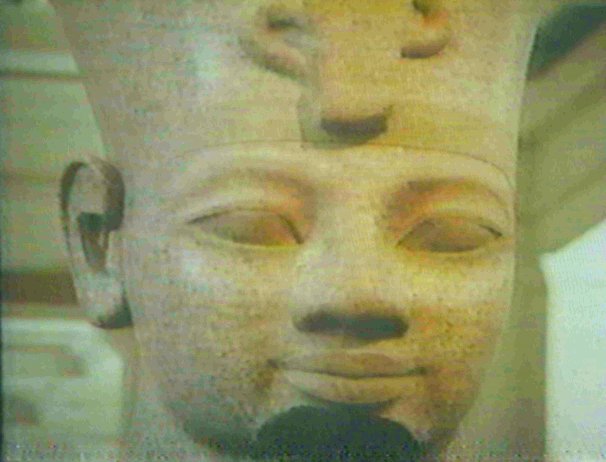
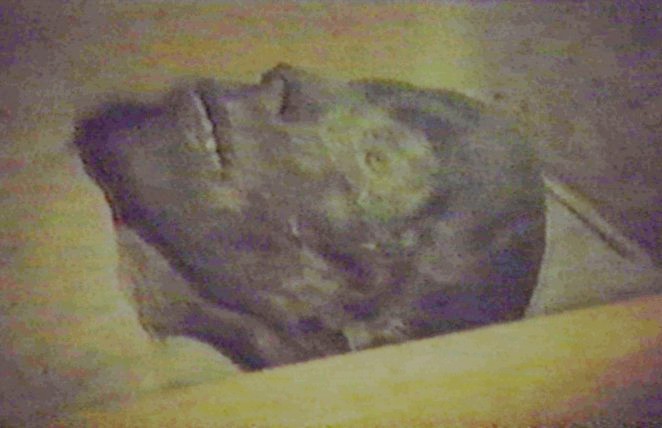
The reason for emphasizing this particular pharaoh of the 18th dynasty was because he was the one that carried the extent of the Egyptian empire when it became an empire all the way up to the Tigris River, to the Euphrates River and up into Persia and even including parts of Europe. This pharaoh conquered and was ruler over what was then the known world. He was probably the most powerful pharaoh in Egyptian history, and again from his facial features you can tell that he is Black.
You are talking about Black people, Africans, dominating much of the world. This is contrary to what we have been taught; that we have always been slaves and that our roots start with "Roots".
That's clearly incorrect. One of the ways you perpetuate that notion is that if you think about the images which people have when they think of Egypt, you think of Nefertiti, of Cleopatra and other figures, some of which were shown earlier, that appear to violate the principle mentioned earlier which stated that this was a Native Black African People who populated and ruled Egypt.
This is the why when you see pictures like the one of Thutmose III, it clearly does not agree with the image people have of Nefertiti that is in the Berlin museum. However, the overwhelming number of portraits and mummies that are there of the royal family show them clearly to have been an Africoid people.
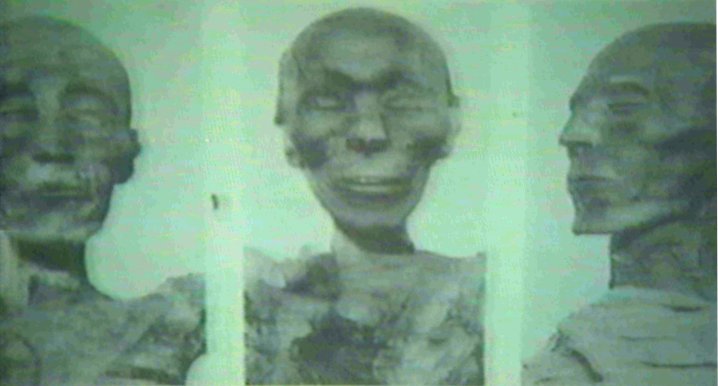
Here is the mummy of Thutmose II, the one in the centre so you can compare it to the pink granite statue to show that there is a very close resemblance between the statue and the mummy. So it's not just artistic license in this case but it's really good when you have the mummies to look at.
On the left you can see a picture of an Asian in terms of stereotype or at least stereotypical Asian features for that mummy. On the right you can see a picture of the mummy who is supposed to be that of Seti I.
According to Dr. Ben Jochannan, the nose on this mummy (Seti I) did not exist when they found the mummy but was added on later. You can see that the nose is an aquiline nose, but though many Africans have aquiline noses, if the mummy did not have a nose, it would be misleading to give it one as this has a way of distorting history.
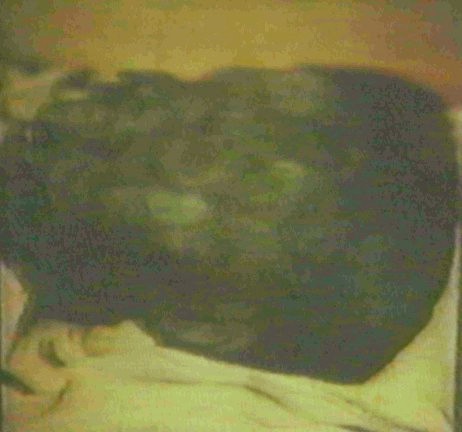 This is the mummy of Thutmose IV. Remember the debate mentioned earlier that occurred when all these mummies kept turning up Black where the question was raised, "is this really the way the skin was in life?" The answer that was sometimes given by those who studied mummies was that the embalming fluid was responsible for a change in the colour of the skin after death.
This had prompted Dr. Cheikh Anta Diop to develop the skin test chemically in order to determine the composition of the melanin in the skin. After he was allowed to do these tests it was clearly demonstrated that they were Black people, and as a result he was unable to complete the rest of the tests with the royal mummies which were then removed from general view.
 |
 |
 |
 |
 |


