PART 5
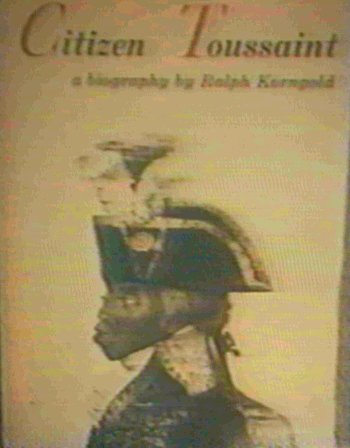 This picture was included because it suggested a possible reason why Napoleon’s soldiers might have been angry enough to turn their rifles and canons on the sphinx shown earlier. Remember that Toussaint le Overture, the liberator of Haiti was at war with France, and France was at war with Haiti, and that Toussaint, Dessalines and Christophe together with Boukman who was an African priest, had begun the Haitian revolution. They all did something that had never before been done in history and still hasn’t been done again. An army of slaves was raised which defeated the army of a developed country.
So here is the man or the people who embarrassed France in the eyes of the world, embarrassed England in the eyes of the world, embarrassed Spain in the eyes of the world because they were successful in establishing their independence militarily. Now that might be a good reason why people would be angry when they saw Black images and might want to blow the nose and mouth off. However, this is merely speculation since there is no available data on which to base those conclusions regarding this point.
 The people of the Nile Valley when they pictured themselves on the so called hieroglyphics which is a Greek word, in African the word is Medu Neder/(Neter) or Medu Netjer which means the writing of the gods. Medu is the word and Netjer is the spirit or force or God, so the Holy writing or sacred writing, is what is meant by hieroglyphics. Higher writing is probably what the Greeks meant by it, but what the Africans meant was the sacred text or sacred writing.
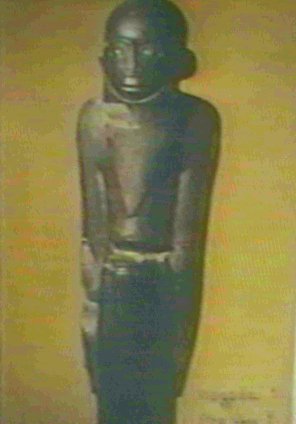
When you therefore see these carvings and human images, you see things that will help you to get a fix on who those people were. For example, just the way this man is dressed should tell you something. Who dresses that way in 110 degree temperature with the sun beating down at high noon? Unless you are pigmented, you don’t stand out there for any long period, but this is the typical form of dress for the African who even today can indeed stand in the sunlight and be dressed only in a cloth like that which becomes, by the way, your Masonic apron. Look at it very carefully, that little kilt or apron that is being worn by the person.
That image is of Tera Neter who was one of the early kings before Egypt became a nation back into the pre-dynastic history. There was at least a thousand years of good civilization before Egypt in that same place. Remember the first date in human history that can be documented for the calendar is about 4,236 BC. That is when Africans in the Nile Valley already had a 365 day a year calendar which, by the way, is the same calendar that is being used today.
So that date is long before the 3,100 years BC that Egypt starts, so you had to have a lot of high tech stuff going on even before the beginning of Egypt, and with people who looked like this.
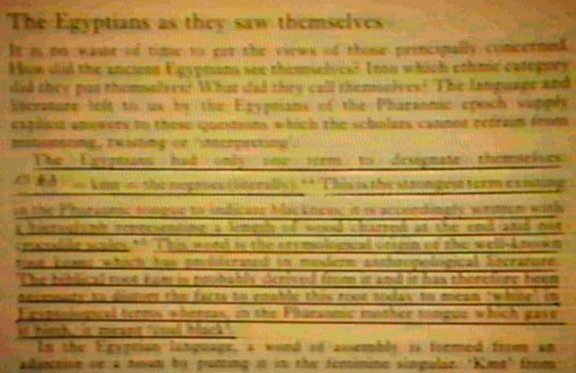
Egyptians referred to themselves by the word KM. Note the hieroglyph in the underlined sentence. On the left side you will see something that looks like a little stair step which is the hieroglyphic symbol or Medu Netjer symbol for KM. It’s sitting over something that looks like half of a ball which is the hieroglyph for T, so we get KMT (Kemet) from which we get words like chemistry, chemical, Kham and so forth. In other words, all of those words are derived from basically the same source.
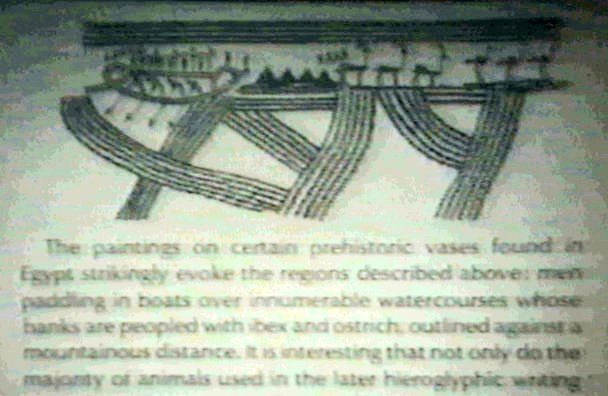 We have the pictures that they drew of their homeland on their pottery. This is a sketch, not the actual object, of the objects that come off pottery showing that ancient Egyptians recall scenes up the river.
The animals in these pictures are found south of Egypt. So these are scenes on their pottery which recall their own cultural connections to the African interior.
When the Aswan Dam was built about 400 miles south of Cairo, it flooded almost all of the country of Nubia. When you look at the Nile from the air, people reside only 2 or 3 miles on either side, and when you go beyond that point you are in desert. You can almost stand anywhere up the river with one foot on the Black land and the other on the red land, one foot on the growing land and one foot on the desert land.
Since the Nubians lived that close to the river it meant that anytime a dam is built it would flood what amounts to the living land of a people. So now the Nubian people who lived south of Egypt in the Sudan, have a lake which is 450 miles long covering their homeland. (That’s about the distance from Los Angeles to San Francisco.) That’s a long lake covering all of the liveable land, all of the Black dirt, leaving only the red dirt or sand, meaning that eventually the Nubian population had to be removed and relocated. Many of them went to Egypt and now live there as Nubian populations in Egypt.
But the important thing is that before the lake covered over the land, UNESCO and other western nations in the world chipped in money to rescue things that were being covered over, which is, the history of Black people. In other words, the cemeteries are covered over, which is one of the major places that you can get bodies to see what the people of the area looked like. That is where you get pottery, bones, artefacts, building structures and so forth that help to recreate the historical past.
When the Aswan Dam was built, the opportunity to finish finding out the story of the Africans who were immediately south of Egypt in Nubian was destroyed, because it is now covered under water and being covered every year with more and more mud that comes down from Southern Africa.
But before that happened, on the front page of the New York Times this sketch of an incense burner was published. This was done by rolling the wooden incense burner over in clay in order to make an impression, so that you can see what the images on the side of the incense burner were like. What’s important about this is the fact that it helps us to establish the date for Ta Seti, the nation south of Egypt that was older than Egypt.
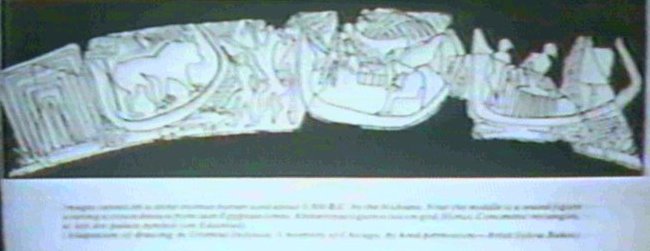
In this incense burner you see three boat litters, in the middle one there is a pharaoh is sitting with his crown on his head which is the crown of the south. He has the flail in his hand and a bird right up over his right shoulder in a tree. That’s the way you always showed the bird Horus which represented the God Horus. This means that in Ta Seti, 200 years before Egypt gets started, there is Horus, Osiris and Isis, already being worshipped by the people of Ta Seti as the first Holy family.
The bodies found of the people of Ta Seti are described as being tall with Negroid appearances by the people who dug them up. So not only do we have a nation south of Egypt, but we have a physical description of the people who populated that nation, and a cultural description of what they were doing, showing that essentially the elements of government and religion that we will find later in Egypt were not native to Egypt but came from the south of Egypt which is where even Blacker people are.
In fact, the Blackest people on the continent of Africa, the truly dark people appear mainly in that Nubian section of Africa, with the blue tint. (Remember “We are the people darker than blue” by Curtis Mayfield.
They were seen and thought of as the most beautiful people in the world even by the Greeks, Romans and even Homer talked about them in glowing terms. So these were the people then that had developed that civilization.
Here is an image of one of them. This is at one of those grave sites. This is the way they looked when they carved either their God or their people, and they still look like the people there.

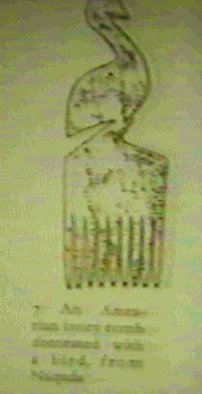 This is one of the combs they used, and this should look very familiar. There is a writer in San Diego by the name of Willie Morrow who wrote the book “400 years Without a Comb.” He is a barber, and what he was calling attention to was the fact that Black people in America had been on the continent for 400 years, and during that whole time if you looked for an artefact that ought to be with them, you would find that they had lost their comb and therefore they cut their hair short. Black people did not know that there were instruments that were appropriate for the texture of Black hair such as the pick. The pick only came back in during the 60’s but Africans were still using it on their continent, while African-Americans had lost their minds about what it was that was appropriate for Black people, so they resorted to using fine teeth combs and hair products like Brylcreem, because “a little dab’ll do you”, but it didn’t.

 The point is, if it is so easy to lose a comb, how easy is it to lose the memory of your culture. So clearly we have to do what we are doing now, which is to go back and reconstruct the evidence for what our people did.
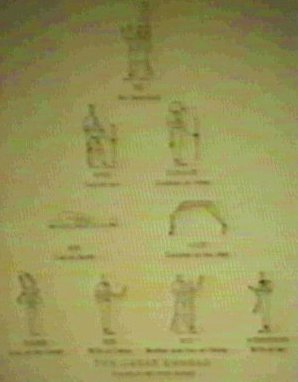 Black people were always worshippers of one God and this is very important, so do not let anyone say that monotheism was created by anybody other than Africans because Africans never had anything other than monotheism. They had different types of monotheism, but nothing other than monotheism. They also had different manifestations of God which confused the missionaries since they could not think abstractly, so they thought that every time a new name was called that the Africans were talking about a new God.
For example, here is the great God Re (Ra) at the top who has two children, Shu and Tefnut but those aren’t gods but aspects of the one God, Shu being the air and Tefnut being the moisture. Look at Geb and Nut; Geb being the earth, Nut being the sky. You don’t think of the sky as being God, but merely a manifestation of God. In other words, these features of the deity became identified as separate Deities in the minds of people who came, but Africans never thought of it in that way. They always thought of these things as powers of God, but they always had one God at the top of the list who was unseen, unknown, unknowable and whose name could not even be spoken. Usually in the south of Egypt that God is called Amon (Amen/Amun/Ammun). That’s from where in many of the western religions we inherited the word Amen, which is for this unknown God, and we end our prayers with Amen or Amon, which means He who is hidden, but who though hidden is the source of all life, power and health. So they never had a name for Him, the word Amen simply meant God who is hidden.
Here is an example of the God Min on the left, and the goddess or power or aspect of God that is known as MAAT on the right.
MAAT stands for truth, justice and righteousness and has always been the major or national African principle, as opposed to some nations that are warlike and who have as their national principle, conquering the world, conquering eternity, conquering space and so on.
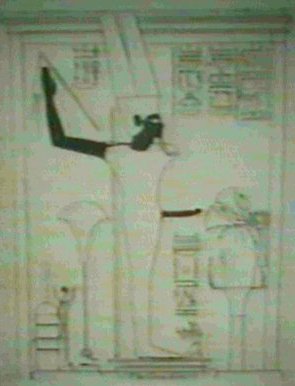
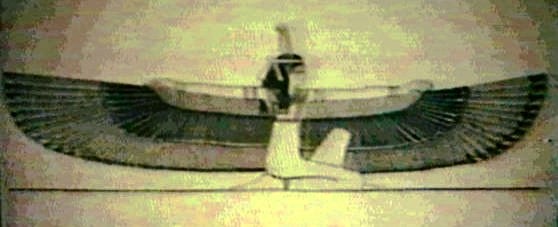
What the Africans wanted when they were truly doing the things that they thought best, was to live according to the principles of God, manifest in MAAT, which meant truth, justice and righteousness.
There is probably no other nation in the history of human kind that has ever had a higher order of goals.
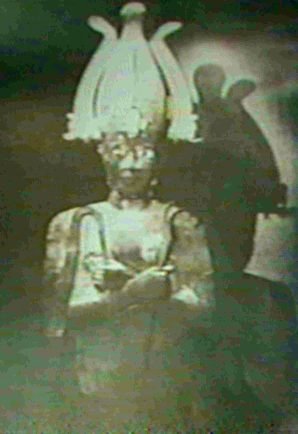
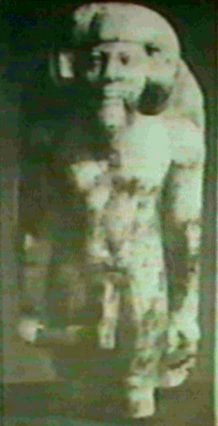 Let’s look again at one of the Deities who is on the left. He is one of the gods and he looks as if he is wearing an afro. He is the pre-dynastic God Osiris, who is always shown as a Black God and also known as The Good Shepherd.
This particular image of Osiris on the right was created in the old kingdom, but there would be images of Osiris that would be created earlier than that, where those images would show Osiris as a Black God.
By the way, Osiris had a crook like the shepherd’s crook in one hand and the flail in the other. He was known as the Good Shepherd, that’s the first time that God was called the Good Shepherd.
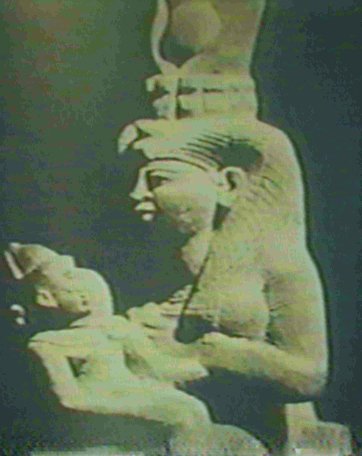 Osiris was married to Isis, who is the first virgin mother in the world. She had a son whose name is Heru or as the Greeks called him, Horus, so God’s son was born of a virgin and is just like God.
The Greeks changed all these African names. Osiris is really the Greek word, his African title was Asar or Asa and his wife’s name is Ast but the Greeks called her Isis. Her son’s name is Heru, the Greeks called him Horus. Therefore, you begin to lose the meanings as you change the names.
This simply was the first holy family in human history which is now imitated or at least there is a strange likeness between this holy family and the Christian holy family where you have God the Father, the virgin mother and the Son of God in Christ. But you already had this model present in Africa at the beginning of Egyptian or Kemetic civilization.
By the way, that God Asar was buried and crucified, thus being the first crucified saviour. He was buried and his body was split into parts and buried all over Egypt. His head was supposed to be buried at Abdju which the Greeks called Abydos.
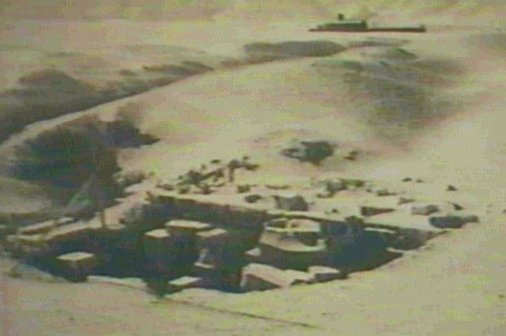 His wife collected the parts together and dedicated places for them. This is the source of the world’s first passion play.
Where there were passion plays at Easter, pilgrims would come from all over the world and go to the grave of Osiris in Abdju (Abydos) to act out the death, burial and resurrection of Osiris.
Of course this place still exists today and used to be called The Holy Land, but we now have other places that are called The Holy Land.
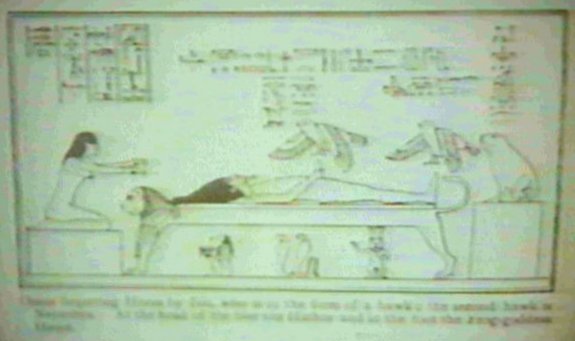
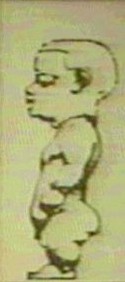 On the right is another picture of Asar (Osiris) who is now shown this time in human form as a pigmy. This is how he was shown in the sacred text when the Africans drew him.
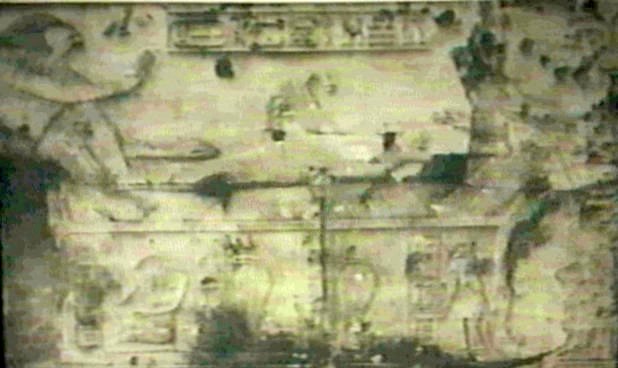
On the left is the first picture or sketch there is of The Immaculate Conception. In it you can see Asar (Osiris) lying down with his phallus raised. The bird hovering over the phallus is the image of Ast (Isis) who is being impregnated by Asar, and then the son of Asar will be born from a virgin mother. Below is the actual picture of the Immaculate Conception as it appeared in Abdju on the wall of the temple of Seti I.
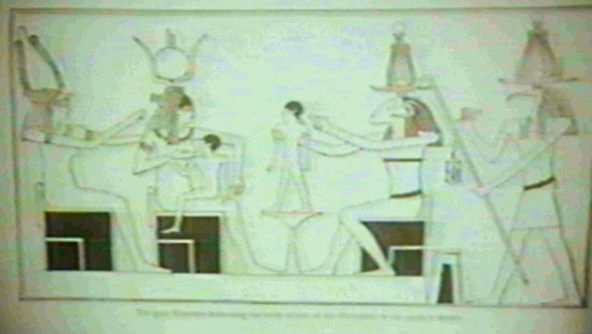 This is Khnum which is an aspect of God, and is one of the images that Africans had of God portrayed as the creator. He has a human body and a ram's head and is seen making a man on his potter's wheel.
So the image that we visualize in the old spiritual "thou art the potter, I am the clay, make me and mould me after thy will", can be found on the walls of temples all up and down the Nile. That's how they conceived of God to be as the creator.
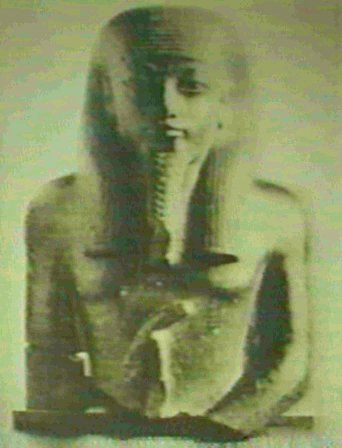
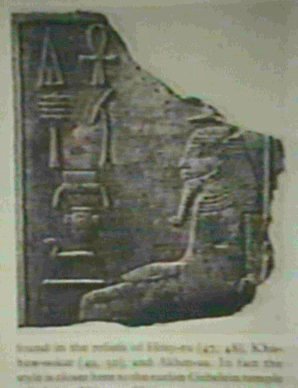 At Memphis, the name of God was Ptah the Supreme Being or the One God. (left). At Abdju (Abydos) they called Him Amon (Amun/ Amen).
At other places he may be known by a different name but they all referred to the one and only Deity.
Their images are being shown so you can see that they are not unlike the Africans who still live there today.
At Memphis, the name of God was Ptah the Supreme Being or the One God. (left). At Abdju (Abydos) they called Him Amon (Amun/ Amen).
At other places he may be known by a different name but they all referred to the one and only Deity.
Their images are being shown so you can see that they are not unlike the Africans who still live there today.
This is the God Geb (right). What is being pointed out here is that all of these images are African in nature, and they appear in the first 1,000 years before invasion.
That is why it is important to have the dates correct, because when we begin to see images of Egyptians that look like Europeans, we are not talking about the old kingdom, we are not talking about the pyramid age, we are not talking about the temple age, we are talking about The Greco-Roman period. We are talking about the time after everything had already been created, and all they are doing is urban renewal.
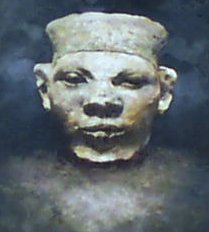 Now here is the first president, his name is Mina or Menes as called by the Egyptians, or Minos as called by the Greeks, but the important thing to note is that he comes from the south. In other words, every time you had a high tech civilization in Egypt, the leader usually came from the south.
What we need in order to get the story of Egypt correct is a calendar similar to the one that exists of US presidents, starting with George Washington. Anyone looking at such a calendar with the presidential faces of America, would know that the country has been run by white males the whole time it has been here. You would not need a lecture on it. If you did a calendar of pharaohnic faces from Egyptians from the earliest time right up to the present, we would not need a presentation like this either.
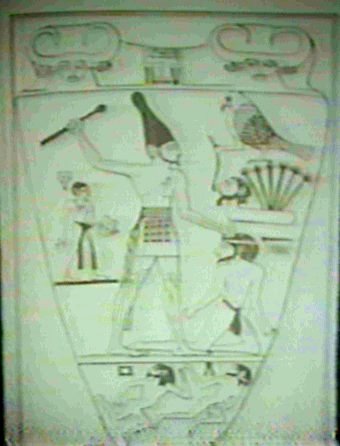
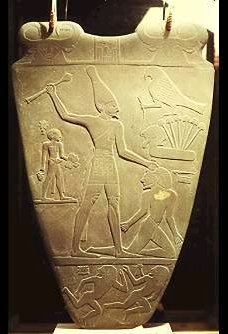
On the left below is a sketch of this artist's palace showing the king knocking his enemies over the head with his mace. You also have an image of the actual object on the right for comparison.
This, by the way, is now imitated every year at graduation ceremonies where you see the professor carrying the mace. This idea of the mace is already present and have influenced the idea of the mace as a symbol of authority and responsibility 3,100 years ago BC.
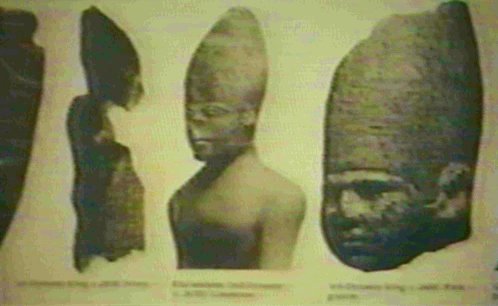
Next are some of the early pharaohs who were in the first, second and third dynasties, who give us a chance to look at what their carvings looked like. Later their mummies will also be shown.

 |
 |
 |
 |
 |


