| Table of Contents | <- Previous [TOC] | Next [Chapter 2] -> | Image Gallery |
| Please note that in these pages, I use û to represent the long "u" sound in Japanese, that is, any of the [u] sounds followed by the "u" sound. Likewise, ô is used for the long "o" sound, [o] followed by "u". | |||
Chapter 1: Southwestern Honshû
|
|
|
|
I got up at 07:30 on the morning of 03 March, 2001, showered, ate breakfast,
and met Matthew in the Common Room of the Kaikan to begin what would prove to
be quite an epic journey. We had been kicking the idea of taking a trip
during haruyasumi (spring vacation) since almost the beginning of our
time here, but until we walked out the door, we were not sure that we would
in fact be going. We both had to fill out some paperwork to let the
Ryugakusei Centre staff know that we would be gone a week before we
left, and in the destination field, we simply wrote "minami no hô
," or "in a southerly direction." We knew that we wanted to visit
Kyushû and Shikoku, the two big islands to the immediate
south of Honshû, the main island of Japan, and we had even
entertained, a time or two, pipe dreams of going to Okinawa, almost
|
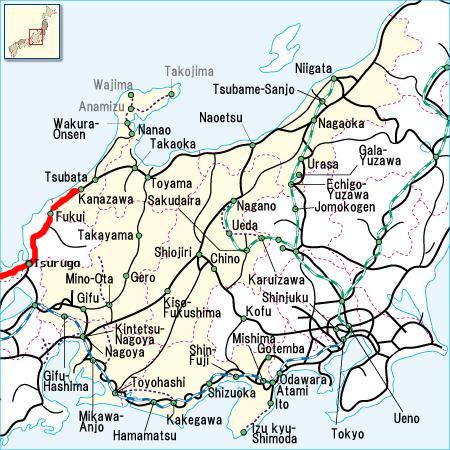
| Upon reaching the station, we consulted a local map and decided that the best destination that would meet our immediate goal of leaving Ishikawa-ken ex post facto would be Fukui, the prefectural capital of the aptly named Fukui-ken. Matthew and I decided that, as residents of Ishikawa-ken, we must hold Fukui-ken'ers as our mortal enemies. Ironically, it turned out that, much later in our trip, we were to find one of our goals, the best "irashaimase" in Japan, within the borders of the black land (Fukui-ken) itself. But that is a story that belongs to a later chapter. The story that I am in the process of telling here is that of the beginning of our trip. So, back in good old Kanazawa-eki (station), we had just selected Fukui as a good first stepping stone to Kyushu. We bought our fare from the fare vending machine, which is quite similar to the fare vending machines in the Washington DC Metro station, only with less guessing about how much fare to put on your card and no "all day for five dollars" option. Then, we began what was to become quite a staple of our ryokô (trip) experience: waiting for trains. It so happened that the next train out of Kanazawa station was at about 10:30, so we had about 40 minutes to kill, which we accomplished by walking about the station rather aimlessly. Kanazawa-eki, one of the nicer stations we were to encounter, is filled with shops selling books, snacks, and the omnipresent omiyage, souvenirs that Japanese people make a point of buying everywhere when they go on trips to give to their friends and coworkers when they return. In fact, I read somewhere that omiyage are used as a sort of proof that one actually went where one was supposed to. You, see, when a salaryman goes on a trip, there is a feeling that he is letting the team down, and to make up for it, he brings omiyage back to his coworkers to prove that he was not just taking it easy in a local bar. Also, in the same article, I read that the boss would go somewhere for a quiet weekend in a love hotel with his secretary and buy some omiyage at the train station to "prove" that he had in fact not been spending the weekend in a love hotel with his secretary... |

| At 10:30, we left the familiar Kanazawa behind as our train sped out of the station. Actually, it took almost 20 minutes to get all the way through the sprawling city and its formidable suburbs. Kanazawa, for all its small town atmosphere, is a city of half a million people. It took close to two hours to reach Fukui, and by that time, the big breakfasts that we both had eaten that morning were largely forgotten. Our next train, this time bound for Tsuruga, one of the numerous minor ports that dot the coast of the Nihon-kai (Japan Sea), did not leave for an hour, so we took a short stroll around the area around the station, declared Fukui a miserable town, to our great satisfaction. We did manage to find a passable ramen-ya, however, so we stopped in and had a bowl apiece. The "irashaimase" was plain-vanilla, albeit in a pleasant female voice, but the ramen was quite good. We both had the "Gakusei," which was your basic cheap ramen, involving corn and beans. |

| It was on the train ride to Tsuruga that we had our first memorable experience of the trip. Soon after the train departed from Fukui-eki, I became aware of a loud, sucking sound, almost like a vacuum cleaner left on by accident. I peered around the corner in the direction of the sound, and saw a quite large person dozing noisily. He appeared to be a late high school or early college student. His snoring, or rather, wheezing, would have been quite annoying had we not found it so amusing. It reflects rather poorly on my character, perhaps, but I found it somewhat relieving to see such a huge person in Japan (outside of the sumô ring, anyway), after hearing all the other ryûgakusei at the kaikan talk about how fat Americans are. We nicknamed this unfortunate "Fatty," another horrible thing, but he was to become quite an inspiration later in our journey, and his son turned out to be our saviour the very same night. |
| In Tsuruga, we had an hour and half to wait for the next train heading in the right direction, so we explored the town a bit. It turned out to be quite a nice town, featuring a large department store at the top of a very pleasant shopping street. This street had a wide sidewalk on either side, covered by a slightly tinted glass roof that would let the light in while keeping the rain, had there been any, out. There were speakers mounted on the outer wall of the shops at intervals of about 25 metres all the way down the street, and they were all playing the same music, which happened to be a nice jazz number while we were walking down the street. The music would fade out slowly as we left the sphere of influence of one speaker, and then fade back in as we approached the next speaker. It was a charming effect, walking down the clean, white sidewalk on a perfect day, listening to some soothing jazz music and looking about at the colourful signs advertising the various small shops that lined the avenue. Also interesting were statues of different characters and scenes from a popular anime (animated television show), "Uchu Senkan Yamato," a show about the adventures of the crew of a giant spaceship that looked just like the Yamato, a Japanese battleship built for World War II. The statues, occurring maybe every 200 metres, were small and tasteful, and the plaques which described each scene or character were autographed by the creator of the anime, Matsumoto. Matthew, who is a big fan of the show, told me that one of the alternative titles of the show was "Ginga Tetsudô 999," and the plaques were dated 1999, so we speculated that the whole bit was a huge ploy for tourist revenue cooked up by the town. We also thought that it might be possible that Matsumoto himself was born in Tsuruga. It seems, according to some random web page, that he was actually born in Fukuoka-ken, in Kyûshû, and I could find nothing on the web linking Matsumoto Reiji to Tsuruga at all. Another speculation is that the shopping street's facelift was completed in 1999, and someone just came up with the gimmick and got Matsumoto to visit for the ribbon-cutting ceremony. |

| We walked all the way down the shopping street to the end, where we saw, predictably enough, a shinto shrine. Japan is like this, you will find shrines and temples woven seamlessly into modern areas. Unlike America, where inconvenient remnants of the past are simply bulldozed to build strip malls, Japan has been built up in layers, so you can feel the echoes of the past wherever you go. Actually, Japanese culture is a lot like "American culture", it is actually all sorts of cultures, mixed into a Japanese-style cultural stew. Modern Japanese culture is a mix of ancient "real" Japanese (Yamatô) culture, Chinese culture, imperialist Western culture, and, most recently, "American culture" itself. It is just so foreign to Americans that we do not realise the mixture exists. |

| We continued down the same road and came to the harbour after a couple more minutes of walking. It was very pretty, as ports on the Nihon-kai (Japan Sea) tend to be. |

| There was a fishing boat docked there by the name of Fukui-maru, named after the prefecture in which Tsuruga lies. I noticed that the names of Japanese ships tend to be painted on the hull backwards, for some unknown reason. I also thought, upon seeing this ship, of the famous Kobayashi-maru scenario from "Star Trek." The Kobayashi-maru was the name of a Japanese merchant starship in one of the holodeck simulations that appeared on the final test at the Star Fleet Academy. The scenario was supposed to be impossible, but James T. Kirk, in typical Kirk fashion, hacked the computer and made it possible to win the scenario. |
|
| 
|
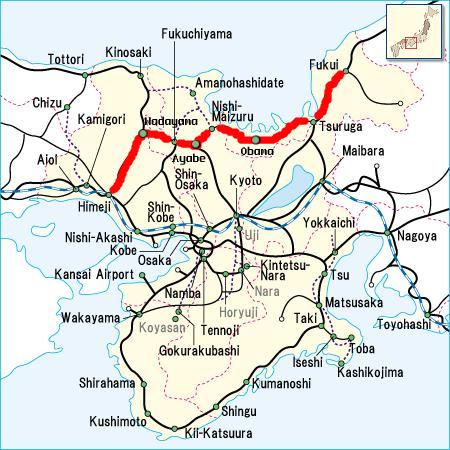
| We got on a train which went to Obama, got off there, and ended up paying some more fare and getting back on the same train, this time heading for Ayabe. We actually returned to the same seats where we had been sitting before on the train. The girl who had been sitting beside me was still there, so I said "tadaima," much to her amusement. "Tadaima," you see, is the Japanese equivalent of "hi honey, I'm home." |
| Traveling through the Japanese countryside has made two impressions on me. First, the population density is, for all the hype, just as low in the countryside as what I am used to, rural America. Sure, in the cities, people are living in approximately 1.27 square metres of space, but you have to remember that close to 75 percent of Japan is mountainous and virtually uninhabitable. The scenery which these mountains create, however (the second impressive thing), is completely different from any place that I have ever seen in the States. The tiny valleys are flat and filled with rice paddies that stretch right up to impossibly steep mountains that rise out of nowhere. With their wooded sides and caps of snow and ice, the mountains are quite beautiful, especially to the northwest, set aflame by the setting sun and in places yielding suddenly and quite unexpectedly to hidden bays and inlets, attempts by the Japan Sea to reconquer the land stolen from it millennia ago when a violent tectonic episode thrust the sea-floor skyward. The area through which we were traveling when I had these thoughts is called Wakasa, and it is famed for delicious crabs and breath-taking views. |
| We had to switch trains rather unexpectedly in a small station called Nishi Maizura (West Maizura). We did not know about this ahead of time, as it was in no way indicated on the fare map. Luckily, I remembered the name of our next destination, Ayabe, so when the conductor came along to evict us from the train, I was able to figure out which train we needed to switch to. We had a fifty-minute wait in Ayabe, which proved to be quite a boring town, at least in the vicinity of the station. We ended up going to a grocery store, where Matthew bought some snacks to tide him over until dinner, which we both hoped would be eaten at a McDonald's. From the grocery store, we saw a hyaku-en store, Japan's equivalent to American dollar stores. Since hyaku-en (¥100), is pretty much worth a dollar, it is a very similar experience, except the quality of the goods seems a bit higher. We paid this particular hyaku-en store a visit, and I got some snack food. On the way back to the station, I saw a bakery, where I bought one of my favourite Japanese baked goods, a doughnut filled with red bean. |
| Our next stop was another spec on the map called Wadayama, but we had to switch trains unexpectedly in some other station, which proved slightly embarrassing, as I had forgotten the name of our real destination, Wadayama, and had to get check the fare map to find out. We ended up getting on the right train, luckily, so we made it to Wadayama. |
| We would have missed nothing had we not stopped there excepting a 30 minute wait. During said duration, we walked around "town" near the station, and found... absolutely nothing. We saw one other person, and no lights were on anywhere, even though it was barely 21:00. We decided that Wadayama should be referred to, from that moment on, as "Wada boring town." So, we returned to the station and just sat in the next train for 15 minutes until it departed for Teramae, which means "in front of the temple." Which temple, we did not know, as there are no famous temples near the town. We actually wanted to go to Himeji, the site of one of the most famous castles in Japan, as we discovered from reading my trusty Lonely Planet guide (many thanks to Ben Cooper for giving it to me), but Matthew thought that we would have to switch trains at Teramae. After having to unexpectedly switch trains twice already that day, he thought he had finally figured out the method to the madness. |
| And he had. You see, we had been looking at the fare map to pick out, in most cases, the destination furthest from where we were (in the right direction, of course) and buying enough fare to get there. What we did not notice, was that the trains had a destination on them. This destination was the shûten, or final point, for that particular train. So, even though we had enough fare to continue to the place where we meant to go, we had to find a train that went at least that far. From Teramae on, we knew this, thanks to Matthew. After a short wait, we left Teramae for Himeji, where we hoped to find a McDonald's in or near the station, then walk the half-kilometre to the castle, give it the once-over, and take the next train in the general direction of Hiroshima, where we planned to spend the first night. |

| The surly guy who took our used-up fare cards in the Himeji station should have tipped us off that things were not going to work out. You see, most Japanese people are very friendly, or at least polite, to gaijin, even if they do not particularly care for us. This guy was neither. He had a scowl on his face that would have made the fainter of heart burst into tears on the spot. As it was, Matthew and I just handed over our cards and moved on. In case you were worried, this guy was a JR (Japan Railroad) employee, not some pickpocket, thug, or bully. |
|
We did not find any McDonald's or other fast food place (or any food place at
all, actually) in or near the station, but we did find the castle easily. It
was about a ten minute walk from the station, but it was very spectacular.
As it was dark out, the castle was illuminated with huge, powerful
spotlights. It was surrounded by a huge moat and some very impressive outer
walls, and Matthew and I figured that our chances of taking it would not be
so good, even with a huge army. The castle had once belonged to
Hideyoshi himself, though no-one attacked it while he held it. If you
have never heard of Hideyoshi, do not worry, a |
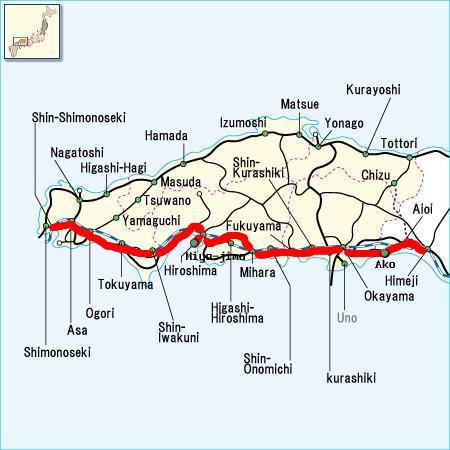
| After taking in the castle, which lived up to its reputation as one of the finest in all of Japan, we walked back to the station and bought fare to Okayama, but a hop away from Hiroshima. Well, I actually had to leave the station and go to a nearby Family Mart (one of the three big chains of convenience stores in Japan) to break a man. Most fare machines only take ¥10, ¥50, ¥100, and ¥500 coins and ¥1000 bills, or "sen en." A man is a ¥10,000 bill, worth about US$100. Matthew went to the Family Mart with me, and we both picked up Snickers (they really satisfy, even irritated gaijin who were looking forward to dining beneath the Golden Arches) to break our respective man. We refer to the spending of a man as "dropping a Fukuzawa," for it is the face of Fukuzawa Yukichi, a famous philosopher and writer in the Meiji period, that adorns the ¥10,000 bill. In this tradition, we call the act of spending a lot of money "dropping mad Fukuzawa." Anyway, after breaking my man, I could buy fare, and I did so. |
|
| 
|

| We had to change trains in a station called Banshû-Akô, the name of which meant absolutely nothing to us when we were approaching it on the train. But that was about to change. We intended to switch trains in Akô for Okayama, then grab a train from there to Hiroshima, where we would stop for the night. However, when we reached Ak&244;, at about 23:45, we discovered something very interesting: the futsû densha (at least in rural Kansai) stop running around midnight. How we discovered this is, when I handed my fare card to the ticket-taker, expecting him to stamp it and hand it back, he did not. I told him calmly that I had paid fare to Okayama, and we were just checking to see when the next train was, thinking he had just misread the fare. He nodded and said, "hai," but he did not turn over the card. Note to the reader: hai does not always mean "yes" in Japanese. In this case, it meant, roughly, "I understand that you are a moron." I explained once again that we meant to go farther, and he finally got to the heart of the matter. He told me that the train we had just gotten off of was the last for the night. I then realised that we would be spending the night in Akô. This did not exactly thrill me, as I had hoped to be in Hiroshima the first night, but at least I understood. So, I told him, "No problem, we will just catch the first train in the morning. Now, may I please have my card back?" Of course, his reply was, "Oh, you may only use this today." Great. |
| So, this is how our Akô experience began. We walked out of the station, which was being rapidly closed up behind us, and walked into the neighbouring building, which contained a movie theatre and a food court. It was nice and warm, so we sat down for a moment to plan our next step. We decided that we would walk around and see if there was anything worthwhile to see in Akô, then come back and sleep until about 05:30, as the first train was at 05:45 in the morning. So, we headed out of the station, crossed the street, and saw a sign that promised the ruins of Akô-jô were but a kilometre straight ahead. That sounded interesting, so we walked straight ahead. It got colder and colder the longer we walked. In fact, had we not been walking, we would have been terribly uncomfortable. To add to the cold, the town was completely deserted, no people, no lights, and were it not for the passage of the occasional car, it would have felt completely like a ghost town. |
| The good news was, we began to see signs about the 300th Anniversary of the 47 Rônin incident. As both Matthew and I knew when the event had occurred, neither of us were surprised to see these signs, but, like the Uchû Senkan Yamatô statues in Tsuruga, we could not figure out why they would be here. Because the 47 Rônin story is set in the town of Asano. Or is it? As we walked on, Matthew's memory was working overtime. Finally, he let out an exclamation and said, "No no no! The daimyô's name was Asano! The town was Akô!" And suddenly it all made sense. Our luck, which had led us to Himeji to see the most famous castle in Japan, one that Matthew thought was in a totally different town, this luck had worked out for us again. We had stumbled into the selfsame town where Oishi Kuranosuke and the other rônin were from! The story is a very interesting one, and since it is considered by many Japanese people as the very definition of bushidô, "the way of the warrior," I will include it here as a footnote. |
| When we finally reached the ruins of Ako-jô, we were not disappointed. They were so interesting, even in the low light of a cloudy night, that we almost forgot about how cold it was! One benefit of the low crime rate in Japan is that public attractions are almost never locked up at night, so we were able to walk through the ruins and have a look at everything. After walking all the way through the castle, we hit the jackpot! Outside of a large jinja (shinto shrine) behind the castle were statues of all 47 rônin. Each had his name written on a plaque that was affixed to the statue, and we had fun trying to read then. We could read about a third of them outright, and were able to make good guesses at another third. The final third were unreadable by us, either due to the poor light or our poor kanji skills. The statues were very cool, and I wish that I could have taken a picture of them, but the light conditions and layout of the statues themselves made this rather impossible. The shrine itself was not so exciting. |
| After looking at the ruins and their surroundings, we headed back toward the station, taking a different route in hopes of finding anything that was open and warm: a convenience store, restaurant, bar, anything, but to no avail. So, cold, hungry, and defeated, we returned to the station with hopes of sitting around and maybe even getting some sleep in the heated food court that we had previously found. No such luck. The food court was locked up, so we just went back into the station and sat down. This particular station was a building with a roof and even walls, but was open to the air in a lot of places. It had no doors between us and the cold night, so the temperature was maybe a degree or two warmer than outside. I would put it at between negative five and zero degrees Celsius (23-32° F). At this temperature, sitting around was simply not an option, and neither of us could get to sleep, though we tried for a good half an hour. It was simply too cold. So, we got up and looked at a tourist map of the town that was kindly affixed to the wall right in front of our makeshift bedroom. I noticed a hospital on the map and suggested, half-seriously, that we go there and sit in the waiting room until they kicked us out. We set off in that direction in search of warmth, or at least less coldth. |
| About two blocks west of the station, I saw salvation in the form of a green and blue Family Mart sign. Family Mart is the second of the three big chains of convenience stores that are as ubiquitous in Japan as 7-Eleven is in the States. The other two chains are Circle K and Lawson Station, but we often get the names mixed up and start talking about how much we want to see a "Family Circle" or a "Lawson K" or a "Circle Mart." These convenience stores, luckily for us, are open 24 hours a day, eight days a week, and even during a hard day's night. Needing no invitation, we walked into the blissful warmth and worked on refining our tachi-yomi technique for the next half an hour or so. Tachi-yomi, literally meaning "standing reading," is a Japanese cultural phenomenon that can be observed wherever books, magazines, or manga are sold. It involves standing in front of a bookshelf and calmly reading the book, comic, or magazine until sated. Japanese people will do this for hours at one bookstore, then go to another when they finally reach the tachi-yomi shû-ten, a phrase that I coined myself, meaning, "the point beyond which tachi-yomi cannot be continued." The shopkeeper, being Japanese, will never be so rude as to ask the "customer" to pay up or get out, as his American counterpart would do as soon as the intent of tachi-yomi was detected. However, Japanese people can broadcast disapproval at a wavelength that only other Japanese (or the select gaijin who has been in Japan for a while and knows a bit about the Japanese psyche) can receive. The tachi-yomi practitioner, or dokuritsu-sha (another of my words!), will, upon receiving these waves for long enough, abandon this location and move to the next store to begin the cycle afresh. |
| Matthew and I were only taking up the art of tachi-yomi in order to extend our time in the embracing warmth of the Family Mart, so our hearts were not in it, and we could only manage 20 minutes before the clerk's ki overpowered our own. This was not so embarrassing, as the clerk was none other than Fatty Junior, the son of Fatty, whom we had seen on the train at the beginning of our long day. A man his size must have enormous ki (spiritual energy) to match. Defeated, we browsed through the four rows of shelves for ten more minutes before heading into the cold once more. We continued toward the hospital, and I jokingly made a remark about how welcome a Lawson Station would be right about now when what to our wondering eyes did appear but a Lawson itself and 12 tiny deer. Well, actually not the deer, that was just involved in the last sentence for a rhyme. Sorry. |

| We walked into the Lawson and repeated the same technique as in Family Mart. The clerk in this store was a pushover, so we got away with about 45 minutes of tachi-yomi and browsing before we left for the hospital. The hospital turned out to be closed, so my plan of waiting room exploitation turned out to be a no-go. We walked on down this road, eastward, hoping to find a Circle K to preserve our lives. We did not find one before running out of town, so we turned around and walked back to the station, stopping again in both Lawson and Family Mart and spending much time there. At the station, we tried again to sleep, unsuccessfully. By this time, it was about 03:30, so we decided to stick it out in the station until 04:00, then head down the street, stop in both convenience stores twice and buy some bread and jam for breakfast. We carried out this plan, returned to the station, bought hot coffee from the vending machine, and ate our humble spread. By this time, it was 05:17, as this picture proves. |
| 05:30, when the station opened up, was the happiest moment of my life to date. We bought fare and immediately boarded our train, which did not even leave until 05:57, but was sitting in the station. The heaters slowly warmed the train, and, by extension, our frozen bodies. We both fell promptly asleep, a mistake, as the train did not stop at Okayama, where we wanted to get out and see the castle. Luckily, the shinto gods of tourism were guiding us, or else it was the Luck of the Irish, for I awoke two stops before Okayama and got us off the train at the right stop. |
| From Okayama-eki, we set out down a broad street, named Momotarô-doori, after the legendary Japanese hero, Momotarô. Not only was the street named for him, it also featured several statues of him and his cronies at intervals along the street. If you want to know more about Momotarô, read this footnote. |

| Near the castle, we took a chikadô under the street, where we saw the amazingly gaudy fountain which is pictured to the left. The bottom of the pool was painted with different, clashing, bright colours, so the water itself appeared to by dyed. Chikadô are often very interesting in this way. A chikadô, in case I have not mentioned them previously, is a pedestrian walkway that goes under a busy intersection. Most have ramps for bicycles and wheelchairs, and some, like this one in Okayama, have interesting things inside them. In larger cities, these underground walkways connect the basements of huge department stores, train stations, and so on. In larger cities, it is often possible to walk through the entire city centre without leaving the underground walkways. |

| Our destination, Okayama-jô, lay at the end of Momotarô-doori. Across the river was another point of interest, Kôraku-en (the name literally means "late relaxation garden"), considered by the Japanese to be one of the three finest traditional gardens in all of Japan. Kanazawa's own Kenroku-en is another one of the big three, and the third is Kairaku-en, in Mito. |

| The castle itself is very impressive to look at. The fortifications are quite extensive, and the castle is very well-situated on the top of a hill right by the river. The most remarkable thing about the castle is that, unlike most Japanese castles, it is black. We walked around the castle on a nice path that wound through a small grove of trees growing on the river-bank, then returned and crossed the bridge to check out Kôraku-en. |

| We reached the south gate of Kôraku-en at 08:00, and since it did not open until 08:30, we decided first to walk around the outer perimeter of the park. We figured that we could see if it was worth going in from the outside, and the island itself was very scenic. On the beach below the south gate, boats in the shape of a giant swan could be rented. We did not, of course, rent a boat, but I did take a picture of the boats with the castle in the background. Further down the path, we came upon an elderly Japanese woman practising Tai Chi in a small clearing. She was going through the short form of the Yang style, the same style that I studied two summers ago in Harrisonburg. Anyway, after walked all the way around the garden, it was obvious that it was worth the ¥350 entrance fee, so we paid up and went in. |

| The park was very lovely, and since we had arrived at opening time, we beat the horde of Japanese tourists who would no doubt descend upon the park a little later in the day. The garden itself had been constructed by the lord of Okayama-jô, which was obvious when you looked at the main attraction in the garden. It was a wooded island in the shape of a small hill, and when you looked at it from the front, it seemed to lord over the rest of the garden, but in the background, you noticed Okayama-jô itself, lording over the island. Besides the hill / island, there was a nice pond and a vast expanse of lawn, quite an attraction in Japan, where no-one has a lawn. There is a miniature tea plantation and a rice paddy, divided into nine squares, with something different growing in each of the squares. |

| After finishing our walk about Kôraku-en, we returned from whence we came, pausing to rest for a moment at the entrance to the castle grounds. I thought that it would be a good time and place to change the film in my camera, but there was one picture remaining on my current roll, so I had to take a picture of something. There was a mildly interesting flowering tree of some sort, so I snapped a picture and changed my film. Much to my surprise, the picture turned out rather nicely, so I included it here. After resting and changing film, we walked back to the station, making the difficult decision to bypass the McDonald's that we had seen on the walk up to the castle on the side of Momotarô-doori. We were not so hungry, I guess due to our jam and break in Akô, so we decided to wait and go to a Mickey D's in Kure or Hiroshima itself. This proved rather fortunate, as the Arches that we had passed had not been closed, as we had assumed, due to the early hour, but rather, for some sort of remodeling. Our hearts would have been broken had we not decided earlier to skip it. Upon returning to the station, we took a train to Mihara, one hop closer to Hiroshima. |
| At Mihara-eki, we decided not to go to Hiroshima by way of Kure, as we had originally planned. Though Kure seemed very interesting, with the old Imperial Naval Academy, we decided that the extra ¥1000 that it would cost to go that way was not in our best interests. Had we only known what we would find out tomorrow! We searched the area immediately around the station for a McDonald's and, finding none, decided that we could (or would have to, more accurately) wait until Hiroshima, where we knew there was a McDonald's, as it was on the Lonely Planet map of the city centre! Yes, McDonald's apparently rates up there with the Peace Park and the Atomic Dome to Western tourists. So, we bought fare to Hiroshima and, in the 15 minutes before our train came, walked out of the north exit of the station to see if we could get a quick look at the ruins of Mihara-jô, which the Lonely Planet said was just outside the station. We did not see them until we turned around, defeated, to go back into the station. For the north exit actually came out of the ruins! The station had been build right next to the ruins, and the north exit, being a tunnel, went right through the old castle wall. There was a moat and a battlement right beside the exit. This was the best example of the layers in which modern Japan is built. Far from being tragic, the way the past and the present were coexisting was very exciting. |
| The first thing we did when we got off the train in Hiroshima was to locate the McDonald's, which was very easy, thanks to the Lonely Planet map. Luckily, it was even on the way to the Atomic Dome and Peace Park, the two main attractions in Hiroshima for us. We fueled up on burgers, fries, and Chicken McNuggets before moving on. The Atomic Dome was less than a kilometre from the Golden Arches, so we moved on toward it. When we arrived, everything changed. |
| I was not quite sure what to expect when we arrived at the Dome. I have read about the bomb and its effects, studied it in history classes, and even seen "Barefoot Gen," an anime about one resident of Hiroshima and his experience with the bomb. In the context of history, I was somewhat wishy-washy, leaning toward believing that the United States should have dropped the bomb, but certainly regretting that we did. My experience in Okinawa later in our trip would convince me that the bomb should have, in fact, been used, but Hiroshima certainly made me think hard. When I looked at the Atomic Dome, which was once the Industrial Promotion Hall, until 08:15 on the sixth of August, 1945, when the atomic bomb dropped by the Enola Gay went off a mere 500 metres above it. If you care to learn more about the bomb, read this footnote. |
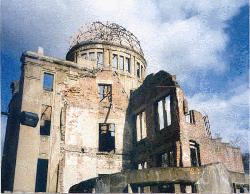
| Seeing the damage that the bomb had wrought on the Atomic Dome was quite a sobering experience. I know the physics behind atomic weapons, and, given the right set of equations, I can give you all sorts of numbers about the bomb, in terms of power, temperature, shock waves; in short, destructive capacity. But the blasted remains of the Atomic Dome, which were left propped up as a reminder of what nuclear weapons can do, made these numbers and data real. The Dome is inspected twice a week for structural integrity, and is constantly being reinforced when weaknesses are found. As an American, the experience was different for me. I did not exactly feel guilty, or even responsible, but seeing the damage caused by a weapon that was dropped by my own country caused me to do a lot of thinking. In the end, my ideas about war and ethics held up, but they were certainly re-examined from every angle during my Hiroshima and Okinawa experiences. This is a picture of the Atomic Dome. I did not take one myself. It just did not seem right at the time. |

| Our next stop was the Atom Bomb Museum, but to get there, we had to walk through Peace Park. It was a very beautiful place which, despite the number of tour groups milling about, seemed somehow peaceful. The weather was very nice, sunny and warm (at least, warm when compared with Akô!), so we took our time getting to the museum. When we finally got there, I was very pleasantly surprised by the truthfulness of the exhibits. The beginning of the museum (which cost ¥5 to enter for adults and ¥1 for children) was all about early Hiroshima and how this fishing town was transformed into one of the biggest war factories in Japan prior to and during World War II. I guess I expected to see nothing but exhibits about the horrible effects of the bomb on an innocent and unexpecting city, but no, the truth was here. I will not present here an argument for why I believe the bomb should have been dropped, but this museum just strengthened my beliefs, which had been in turmoil since seeing the Dome. The bomb should be looked at from all sides, and the museum, I felt, did a good job in presenting an impartial view of the incident. On the other side of the argument, the most chilling thing that I saw was a pair of scale models of the Hiroshima city centre, one before the bomb and one after it. Quite telling, I am telling you. |
|
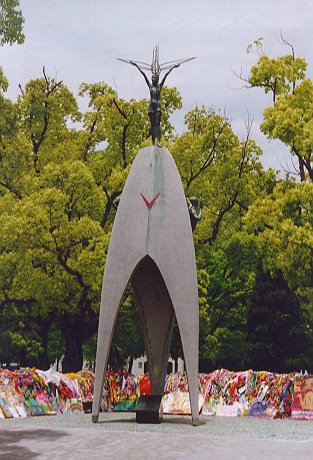
As we walked out of the museum, we took a last look around Peace Park. I
noticed for the third time a large pile of brightly coloured paper,
this one surrounding a memorial to the reason for the paper. You see, one of
the residents of Hiroshima during the bombing was a little girl named
Sasaki Sadako. In fact, she was only two years old when the bomb was
dropped. She contracted leukemia due to exposure to the radiation, and in the
hospital, decided to fold 1000 origami cranes in order to please the
gods, who would presumably make her well again. She died in the hospital at
the age of 12, only having folded only 644 cranes. However, by then, her
story was known, and schoolgirls from all around Japan folded cranes for her
memory. Not only did the number of cranes reach 1000, it has since reached
ten million, and beyond, as it has continued, worldwide. At least four books
have been written to tell her story:
|

| From the park, we decided to walk to the Hiroshima Youth Hostel, were we planned to spend the night. We were very tired, both from walking and too little sleep, so we hoped to drop our bags at the Youth Hostel and then take a look around Hiroshima without 25 kilograms of stuff on our backs (I am exaggerating, of course; I think our packs were closer to 10 or 15 kilograms). En route to the Youth Hostel was Hiroshima-jô, which was a nice-looking castle. The moat was especially impressive, as pictured here. We rested there for a moment, but did not go in, as we wanted to get to the Youth Hostel as soon as possible. The castle was a reconstruction, which Matthew maintained was not worth seeing anyway. According to the Lonely Planet, Hiroshima-jô had some neat displays inside, including some laser holograms. Oh well, maybe I can go back some day! |
| The Youth Hostel, according to the Lonely Planet map, was down the same street that ran past the castle, but a little farther. A little farther turned out to be about five or six kilometres, unfortunately for our throbbing feet! The map just had an arrow pointing off the northern side, labeled "Hiroshima Youth Hostel." This would not be the last time that we would follow an arrow nearly to our doom, as you will see if you read on to the end of this chapter. Anyway, we were just about to give up when I spotted a sign promising that the Youth Hostel was a mere 300 metres down a side street. We walked on, picking up the pace as much as our broken feet would allow, only to find, to our utter dismay, that the signs, which appeared every 75 metres or so to encourage us, were leading us up the steepest hill that we had ever seen. We pressed on, determined to reach the hostel or die in the attempt. |
| We finally did make it, and to our relief, there were vacancies. I arranged for two rooms with the young man at the counter, who was very relieved to find that I spoke Japanese, as I guess he was used to trying to communicate the procedures in his limited English to people who spoke no Japanese beyond "hai," "iie," and "bi-ru wo kudasai" ("yes," "no," and "beer, please," respectively). The rate was very reasonable, at ¥2000 a head for one night, including breakfast and sheet rental. The first thing that we did after dropping our bags in our room was to take advantage of the Japanese-style bath in the hostel. In case you do not know the difference between a Western- and Japanese-style bath, in the latter, you wash yourself before getting into the bath, were you just soak in the hot water. Needless to say, this is just what we needed after two days of nonstop walking and traveling. |
| After bathing, we rested for about an hour on our beds, Matthew reading the Lonely Planet and me writing in my Green Book the account that you are now reading (heavily edited, of course). I was interrupted by a phone call that resulted in us going to Okinawa. It was my girlfriend, calling to see how I was. She told me about a train ticket called the Seishun Jyû Hachi Kippu (Youth 18 Ticket) that cost something like ¥12,000 and would allow one unlimited riding of the futsû densha for five separate days. This meant paying only ¥2050 a day (approximately; ¥2040 if you are that much of a stickler for math!). As we had been laying out about ¥4000 a day for fare in the past two days, this was some seriously good news! I thought it was rather too good to be true, in fact, but I promised Delyana that I would at least look into it at the station the next morning. Matthew also thought that there had to be some sort of catch. We vowed, however, that if we could get the Seishun ticket, we would be going to Okinawa! |
| Somewhat rested, we headed out for some supper, as we had missed the Youth Hostel's offering. As we were five or six kilometres from the city centre, there were not very many restaurants along the road. We found one five minutes from the Youth Hostel, but we had to pass it up, as it was pricey and we were operating on a tight budget. The next restaurant was closed, and the one after that was a pizza joint. This would have been great, except that Matthew does not like pizza! He must be the only person on the North American continent (actually, he lives in St. Johns, Newfoundland, which is a huge island and thus technically not part of the continent, so maybe that explains it!) who does not like pizza! After ten more minutes, just as we were considering cannibalism, or at least cannabis, we saw a place called the Royal Guest. The featured dishes in the display case outside (plastic food models are big in Japan; every restaurant has them, and there is even a district in Tôkyô filled with plastic food shops!) looked expensive, but we simply could not walk any farther without some fuel, so we took a look at the menu. Things were looking grim for us until the last page: appetisers. Two that looked very interesting were a plate of pancakes for ¥400 and a fried chicken basket (three pieces of chicken, fries, and a biscuit) for ¥640. I ended up eating the pancakes and Matthew the chicken, but we ordered another fried chicken basket for dessert and split it. |
| With our appetites finally subdued, we walked the two kilometres back to the Youth Hostel and fell asleep almost before our heads hit our respective pillows! We awoke in the morning from our warm and comfortable beds (they seemed the finest sleeping accommodations in the world after a night on the cold streets of Akô!) at 06:55. We did not want to get out of bed, of course, but we were urged on by the allure of a hot breakfast at 07:00. We enjoyed said breakfast: eggs, toast, fresh fruit, and lots and lots of coffee, with CNN Asia's morning headlines on the large TV in the dining hall. If we had only had more time to spend in Hiroshima, the Youth Hostel would have been a great place to spend a week, but we had to press on. We checked out, an elaborate process that involved simply dropping your used sheets in a box, putting your shoes on, and walking out the front door. We walked back to the station, which was a "mere" three kilometres from the Youth Hostel and not so bad, considering we were fed, rested, and our feet had mostly healed. We noticed on the way how much smog was in the air in Hiroshima. From the station, we got on a train to Miya-jima, home of one of the most famous jinja (shinto shrines) in Japan. |

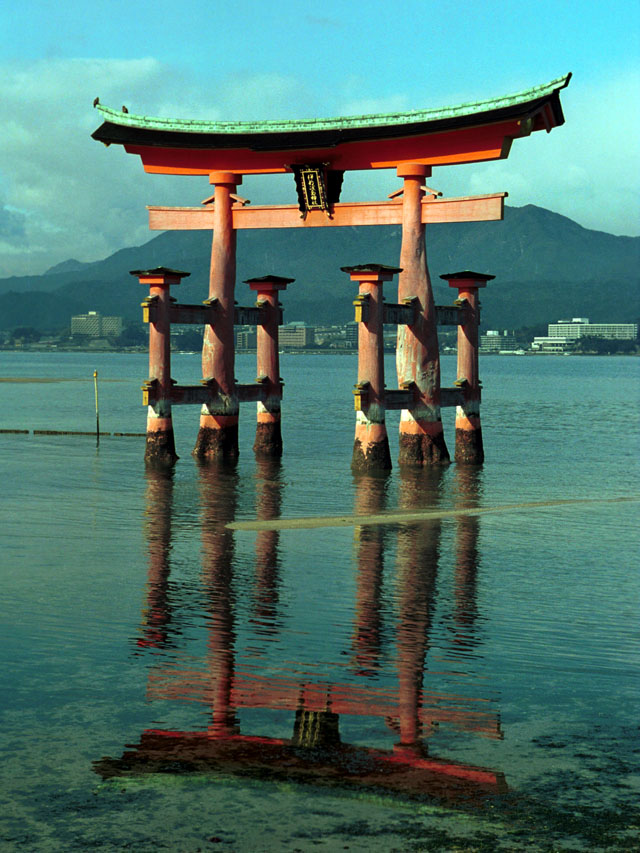
| Miya-jima, as its name would suggest (at least to a speaker of Japanese; jima means island), is an island, so the last leg of the Miya-jima line was a ferry. We took the JR (Japan Railroad) ferry, so we could ride for free just by flashing our Jyû Hachi Kippu. The name of the island is actually Itsuku-shima, but people usually call it by the name of the shrine itself. The reason that the shrine is so famous is because of its torii, the entrance gate to the shrine. I would expect that most of you have seen a better picture of it than the one to the left, in fact, take a look at this picture, courtesy of the PBase Photo DB (which I have used without permission, email me if I shouldn't have). At high tide, the torii and the shrine itself are surrounded by the ocean. At low tide, it is only mud. Thankfully, we went at high tide. |

| Before we even made it to the shrine, we saw one of the island's attraction: tame deer. Just like at Nara, tame mule deer wandered about calmly through the crowds of tourists, pausing here and there for a handout or just to sniff someone in hopes of finding some food. The picture at left shows a very friendly deer indeed. I have no further comment, other than to highlight that there is very little, if any, Scottish blood flowing through my veins. After visiting the shrine, which was pleasant enough, we checked out a neighbouring Buddhist temple and the associated omiyage shops. Omiyage are little souvenirs, see my bit on omiyage at the beginning of this chapter for more information. I saw a hachimaki bearing the kanji that read kamikaze ("Divine Wind," but I guess you already knew that; read on for more on the kamikaze, as it played an interesting part in our journey later that very day). A hachimaki is a headband worn for good luck, especially by martial artists, taiko performers, and Japanese high school kids who are cramming for the university entrance exams. In fact, Mr. Miyagi gives Daniel-san a hachimaki in "The Karate Kid." Anyway, this hachimaki had the kanji for kami on one side, kaze on the other, and the imperial battle flag in the centre. You know, the one with the rising sun with the red sun rays radiating from it. I could not resist, and neither could Matthew. I also picked up another one that said "hisshô," or "absolute victory." |

| After the omiyage shops, we headed up into the hills that are pictured to the left. It was a great day, and we could not believe that it had been snowing in Kanazawa when we left, only two days previously. The forest was fragrant and oh so green. It was too bad that my mother was not there, as I had no idea what any of the trees or plants were called, beside the take (bamboo) and the Japanese cedars. We had a nice walk, then took the ferry back to Hiroshima and caught a train to Iwakuni, our last stop before Shimonoseki and the bridge to Kyûshû! |
| We got off the train in Iwakuni for the reason that we wanted to see the castle, though it did not hurt that we were very hungry, as well! Iwakuni itself was a pretty disgusting place, an large industrial sprawl featuring lots of factories pumping nasty-looking smoke into the air and metal scrap-yards, all visible from the train. However, the area around the train station itself was nice enough. We walked toward the castle, but it did not seem to be in the direction that the map indicated, so we stopped in one of the ubiquitous keitai shops (this one was AU, my own mobile phone carrier, I think, though it could have been J-Phone or Dokomo, the two other big carriers) and asked. It turned out that Iwakuni-jô was quite a bit farther from the castle than we thought, so we gave up and returned to the station, where we had seen a little noodle bar. We ate some tempura udon for lunch, a bowl of udon noodles (I am sure I have described them before, but just in case, they are more or less chicken noodle soup style noodles) with bits of battered and deep-fried shrimp floating around in the broth. Tempura itself does not have to be shrimp, it just has to be battered and deep-fried. Yasai tempura (battered and deep-fried vegetables) are common, and I even had tempura cheesecake once in a Japanese restaurant in Virginia Beach! |
| As most of you know all too well, I am probably the world's slowest eater. In this case, it worked to our advantage, because we missed our train. You will understand in a moment why it was advantageous in this case to miss a train, I promise. Since we had 15 minutes to wait for the next train, we went to a pan-ya (bakery) near the station and bought doughnuts and these delicious cinnamon twists. After making quick work of our dessert, we went back to the station and headed for the platform where our train would be arriving shortly. In doing so, we had to cross over one track on an overpass, at the top of which there were two staircases leading down to the platform, one to the right and one to the left. Because I saw people climbing the stairs on the left and no-one on the stairs to the right, I made the seemingly insignificant yet arbitrary decision to take the stairs to the right. I mention this only because it was the last in a series of coincidences, starting with us getting off the train in Iwakuni, in a rather quixotic fashion, as it turned out, in search of a castle. These coincidences finally led to us meeting some friends from the kaikan, two students from Finland named Taneli and Pauliina (the double 'i' is not a typo). You see, as the train pulled up, Matthew noticed them sitting in the train right in front of where we were standing! If we had not gotten off at Iwakuni, missed our train because of my slow eating, and taken that right staircase, we probably would not have seen them at all! |
| So, we got on the train and sat down with them. After exchanging greetings and remembering that they had mentioned, weeks ago, that they were heading for Kyûshû during haru-yasumi, we exchanged ryokô stories. It turned out that they had also visited Miya-jima, about an hour and a half after we ourselves had. We had managed to miss them on the island itself, somehow. They had ridden the "rope-way," which is basically a ski lift, in Miya-jima, and gotten a strange wooden thing that resembled a spoon for their troubles. We had seen the sign for the rope-way, but had not been able to find it, even though we had been interested in at least finding out what a rope-way was. Neither Matthew nor I had the faintest idea what the wooden thing was, so I borrowed it from Taneli (the guy, in case you were not sure from just the name) and asked a chûgakusei (junior high school student) who was sitting across from us what it was called. He responded, "Shamoji to iimasu," ("It is called a shamoji"). I thanked him, but, as we were no closer to understanding what it was, Taneli pulled out his denshi jiten (electronic dictionary) to look it up. |
| When he did so, my jaw hit the floor. Why? Because, gentle reader, he possessed the single coolest jiten that I had ever laid eyes on! With a normal electronic dictionary, one enters the word to be looked up using a tiny keyboard. His dictionary had a pen, and he just wrote "shamoji" in hiragana on the screen of the dictionary and then touched the look-up "button," actually just a bunch of pixels on the touch-sensitive screen, with the pen. The dictionary informed us that a shamoji was, in fact, "a large spoon." Souvenir spoons... only in Japan, I guess. |
| We planned to part ways with the Finns in Shimonoseki, as they are heading on to Kyûshû, and Matthew and I want to look around Shimonoseki for a little while before continuing to Fukuoka, in Kyûshû, the site of the original kamikaze. There were actually two "original kamikaze", the first in 1274 and the second in 1281. You see, the Mongols decided to invade Japan (and why not? they had already conquered the rest of Asia), so they sent a huge fleet to invade Japan, which attempted to land in what is today Fukuoka. The Japanese resisted the landing very effectively, keeping the Mongol ships at sea for several months, until late summer, when a typhoon came along and destroyed the fleet. The Japanese considered this an act of the gods, and thus termed it "kamikaze," or "divine wind," which I am now assuming that everyone knows, and thus will not translate it again. The Mongols, it would seem, were rather stubborn, for they tried to invade Japan again, at the same point, a mere seven years later. The same thing happened, and even Genghis Khan could not suck up the courage for a third try. |
| As we were discussing the kamikaze ("divine..." oh, forget it) incident, I was explaining something or other, and, by way of illustrating my point, I said, "kamizake wo tabero!" loudly enough for a group of three high school girls who were sitting across from us (the chûgakusei had gotten off earlier) to hear. They immediately burst into laughter, for what I had said was, "eat the divine wind!" Surprised, I glanced over, at which time the bravest of the three asked me, incredulously, in Japanese, "you speak Japanese?" I replied that I could speak only a little bit (I think that I actually said something like, "even a retarded tree slug can speak more Japanese than my insignificant and utterly foolish self," which is a very proper way to receive a compliment in Japanese). This started a half hour long conversation between the girls and I (my companions could understand most of what was said, I think, but did not really speak) about subjects as varied as where we came from to what we were planning to do in Kyûshû to famous bicycle parts factories (Shimano, in this case, which also makes fishing rods and reels, go figure). At one point, the brave girl admitted her love for me, in English ("aye rowbu yew"), to which I responded with an offer of marriage. This was after the subject had come up, you see, as they (meaning the brave girl, who asked all the questions that Americans consider slightly personal, and Japanese consider grounds for seppuku (ritual suicide), upon which she was immediately rebuked for being shockingly rude by her two friends, leading me in turn to reassure them that I was not in the least offended) had asked if we were married. She meant the Finns, as they are a couple, but I could not resist, after translating their question to the Finns and relaying that no, but they were engaged, that Matthew and I were not married or engaged! |

| We got off the train at Shimonoseki, said our farewells to the Finns, and looked around the station, which was rather large and contained many various shops. One of them had a large Sega sign above it, so I thought it was some sort of Sega Store, but it turned out to be an arcade. Not that I was disappointed, mind you, I dropped a couple of the requisite ¥100 coins into a shooting game by the name of "Time Crisis" and proceeded to go John Woo on the game. (John Woo, in case you do not know, is a movie director who started out in Hong Kong in the 70's and has since made several Hollywood movies, most recently "Windtalkers," but also "Mission: Impossible 2," "Face Off," "Broken Arrow," and "Hard Target." He is famous for amazing action scenes highlighted by characters with two pistols, one in each hand, doing incredible things. Therefore, to play a game "John Woo style," is to play as Player One and Player Two, a gun in each hand. It takes practise, trust me!) |

| After the arcade, we left the station and walked about the harbour for awhile. At one point, we passed a group of small boys, who must have been rather surprised to see a couple of white boys walking around in the rough part of town. One of them said to his friends, loudly, "gaijin!" I could not resist looking at him and saying, "sôdesuyone," which translates to something like, "yes, we are, aren't we?" At this, they went into spasms, exclaiming, "Nihongo ga shaberareru!" ("he can speak Japanese!") I, of course, replied in Japanese that I certainly could not, they must be hallucinating. I cannot help myself, sometimes I have to go for a little meiwaku (causing trouble). |

| On the way to our next destination, the Akama shrine, pictured at left, I discovered a pair of brass knuckles lying on the street. Needless to say, I pocketed them on the sly. They are illegal in Japan, as are all weapons, so they were the perfect souvenir. How I am going to get them through customs at the airport, I do not know. Maybe as a keychain... From the station, we took a bus to the shrine and looked around. It was rather unremarkable, other than being shockingly red and affording a nice view of the bridge to Kyûshû. From there, we took a bus about halfway back to the station, in search of the road leading to the House that Ronald Built (McDonald's, of course). The Lonely Planet map had another of the infamous arrows pointing to the Golden Arches, with no indication of distance. While I was looking intently at the map and trying not to trip over any curbs (yes, mapping and walking is dangerous!), Matthew was looking up. |
| He noticed a really tall observation tower, well, towering over us. We set out in that direction, hoping that it was open and that we could see Korea from the top. It was open, but we could not see Korea due to the failing light and the smog. I actually had the audacity (and ingenuity) to try and locate the McDonald's from the observation deck! I failed, unfortunately. Anyway, we did get our bearings, so we took the elevator back down and set off on what would turn out to be a long walk to the Promised Land (flowing with McNuggets and honey sauce). We had to walk about five kilometres, I would guess, as it took about an hour, uphill. After eating, we pressed on toward a train station which road signs indicated was straight ahead. After walking for 20 minutes with no sign of said station, we stopped at a 7-11 to ask for directions. Actually, Matthew got a Snickers and I asked for directions, but who's counting? The directions were given to me by an attractive clerk who I swore was Chinese, raised in Japan, I guess, as her Japanese was perfect. She informed me, sadly, that while the station was straight ahead, it would take between 20 and 50 minutes to walk there, so it would be better to ride a bus. We thanked her, and left the 7-11 (for the record, the Japanese just bought the rights to the 7-11 name, it is not even related to the American chain) in search of a bus stop, which we found without any trouble. |
| We rode the bus back to the station, and were rather shocked to find that it was the same station that we had left four hours before! We had come in a giant, painful loop! We quickly got on a train for Yahata Station, in the metropolitan sprawl that is Kita-Kyûshû. As it was 21:00, I called ahead to reserve a room, but was informed that they were full. This is sometimes the Japanese way to refuse rooms to gaijin without having to tell them that gaijin are not allowed, but as this was a youth hostel, I am pretty sure that they were just out of rooms. So, we decided to go to Fukuoka, another city in the Kita-Kyûshû metropolitan area, as the Lonely Planet promised a fairly cheap hotel right by the station. |
| This first chapter will end here, with us crossing the bridge to Kyûshû. You may expect the next in a week or two, depending on how much homework my Japanese teachers give me... |