(The 47 Rônin)
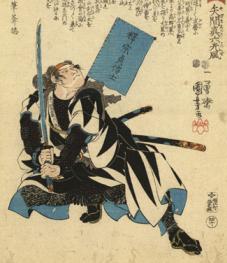
- Japan: An Illustrated Encyclopedia, Kodansha, 1993
- http://victorian.fortunecity.com/duchamp/410/47ronin.html (this page has great content, but a pretty terrible layout, so I have an edited version here)
|
Shijûshichi Shi (The 47 Rônin) | |
|
| Our story opens in the year 1701, pretty much smack-dab in the middle of the Edo-jidai. Japan was at this time ruled by the Tokugawa Bakufu under the Bakuhan system of government. I will try to explain briefly without going into excruciating detail on the Bakuhan. Japan at that time was divided up into different han, or domains, each ruled by a daimyô who had to pledge his loyalty to the shôgun. This is why the Bakufu system is often referred to as feudalism, though it tends to defy that definition when examined more closely. Anyway, the point of this information is that the daimyô was required to spend much of his time in the capital city of Edo (present-day Tôkyô). This was to prevent him from consolidating too much power in his own han. This ingenious requirement was, in my opinion, at least, the cornerstone of the entire Bakuhan system, and what allowed it to work so successfully, from its invention by Tokugawa Ieyasu, the first Tokugawa shogunate, for about 250 years before the Meiji Isshin. |
| Under the Bakuhan system, the shôgun held the real power, but even he had to show deference to the emperor, who was, as you will remember, of divine birth until 1945, when Hirohito announced that the emperor was not The One, he was just another guy. One of the ways that the shôgun tipped his hat to the divine status of the emperor was to send some envoys, bearing gifts, to the Imperial Palace in Kyôto. In return, the emperor sent his own envoys to Edo around the New Year. In this particular year, 1701, Lord Asano Naganori, the young daimyô of Harima-han, and Date Munehare, Lord of Sendai, were asked to entertain the imperial envoys. Before being entrusted with such an important job, the two were to receive training from Kira Yoshinaka, the shôgun's head of protocol. | |
| According to history, Kira was a greedy and corrupt official, and somehow, Lord Date's retainers had heard the stories of his behaviour, and thus advised Date to bribe Kira with expensive gifts. Date did not pass this information along to Asano, in one version of the story because he just imagined that Asano must have been informed by his own retainers, in another because he wanted to rise above Asano in the shôgun's favour. All versions of the story agree, however, that Asano did not know of Kira's nature, and did not bribe him. | |
| Because of this, Kira was greatly angered, and took every opportunity that presented itself to make Lord Asano look bad. After two months of abuse, Asano could not take it anymore. He drew his sword and attacked Kira, wounding him slightly. Unfortunately for Lord Asano, drawing one's sword inside Edo-jô was a capital offence. Asano was ordered by the shôgun, Tokugawa Tsunayoshi to commit seppuku (ritual suicide, known in America by its more vulgar name, harakiri, literally "cut the stomach"). Kira, whose nature was not known to the shôgun (at least, according to the story), was not punished, in fact, he was pitied and allowed to go on carrying out his official duties. | |
| When Oishi Kuranosuke, Lord Asano's chief retainer, heard this news back at Ako-jô, he had to come up with a plan quickly. For, under the Bakuhan system, when a daimyô was asked to commit seppuku by the shôgun, his lands and castles were forfeited to the Bakufu, his family was stripped of its title, and his samurai were forced to disband, thus becoming rônin, or masterless samurai. Among the 321 samurai who served Asano, some wanted to refuse to surrender the castle to the shôgun's approaching armies, some wanted to avenge Asano's death by cutting down Kira, and some wanted to surrender peacefully out of respect for the shôgun and the law. After much hurried deliberation, it was Oishi who came up with a compromise: he would petition the shoôgun to re-establish the House of Asano, with Asano Daigaku, the former Lord Asano's younger brother, as its head. If the shôgun were to refuse, the samurai would refuse to surrender the castle and go down fighting. | |
| Unfortunately, the samurai who were opposed to this plan deserted the castle, leaving only 60 men to oppose the huge army of the Bakufu. However, before said army could reach the castle, Oishi received a letter from Asano Daigaku himself, asking that he surrender the castle to the shôgun without any bloodshed. Oishi did so, but before the 60 loyal samurai left the castle for the last time, they vowed to kill Kira, whose dishonourable behaviour had stained the name of Asano and brought his family to ruin. This being settled, the samurai left Ako-jô and disbanded, at least as far as the Bakufu could tell. You see, Kira was rotten to the core, but not stupid. He knew that he was in the wrong, and he also knew that Asano's samurai were bound by bushidô to restore their lord's honour. This being so, he was afraid, and rightly so. For the Ako samurai had not really disbanded, they were just laying low for several years, until an opportunity for revenge presented itself. | |
| Oishi himself left his wife and kids behind in Ako and went to Kyôto, where his gambling and womanising convinced even some of his fellow rônin that he had no intention of prolonging the Ako incident. The shôgun, however, concerned that the incident might not really be finished, ordered for Asano Daigaku to be placed under house arrest. Some two years passed before Kira relaxed his guard enough to make an attempt on his life viable. So, the rônin reconvened to plan the attack. 13 of the rônin were too old, young, or sick to participate, so Oishi released them from the oath and sent them home to their respective families. That left (you guessed it) 47 rônin to avenge their lord. | |
| So, on the night of December 14, 1702, the rônin surrounded Kira's mansion. They posted a sign on the front gate explaining that they were the retainers of Lord Asano here to avenge his honour by killing Kira, and that they would not harm anyone else or cause damage to the surrounding residences. This being done, they attacked, and in an hour and a half, they had cut their way through Kira's 60 or more guards without losing any of their own men! After a search of the grounds, Kira was found hiding in an outbuilding. He was brought to the courtyard and given the chance to commit seppuku and preserve a shred of his honour, but he would not take it. Oishi killed and beheaded him, then the rônin took his head and set it in front of Asano's grave. Finally, declaring Asano's honour redeemed, they retired into Sengaku-ji (a Buddhist temple) and sent two delegates to the head of the Edo police, telling him what they had done and that they were at the temple, awaiting orders from the shôgun. | |
| The shôgun was deeply impressed with the actions of the rônin, but the law was very clear on their sentence. Still, he deliberated for 47 days (the number is just a coincidence) while the rônin were under arrest before sentencing them to death. They were allowed to commit seppuku, and 46 of them did so. The 47th, according to one version of the story, was an old man who grew sick (and died, according to some versions) and could not participate in the attack. According to another version, the 47th was a young man who was sent back to Ako with news of Kira's death. The records do show that only 46 men committed seppuku that day, however. The men were buried at Sengaku-ji with their master. | |
| Some time later, this story was made into what is quite possibly the most popular kabuki play of all time, "Chûshingira." In the 20th century, numerous movies were made of this story. Generally considered the best is Mizoguchi Kenji's 1942 masterpiece, "The Loyal 47 Ronin." Regrettably, I do not know the Japanese title of this movie, though it is a Japanese movie. Sengaku-ji, the temple where the rônin are buried beside Lord Asano, is visited by thousands of Japanese tourists every year. Most modern Japanese would consider this story the hallmark of bushidô. Interestingly enough, the idea that we have of bushidô in the West is pretty much the same, as it comes from the same sources, Japanese movies! | |
| Cited works for this footnote: | |
| |