The Hiroshima Atomic Bomb
|
Albert Einstein carried the guilt of killing 200,000 people to his own
grave. He felt that he was personably resonsible for the deaths caused
by the atomic bombs that were dropped on Hiroshima and
Nagasaki during the Second World War. Why? You see, Einstein fled
Nazi Germany for the United States, and he feared that the Germans were
close to developing an atomic bomb. Because of this fear, he urged US
president Franklin D. Roosevelt to start atomic weapons research. In
1942, Einstein got his wish and the infamous Manhatten project was begun.
By 1945, the United States had developed and tested some primitive
atomic bombs and decided to use them on Japan. For more information about
this decision, check out Gene
Dannen's excellent page which contains links to quite a few documents
on the decision process.
|
|
Harry Truman was the man who called the two shots on Japan, citing a need
to "seek to make a profound pyschological impression" on "a vital war
plant employing a large number of workers and closely surrounded by
workers' houses." Also, to learn more about the effects of the bombs,
it was decided that they be used on targets that were relatively
undamaged by conventional bombing. So, Kokura, Niigata, and
Hiroshima were chosen as potential targets. By early August 1945,
the two bombs that had thus far been produced were moved to the Pacific,
and the decision was made to drop the first bomb on the first clear day,
which turned out to be the sixth of August.
|
|
The atomic bomb that was dropped on Hiroshima was three metres
long and .7 metres in diameter, weighing four metric tons. It contained
between 10 and 30 kilograms of uranium 235, only one kilogram of which
actually reached fission, resulting in only 13 kilotons of explosive
power out of a possible 150-400 kilotons. In short, Hiroshima was
lucky. Nagasaki was even more lucky, though the plutonium 239
bomb that detonated over the city was equivalent to 22 kilotons of TNT.
Due to the geographical features of the terrain on which Nagasaki
is located and the epicentre of the bomb, it suffered less damage and
fewer deaths (maybe 70,000, all told) than did Hiroshima.
|
|
The Hiroshima bomb went off 500 metres above the city, about 50
metres northwest of the Industrial Promotion Hall at 08:15. The
temperature at the epicentre of the bomb immediately reached several
million degrees celcius, and the temperature at the hypocentre (the area
on the ground above which the bomb detonated) reached 3000-4000° C.
About 15% of the 12 kilotons of energy generated by the bomb was
radiation, 35% was thermal, and 50% was blast. People within a kilometre
of the hypocentre died within a week due to the rupture of their skin and
internal organs by the intense heat. People up to 3.5 kilometres away
suffered skin burns. Wooden structures within three kilometres of the
hypocentre spontaneously combusted, and firestorms lasted up to three
hours ravaged the city. Due to the temperature at the epicentre of the
bomb, the air rapidly expanded, causing shock waves to race away from the
epicentre at speeds of or greater than the speed of sound. Wooden
structures within two kilometres were instantly obliterated. Concrete
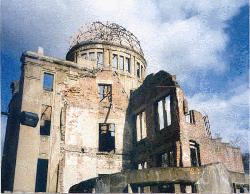
structures, such as the Atomic Dome itself, withstood the shock waves,
though with considerable damage, as you can see from the picture at the
top of this page.
|
|
The Nagasaki bomb was actually only dropped on Nagasaki
because the ninth of August turned out to be a cloudy day, contrary to
the weather forecast. Due to the cloud cover, the pilot of the bomber
that was supposed to drop the Fat Man (the nickname for the
Nagasaki bomb; the Hiroshima bomb was called "Little Boy")
on Kokura (one of the cities in the present-day urban sprawl that
is collectively known as Kita-Kyûshû) could not find
the city, so nearby Nagasaki was used as a substitute. Due to the
fact that Nagasaki had been built in a very hilly region, the
damage done by the larger bomb was less than in Hiroshima.
|
|
Cited works for this footnote:
|
|
| |