| FREE WILL: The Ability to Choose Good or Evil |
 |
 |
 |
 |
| Alex - "I just want to be good. I want for the rest of my life to be one act of goodness." Chaplain - "The question is whether or not this technique really makes a man good. Goodness comes from within. Goodness is chosen. When a man cannot choose he ceases to be a man." Alex - "I don't understand about the whys and wherefores, Father. I only know I want to be good." |
| Chaplain - "Choice. The boy has no real choice, has he? Self-interest. The fear of physical pain drove him to that grotesque act of self abasement. Its insincerity was clearly to be seen. He ceases to be a wrongdoer. He ceases also to be a creature capable of moral choice." Minister of the Interior - "We are not concerned with motives or the higher ethics...He will be your true Christian ready to turn the other cheek. Ready to be crucified rather than crucify. Sick to the very heart at the thought even of killing a fly. Reclamation. Joy before the angels of God." |
 |
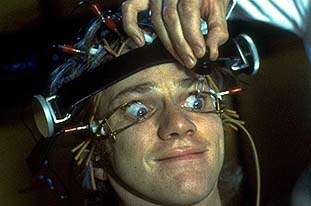 |
| The theme of free will is the central theme of A Clockwork Orange. Anthony Burgess himself has said that it is an "allegory of Christian free will". Free will is the ability to choose your own destiny. Christians believe that God gave us the power to make our own decisions, and that we are responsible for making the correct choices on our own. One of the biggest aspects that make humans different from other creatures is the presence of moral choice. It allows us to feel human, for we feel like we have control of our destinies. When Alex undergoes the Ludovico Technique, his ability to choose is stolen from him. The Ludovico Technique consisted of forcing Alex to watch disturbing videos of violence, rape scenes, and images of war. Before entering the cinema where the films were shown, he was injected with a serum that would cause him to feel extremely sick. With repeated viewings of the films paired with the sickness, Alex becomes conditioned against sex and violence. During a scene where Alex is beginning to feel sick as he watches a film, Dr. Brodsky describes the sickness and the conditioning to his assistants. "Very soon now, the drug will cause the subject to experience a death-like paralysis, together with deep feelings of terror and helplessness. One of our earlier test subjects described it as being like death, a sense of stifling or drowning, and it is during this period that we have found that the subject will make his most rewarding associations between his catastrophic experiences-environment and the violence he sees." - Dr. Brodsky |
| Alex is conditioned against sex and violence during the torturous Ludovico Technique. |
| Therefore, anytime Alex would feel a sexual urge or the need to act in a violent manner after receiving the treatment, he would feel sick immediately This forces him to switch to thinking opposite thoughts. He acts good in a reflexive manner to avoid feeling sick. The Minister of the Intererior describes the process: "Our subject is impelled toward the good by paradoxically being impelled towards evil. The intention to act violently is accompanied by strong feelings of physical distress. To counter these, the subject has to switch to a diametrically opposed attitude." - Minister of the Interior The treatment causes Alex to lose his ability to choose. Witnessing Alex's behavior after he has received the treatment, the prison chaplain is disgusted . He confronts the minister about Alex's lack of freedom to choose. |
| Prior to the treatment, Alex and the chaplain discuss the Ludovico technique. The chaplain brings up points about free will and also tries to warn Alex about the effects, but Alex does not want to listen. He tells the chaplain that he wants to be good, when in reality he wants to get out of prison. Little does Alex know that he will soon be good, because he will have no other choice. |
| Although we are introduced to Alex as being a violent sociopath, audiences feel badly for his suffering and inability to defend himself throughout the final third of the film. Anthony Burgess, author of A Clockwork Orange, argues that humanity must consist of individuals making their own moral choices, even if they choose evil. When Alex's ability to choose is removed, he doesn't seem like a person anymore, although he would appear to be a model citizen. He becomes more of a thing. The Ludovico Technique may cut down crime, but it in turn replaces a society of humans with a society full of deterministic, machine-like beings. |
| The notion of free will suggests that good and evil exist as separate choices, one being just as valid as the other. If one cannot choose evil, goodness seems meaningless and empty. Free will is connected to the Christian concept of morality. If a person is good, they choose to be good. It is all about the choice. The sense of morality and free will cannot exist without the other. The whole concept of morality rests upon choice, for we are not blamed for actions that are inevitable. Many believe that moral evil cannot be explained without free will, and that we are constantly faced with decisions on which we choose good or evil. Free will is what makes us the people we are. |
| At the end of A Clockwork Orange, Alex's free will is restored. Although this means that Alex can now think and do horrible things, audiences feel glad that he has the ability to choose again. This ending makes A Clockwork Orange quite different from other movies. It leaves us questioning and thinking about our own morality. We feel better knowing that someone is able to choose evil rather than being forced to choose goodness. |
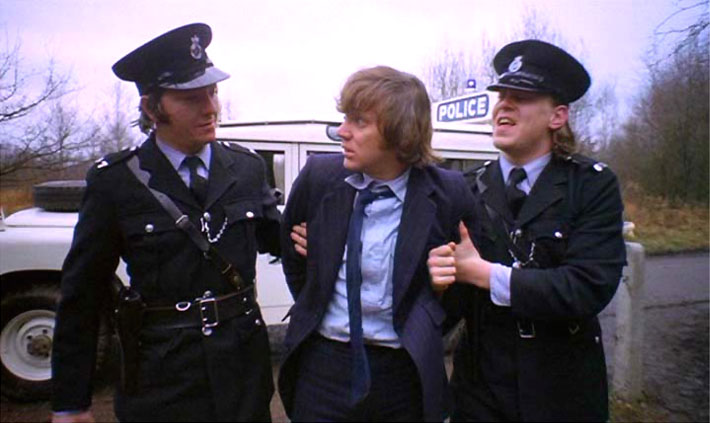
| Due to the conditioning, Alex is unable to defend himself against Georgie and Dim when they seek revenge against him |