 |
|
|
|
|
|
|
|
|
|
|
|
|
|
|
|
|
|
|
|
|
|
|
|
|
|
|
|
|
|
|
|
|
|
How Doping Silicon makes an ideal Semiconductor |
|
|
|
 |
|
|
|
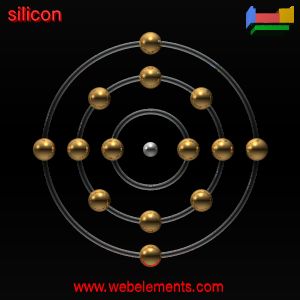
Left: Silicon's shell structure
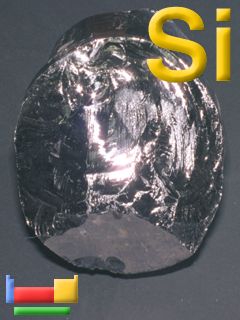
Below: A sample of Silicon |
|
|
|
|
|
 |
|
|
|
|
Silicon is the most typical kind of semiconductor in PV cells. The reason for this is its atomic structure and the way in which the atoms bond with each other.
Silicon's valence shell is 2s2 and 2p2. Each atom would like to gain 4 more electrons to fill its valence shell, therefore they make non-polar bonds with 4 other silicon atoms, sharing one electron from each atom, to fill the shell. This creates silicon's crystalline structure.
|
|
|
|
|
|
|
http://www.webelements.com/.../text/Si/econ.html |
|
|
|
|
|
Unfortunately this pure form of silicon is not good for PV cells. The strong crystalline structure makes it very difficult for the photons to knock loose an electron, since they're all tied up in bonds. In order to loosen up the electron configuration a little bit, you need to throw in some phosphorus atoms- about 1 per million silicon atoms. These impurities only need three electrons to fill their shells and therefore disrupt the crystalline pattern. Now when the photons enter the semiconductor of silicon with impurities, it can easily knock loose the electrons needed to create a current of electricity. This process of depurifying the silicon is called doping and it creates the ideal semiconductor for PV cells. |
|
|
|
P-Type Silicon |
|
|
N-Type Silicon |
|
|
|
|
|
|
 |
|
|
|
 |
|
|
|
|
|
http://www.localhistory.scit.wlc.ac.uk/museum/engine |
|
|
|
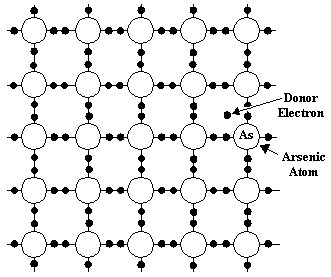
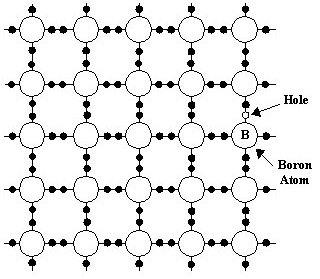
On the left is the N-type Silicon, except in this example it was doped with arsenic instead of phosphorus. On the left is the P-type Silicon doped with boron. |
|
|
|
This phosphorus doped silicon is called n-type silicon, n for negative. The extra electrons from the phosphorous floating around freely give the silicon a negative charge, thus calling it n-type.
Only half of the silicon in a PV cell is doped with phosphorous. The other half is doped with boron, which has only three electrons making this part of the silicon semiconductor p-type, positive. The result of these oppositely charged parts of silicon is an electric field. |
|
|
Previous Page |
|
|
Next Page |
|
|
|
|
|
|