A fundamental and critical ‘ingredient’ of
change, of betterment, is people. A true change does not
occur until people undergo some change. Though most of us
would agree with this, we sometimes do not take this issue
seriously. For instance, when companies wish to optimize
their work process, they make use of advance automation
technologies, impose
standards, and develop trainings. When things do not end
up as planned, the managers say, “There is a problem
with human resources; they lack of motivation to gain
opportunities from advance technologies.” Thus, we often
blame people for their ‘unreadyness’ to take up change
being implemented. In the same fashion, government
agencies often blame local communities for their lack of
participation in the implemented development projects.
Thus, when
things do not work as we wish, instead of looking
carefully into how people actually react to, and take
participation in changes, we tend to blame them as
resisting to change. Of course, quite often people resist
to change, or even oppose it. However, we could never know
precisely which individuals really resist to change, and
whether their resistance comes from disagreement or from
different perception regarding the goals of the change.
On the other
side, employees or faculty members sometimes resist to new
rules or performance criteria introduced by their leaders.
They respond to these by saying, “We agree that we need
organizational transformation to bring a higher prosperity
to us, but the executives just ask too much from us ...”
or “It is the main responsibility of the leaders to make
change happen, not ours.” Thus, even though agreement
has been achieved through out an organization, people may
not be fully aware that they themselves are a critical
factor of change.
Since people aspect is critical to change, it is
very important that we understand people (either those
under our level—the juniors, or above—the bosses) in
dealing with change. And the most effective way to
understand people is listening. Listening is a main
‘channel’ to get to know about other (people), since
it is through listening that we gain meaningful
information about other from the most valid source of
information (i.e., the people themselves). Although there
are other useful sources of information about other people
like statistics, charts, questionnaires, human mediators,
spies, they are all secondary.
Fruitful
listening come out of trust
On one occasion, in a directional meeting, the
director raised the issue of integration across units, as
this is believed to be important to increase overall
efficiency of the organization. In response, most of the
attendees were telling the director how important and
unique their respective units were, and how good they had
been performing so far. Since each unit manager was
emphasizing the importance and uniqueness of each
individual unit, the director failed to find a criterion
to implement integration policy. He did not see how the
units could be classified into fewer, larger in size,
divisions.
After a few
weeks passing by, the director changed his strategy. At
this time he organized the same meeting, but raised
different issues. He asserted in the meeting that there
was urgency for the organization to increase capacity and
to create bigger opportunity, and for this, integration of
competencies across units would be instrumental. Quite
surprisingly, the attendees responded in a very different
ways. The attendees expressed their agreement that
integration policy was very important for increasing
capacity. They mentioned that had the units been able to
integrate their strengths, bigger opportunities would have
been in their hands. They said that they would not resist
to integration policy imposed from the top, as long as
their individual unit identity and independency were
maintained to some extent. Thus, in the first meeting, the
director failed to get meaningful words from the
attendees, and in the later meeting, he was more
successful. The way the (very same) director position
himself seems to influence the way the attendees talk to
him.
Listening
occurs within interaction, not outside of interaction.
When someone tells us a story, he/she would expect that we
(the listener) will react in a certain way.
If we are able to position our self as a
trustworthy ‘delegate’ of the speaker, we might get
many words from the speaker to make us understand what
he/she wants. If the speaker do not have trust in us (the
listener), he/she is likely to speak without sincerity,
though he/she might still talk politely, by using nice
words, and with smiles.
Thus,
listening is not the same as taking other’s
argument/opinion to be criticized.
Suppose that a father, with anger, asks his son,
“Why did you do such a bad thing?!!” The son might
choose to remain silent, or say something defensive,
“No, father, … I did not do that.” The son might
realize that whatever answer he gives to the ‘why’
question, his father would disagree and gets more reasons
to remain anger. The response of the son would be
different if the father asks, “As you see, what you did
have brought you into trouble. So, what can I do the help
you?”
Good
listening deserves patience
Sometimes we (as listener) feel uncomfortable when
the speaker we listen to do not say words we expect. Often
we get upset when the speaker say words in opposition to
what we believe to be true. When such feelings fill our
heart, we start to counter what the speaker say, word by
word. If this happens, then the listening stops. And we
get into a battle of arguments. Thus, different from
hearing, listening demands for patience and sincerity. For
listening to continue, sometimes we need to sacrifice our
desire for demonstrating intellectual authority, or power,
for the sake of understanding about the speaker.
2.2
Learning from
listening
When we learn about something, we get more
knowledge, either theoretical knowledge or practical
knowledge, or both. We
acquire this knowledge either through analytical thinking,
deductive reasoning, or intuitive grasping/comprehending.
Although we gain a substantial amount of knowledge from
formal education, we also gain much knowledge from our
lifelong experience.
In daily life
we encounter various circumstances, events, phenomena from
which we make perception, conception, and comprehension.
Sometimes we do this by intention, sometimes not;
sometimes concisely, sometimes not. All these make up our
knowledge and shape our way of perceiving things and
people. And
from this we learn about what is good and what is bad.
Thus, learning is instrumental in broadening our
perspective, sharpening our vision about good and bad, and
identifying opportunities for betterment.
Learning
about others
We get to know others from interaction, especially
communication. There is no formal education program, nor
textbook that we can use to understand our friends, our
colleagues, or our beloved family. A grand theory on human
being does not tell us why our friend behaves in certain
ways in response to our action. Any individual has unique
character, and has developed their own framework to act
and react. The only way we could learn in sufficient
detail about other people is through communication within
interaction and engagement. And the critical aspect of
communication is listening.
When we learn
about others, we do not merely ask for what is good theory
or method, or how to reason properly. What we would
fruitfully learn from others are how others see things,
how others value things, and how others choose certain
actions to get what they perceive as good. These are key
subjects that we need to learn, if we really want to understand about others.
Learning
about one self
While we may learn about other people from
communication, we could also learn from it about our self;
that is, we could learn about our self from how people
react or make comments upon us. For example, we could
learn about our self from critics addressed to us from our
friends. Sometimes, we get more meaningful critics from
our enemies that have spent great deal of effort looking
out our weakness. Another source for learning about our
self is reflection upon our own experience.
Learning
from ongoing changes
Another useful source for learning about change
is the ongoing change itself. When we see things or people
are changing, we can make comparison between the old and
the newer ones, and grasping from this difference what is
good and what is bad. Thus, change itself could become a
source for learning about good and bad, and about better
change.
2.3
Change and
knowledge about it
We voluntarily undertake actions for changes if
we believe that some goodness will come out of these
changes. In this matter, it is important to note two
things regarding our knowledge about change: firstly, our
knowledge about goodness that we wish for may be
incorrect, or imprecise. Secondly, the changes that we
conceive as necessary may not be the right ones that will
actually bring about the expected outcome. In the first
case, there may be a gap between what we desire for and
what we really need for our own betterment. And
in the second case, there may be a gap between the
pre-conceived process of changes, and the actually
required changes. These gaps can, in principle, be
eliminated through various kinds of learning.
Thus, it is
important to liar from our past failures. Sometimes, we
fail to get what we wish, despite tremendous effort we
have undertaken to pursue what we wish. Quite often that
we fail because what we wish for turns out to be not what
we really need for our own goodness. The source of such a
failure could be the lack of knowledge about our self.
The meaning of
change used in this context is
broader and deeper than that of mechanism. Though
seem similar, mechanism and change differ in two aspects: certainty
and novelty.
People design a mechanism to ensure the emergence of
impacts based on specific steps and pre-conditioned
cause-effect relations. In other words, a mechanism is
built upon things we already know and cause-effect
relations we already keep under control.
When a mechanism is accomplished, there is nothing
genuinely new with the impact that emerges. Thus in
mechanism, certainty comes at the price of novelty.
On the other
hand, even though people may design change, there are
certainties in place. We are not certain about the right
steps to undertake; we can not force people to accept 100
% the change we design; and we are not 100 % sure whether
the objectives we wish for are, in fact, achievable.
People develop models, undertake simulations and
predictions, but still, often they are made surprised with
‘strange’ things occurring along the way of changes.
Thus, uncertainties seem to be inherent in changes.
A true or
genuine betterments in life are seldom the result of a
mechanistic process. If everything about tomorrow is known
with certainty today, then there is nothing genuinely new
when tomorrow events take place. Uncertainty is ‘out
there’ to provide a ‘room’ for true betterment to
emerge.
3.
LLC Cycle and
Values
A better future would come to reality only when
certain changes take place, and people is key to change
(and also a critical part of future betterment).
Thus, to manage for better future, it is important
to understand aspects of changes, to understand people,
and to understand how people could deal with change they
live in. LLC cycle provides a simple framework to
understand this, and hence, to manage for a better future.
People have different views on what better
means, and different views on what is not so good with the
present condition. People also differ in valuing things
they regard as good. When people talk about changes they
want, they do not always express explicitly/clearly what
things we believe to be good.
For instance,
when we talk about ‘good governance,’ and want some
change to get better governance, sometimes we are not
fully aware of what is really better when the ‘good
governance’ actually take place. We do not ask whether
transparency will promote sincere communication throughout
the company, or whether accountability will promote
learning across units.
When
university researchers are asked what they want
for change, typically they would say they want a
rise in financial support for their research projects. If
they are asked about what goodness will come out of their
projects, they would say papers, patents or knowledge
advancement. And if they are asked further about what
goodness that will ultimately come out, they may not have
further answers.
Thus in our
daily life, we do not always deal with ‘ultimate’
goodness questions. We more often deal with intermediary
questions, and a shorter way to get intermediary good
nesses. Since we are often endowed with partial knowledge
regarding goodness, and partial knowledge regarding
changes, the
cycle of listen-learn-change becomes important as this
helps us to shape changes in a better direction.
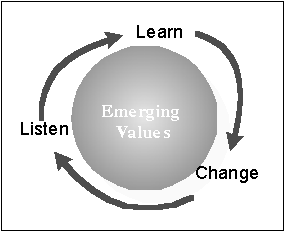
The Listen-Learn-Change Cycle
-
The first stage: listen >
learn > change
Here,
we listen to people that we think as critical for change
to occur. From this we learn about what people wish for,
the way people see good things, and the way people
see the present situation. We also learn from
listening to other about our own way in seeing good things, and whether what we wish is really
good for us and for others. Having had a clearer vision of
what goodness to wish for, and about various conditions
and opportunities of the present, actions can then be
conceived, planed, and undertaken. Sometime, to change our
self is a critical part of the action.
-
The cycle: change >
listen > learn > further
change
When
change does occur as a result of the actions, we need to
take lesson from it without waiting until some desired
impact to emerge. This entails listening to people
involved in the process of change and finding out what are
really going on. From this we may acquire better knowledge
of the ongoing changes, and could then better justify
whether it is the right change that
will bring about the desired outcomes. And then,
some adjustment on the actions could be undertaken to
shape the changes in a better direction.
The LLC cycle would suggest that in our daily
life, it is important to become a good listener, and to
learn form others in every form of interactions we could
engaged in. From
listening and learning we may acquire better knowledge
about what is better or worse, and how certain actions can
actually be taken to effectively bring about betterment
for us, and for others. This does not mean that by
performing LLC cycle we will always get what we wish for.
We may fail to undertake changes we plan (since we lack
proper knowledge on the right changes), or we may get
disappointed with what objective we aimed for (since it
turns out that it is not what we really need).
Nevertheless, if we keep in listening and learning during
the course of changes, we will get at least two valuable
things: a better social relation from being a good
listener, and a better knowledge from learning.