

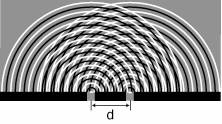
Double-slit diffraction and interference pattern
Diffraction refers to the various phenomena associated with wave propagation, such as the bending, spreading and interference of waves emerging from an aperture. It occurs with any type of wave, including sound waves, water waves, electromagnetic waves such as light and radio waves , and matter displaying wave-like properties according to the wave–particle duality . While diffraction always occurs, its effects are generally only noticeable for waves where the wavelength is on the order of the feature size of the diffracting objects or apertures.

Photograph of single-slit diffraction in a circular ripple tank .
The most conceptually simple example of diffraction is single-slit diffraction in which the slit is narrow, that is, significantly smaller than a wavelength of the wave. After the wave passes through the slit, a pattern of semicircular ripples is formed, approximately equally strong in all directions, as if there were a simple wave source at the position of the slit. This semicircular wave is a diffraction pattern.
When the slit is significantly more than a wavelength wide, the wave propagates more nearly straight through, but a diffraction pattern at the edges of the wave can be seen. The center part of the wave travels through largely unaffected at short distances, but the wave forms a stable diffraction pattern at longer distances. This pattern is most easily understood and calculated as the interference pattern of a large number of simple sources spaced closely and evenly across the width of the slit.
In multiple-slit experiments, narrow enough slits can be analyzed as simple wave sources.
A slit is an opening that is infinitely extended in one dimension, which has the effect of reducing a wave problem in 3-space to a simpler problem in 2-space. All the same effects can be seen and analyzed for small round holes and other shapes, in 3D, but they're harder to describe, compute, and illustrate.
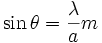
Quantitatively, the angular positions of the minima in multiple-slit diffraction are given by the equation
|
|
|
|
|
The central maximum is two orders wide, however, so m = 0, θ = 0 is the absolute maximum of the distribution and intensity functions. This is a form of Bragg's law (see below). Quantitative analysis of single-slit diffraction
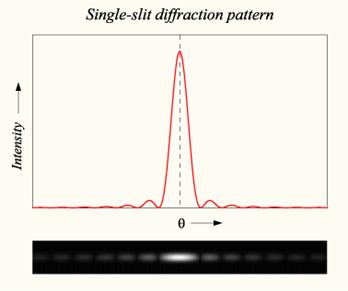
Graph and image of single-slit diffraction
As an example, an exact equation can now be derived for the intensity of the diffraction pattern as a function of angle in the case of single-slit diffraction.
Posting Date:
Monday, September 25, 2006
where
m is an integer that labels the order of each minimum,
λ is the wavelength,
a is the distance between the slits
and θ is the angle for destructive interference