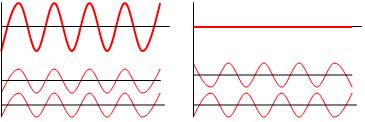


Interference is the superposition of two or more waves resulting in a new wave pattern. As most commonly used, the term usually refers to the interference of waves which are correlated or coherent with each other, either because they come from the same source or because they have the same or nearly the same frequency . Two non-monochromatic waves are only fully coherent with each other if they both have exactly the same range of wavelengths and the same phase differences at each of the constituent wavelengths.
The principle of superposition of waves states that the resultant displacement at a point is equal to the sum of the displacements of different waves at that point. If a crest of a wave meets a crest of another wave at the same point then the crests interfere constructively and the resultant wave amplitude is greater. If a crest of a wave meets a trough of another wave then they interfere destructively , and the overall amplitude is decreased.
Interference is involved in Thomas Young 's double-slit experiment where two beams of light which are coherent with each other interfere to produce an interference pattern (the beams of light both have the same wavelength range and at the center of the interference pattern they have the same phases at each wavelength, as they both come from the same source). More generally, this form of interference can occur whenever a wave can propagate from a source to a destination by two or more paths of different length. Two or more sources can only be used to produce interference when there is a fixed phase relation between them, but in this case the interference generated is the same as with a single source; see Huygens's Principle .
Total phase difference is derived from the sum of both the path difference and the initial phase difference (if the waves are generated from 2 or more different sources). Hence, we can then conclude whether the waves reaching a point are in phase (constructive interference) or out of phase (destructive interference).
Light from any source can be used to obtain interference patterns, for example, Newton's rings can be produced with sunlight . However, in general white light is less suited for producing clear interference patterns, as it is a mix of a full spectrum of colors, that each have different spacing of the interference fringes. Sodium light is close to monochromatic and is thus more suitable for producing interference patterns. The most suitable is laser light because it is almost perfectly monochromatic.
Posting Date:
Monday, September 25, 2006
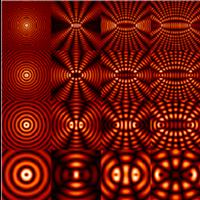
Interference of two circular waves - Wavelength (decreasing bottom to top) and Wave centers distance (increasing to the right). Absolute value snapshots of the (real-valued, scalar) wave field. As time progresses, the wave fronts would move outwards from the two centers, but the dark regions (destructive interference) stay fixed.
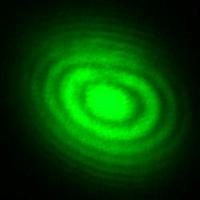
Interference pattern produced with a Michelsoninterferometer . Bright bands are the result ofconstructive interference while the dark bands are the result of destructive interference .
When two sinusoidal waves superimpose, the resulting waveform depends on the frequency (or wavelength) amplitude and relative phase of the two waves. If the two waves have the same amplitude A and wavelength the resultant waveform will have amplitude between 0 and 2 A depending on whether the two waves are in phase or out of phase .
combined |
|
|
wave 1 |
||
wave 2 |
||
|
Two waves in phase |
Two waves 180° out |
Consider two waves that are in phase, with amplitudes A 1 and A 2 . Their troughs and peaks line up and the resultant wave will have amplitude A = A 1 + A 2 . This is known as constructive interference .
If the two waves are pi radians , or 180°, out of phase, then one wave's crests will coincide with another wave's troughs and so will tend to cancel out. The resultant amplitude is A = | A 1 ? A 2 | . If A 1 = A 2 , the resultant amplitude will be zero. This is known as destructive interference .