


In electrodynamics , polarization (also spelled polarisation ) is the property of electromagnetic waves , such as light , that describes the direction of their transverse electric field . More generally, the polarization of a transverse wave describes the direction of oscillation in the plane perpendicular to the direction of travel. Longitudinal waves such as sound waves do not exhibit polarization, because for these waves the direction of oscillation is along the direction of travel.
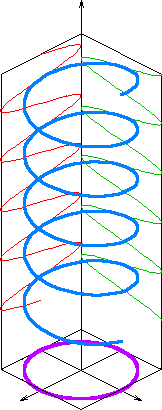
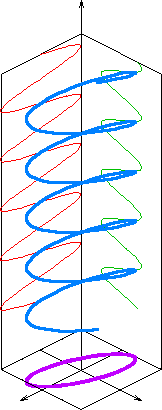
The simplest manifestation of polarization to visualize is that of a plane wave , which is a good approximation to most light waves (a plane wave is a wave with infinitely long and wide wave fronts). All electromagnetic waves propagating in free space or in a uniform material of infinite extent have electric and magnetic fields perpendicular to the direction of propagation. Conventionally, when considering polarization, the electric field vector is described and the magnetic field is ignored since it is perpendicular to the electric field and proportional to it. The electric field vector may be arbitrarily divided into two perpendicular components labeled x and y (with z indicating the direction of travel). For a simple harmonic wave , where the amplitude of the electric vector varies in a sinusoidal manner, the two components have exactly the same frequency. However, these components have two other defining characteristics that can differ. First, the two components may not have the same amplitude . Second, the two components may not have the same phase that is they may not reach their maxima and minima at the same time. The shape traced out in a fixed plane by the electric vector as such a plane wave passes over it (a Lissajous figure ), is a description of the polarization state . The following figures show some examples of the evolution of the electric field vector (blue) with time (the vertical axes), along with its x and y components (red/left and green/right), and the path traced by the tip of the vector in the plane (purple):
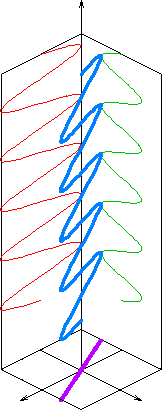
In the figure on the left, the two orthogonal (perpendicular) components are in phase. In this case the ratio of the strengths of the two components is constant, so the direction of the electric vector (the vector sum of these two components) is constant. Since the tip of the vector traces out a single line in the plane, this special case is called linear polarization . The direction of this line depends on the relative amplitudes of the two components.
In the middle figure above, the two orthogonal components have exactly the same amplitude and are exactly ninety degrees out of phase. In this case one component is zero when the other component is at maximum or minimum amplitude. There are two possible phase relationships that satisfy this requirement: the x component can be ninety degrees ahead of the y component or it can be ninety degrees behind the y component. In this special case the electric vector traces out a circle in the plane, so this special case is called circular polarization . The direction the field rotates in depends on which of the two phase relationships exists. These cases are called right-hand circular polarization and left-hand circular polarization , depending on which way the electric vector rotates.
All other cases, that is where the two components are not in phase and either do not have the same amplitude and/or are not ninety degrees out of phase are called elliptical polarization because the electric vector traces out an ellipse in the plane (the polarization ellipse ).
The "Cartesian" decomposition of the electric field into x and y components is, of course, arbitrary. Plane waves of any polarization can be described instead by combining waves of opposite circular polarization, for example. The Cartesian polarization decomposition is natural when dealing with reflection from surfaces, birefringent materials, or synchrotron radiation . The circularly polarized modes are a more useful basis for the study of light propagation in stereoisomers .

Effect of a polarizer on reflection from mud flats. In the first picture, the polarizer is rotated to minimize the effect; in the second it is rotated 90° to maximize it: almost all reflected sunlight is eliminated.
Light reflected by shiny transparent materials is partly or fully polarized, except when the light is normal to the surface. A polarizing filter, such as a pair of polarizing sunglasses , can be used to observe this by rotating the filter while looking through. At certain angles, the reflected light will be reduced or eliminated. Polarizing filters remove light polarized at 90° to the filter's polarization axis. If two polarizers are placed atop one another at 90° angles to one another, no light passes through.

The effects of a polarizer on the sky in a color photograph. The right picture has the polarizer, the left does not. Although some photographic polarizers are called circular polarizers because they emit circularly polarized light, they select a linear polarization state from the scene.
Polarization by scattering is observed as light passes through the atmosphere . The scattered light produces the brightness and color in clear skies. This partial polarization of scattered light can be used to darken the sky in photographs, increasing the contrast. This effect is easiest to observe at sunset , on the horizon at a 90° angle from the setting sun. Another easily observed effect is the drastic reduction in brightness of images of the sky and clouds reflected from horizontal surfaces, which is the main reason polarizing filters are often used in sunglasses. Also frequently visible through polarizing sunglasses are rainbow -like patterns caused by color-dependent birefringent effects, for example in toughened glass (e.g. car windows) or items made from transparent plastics . The role played by polarization in the operation of liquid crystal displays (LCDs) is also frequently apparent to the wearer of polarizing sunglasses, which may reduce the contrast or even make the display unreadable.

A view through polarized sunglasses
The photograph at the right was taken through polarizing sunglasses and through the rear window of a car. Light from the sky is reflected by the windshield of the other car at an angle, making it mostly horizontally polarized. The rear window is made of tempered glass . Stress in the glass, left from its heat treatment, causes it to alter the polarization of light passing through it, like a wave plate . Without this effect, the sunglasses would block the horizontally polarized light reflected from the other car's window. The stress in the rear window, however, changes some of the horizontally polarized light into vertically polarized light that can pass through the glasses. As a result, the regular pattern of the heat treatment becomes visible.
Many animals are apparently capable of perceiving the polarization of light, which is generally used for navigational purposes, since the linear polarization of sky light is always perpendicular to the direction of the sun. This ability is very common among the insects , including bees , which use this information to orient their communicative dances . Polarization sensitivity has also been observed in species of octopus , squid , cuttlefish , and mantis shrimp . The rapidly changing, vividly colored skin patterns of cuttlefish, used for communication, also incorporate polarization patterns, and mantis shrimp are known to have polarization selective reflective tissue. Sky polarization was thought to be perceived by pigeons , which was assumed to be one of their aids in homing , but research indicates this is a popular myth.
The naked human eye is weakly sensitive to polarization, without the need for intervening filters. Polarized light creates a very faint pattern near the center of the visual field, called Haidinger's brush . This pattern is very difficult to see, but with practice one can learn to detect polarized light with the naked eye.
The property of (linear) birefringence is widespread in crystalline minerals , and indeed was pivotal in the initial discovery of polarization. In mineralogy , this property is frequently exploited using polarization microscopes , for the purpose of identifying minerals. See pleochroism .
Polarization is principally of importance in chemistry due to the circular dichroism and "optical rotation" (circular birefringence) exhibited by optically active ( chiral ) molecules . It may be measured using a polarimeter .
Polarization may also refer to the through-bond ( inductive or resonant effect ) or through-space influence of a nearby functional group on the electronic properties (e.g. dipole moment ) of a covalent bond or atom.
Posting Date:
Monday, September 25, 2006