|
| Sports |
|
|
| Photo Gallery |
|
|
| Funny Pics |
|
|
| Links |
|
|
| Guest Book |
|
|
|
|
 Founded
in 1882 by Jigoro Kano (1860--1938) who was a student of jujutsu.
He formulated a new system of fighting that pertained to the use of
barehands, thus judo or "gentle way" was developed. Judo is comprised
of several effective throwing techniques, strangling, and joint locking,
alike those methods of jujitsu. The use of strict rules, regulations,
and guiding principles are the factors that distinguishes judo from
jujitsu. The emphasis on the manner of techniques is what makes judo
a popular activity and famed as an international sport. Kano based
his new art on two principles: seiryoku zenyo (maximum effort with
minimum effort) and juta kyoei (mutual welfare and benefit). Seiryoku
zenyo occurs when one can skillfully defeat an opponent of considerable
strength by yielding to his attack and at the same time, maintaining�
his own balance, which would then, throw his opponent off� balance
so he becomes open to a counterattack. In juta kyoei, Kano stated
that the purpose of judo was not to prevail in contests but to "perfect
one's mind and body for the mutual benefit and welfare of all mankind."
Thus, like jujutsu, its predecesor, judo is a system that entails
turning the strength of an attacker against him, thereby resulting
in defeat. The sport of judo has recieved worldwide recognition and
in 1964, was inducted into the Olympics and was soon governed by the
International Judo Federation, which regulates all judo activities
throughout the globe. Throwing techniques is the essential premise
to judo. Judo throws are divided into three parts: kuzushi (breaking
opponents balance), tsukuri (entry of body into a position which prevents
the opponent from regaining his balance), and Kake (execution of the
throw). All three phases are performed as one continuous movement
from start to finish. Founded
in 1882 by Jigoro Kano (1860--1938) who was a student of jujutsu.
He formulated a new system of fighting that pertained to the use of
barehands, thus judo or "gentle way" was developed. Judo is comprised
of several effective throwing techniques, strangling, and joint locking,
alike those methods of jujitsu. The use of strict rules, regulations,
and guiding principles are the factors that distinguishes judo from
jujitsu. The emphasis on the manner of techniques is what makes judo
a popular activity and famed as an international sport. Kano based
his new art on two principles: seiryoku zenyo (maximum effort with
minimum effort) and juta kyoei (mutual welfare and benefit). Seiryoku
zenyo occurs when one can skillfully defeat an opponent of considerable
strength by yielding to his attack and at the same time, maintaining�
his own balance, which would then, throw his opponent off� balance
so he becomes open to a counterattack. In juta kyoei, Kano stated
that the purpose of judo was not to prevail in contests but to "perfect
one's mind and body for the mutual benefit and welfare of all mankind."
Thus, like jujutsu, its predecesor, judo is a system that entails
turning the strength of an attacker against him, thereby resulting
in defeat. The sport of judo has recieved worldwide recognition and
in 1964, was inducted into the Olympics and was soon governed by the
International Judo Federation, which regulates all judo activities
throughout the globe. Throwing techniques is the essential premise
to judo. Judo throws are divided into three parts: kuzushi (breaking
opponents balance), tsukuri (entry of body into a position which prevents
the opponent from regaining his balance), and Kake (execution of the
throw). All three phases are performed as one continuous movement
from start to finish. |
Judo, which is translated as the "gentle way",
teaches the principle of flexibility in the application of technique.
This is the flexible or efficient use of balance, leverage, and movement
in the performance of Judo throws and other skills. Skill, technique
and timing, rather than the use of brute strength, are the essential
ingredients for success in Judo. For example, in Judo classes you
may learn how to give way, rather than use force, to overcome a stronger
opponent.
|
The
Judo Rank System     
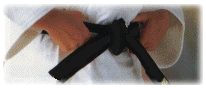
Achievement in Judo is recognized by awarding different color belts. The six student ranks are called kyu. The ten black belt, or expert, ranks are called dan. Juniors under 17 years old earn different color belts than seniors. In the US most dojos use the following system: ��� English������ Japanese��� Senior belt�� Junior belt ��� 6th
grade���� rokyu������ white�������� white ��� 1st
degree��� shodan����� black |
| Judo Terms
Ashi (Foot, leg), Atemi (Striking), Ayumi Ashi (Ordinary pattern of walking), Dojo (School or training hall for studying the way), Eri (Collar, lapel), Hantei (Referee call for judge's decision), Happo no Kuzushi (Kuzushi in 8 directions), Hara (Stomach), Hidari (Left), Hiji (Elbow), Hiki-Wake (A draw), Hikite (Pulling hand), Hiza (Knee), Ippon (One point in competition), Jigotai (Defensive posture), Jikan (Referee call to stop the clock), Judogi (Judo practice uniform), Judoka (Judoist), Ju-no-kata (Forms of gentleness), Kaeshi-waza (Counter techniques), Kake (Completion of technique), Kansetsu (Joint), Kata (Forms), Kata (Shoulder), Kenka Yotsu (Fighting Grip), Kiai (Spirit shout), Kime-no-kata (Teaches attack & defence in combat situations), Kogeki-Seyo (Request for judoka to be more active), Koka (a score less than a yuko), Koshi (Hip), Kubi (Neck), Kumikata (Gripping methods), Kuzure (Modified (hold)), Kuzushi (Unbalancing the opponent), Mae (Forward, front), Mae-Mawari Sabaki (Fron-turn movement Control), Mae-Mawari Ukemi (Tumbling forward), Mae Sabaki (Front movement control), Mae Ukemi (Falling forward), Masutemi Waza (Rear sacrifice throws), Migi (right), Momo (thigh), Mune (Chest), Obi (Judo belt), Osaekomi (Referee call to begin timing of hold), Osaekomi-Toketa (Stop timing of hold), Randori (Free practice), Randori-no-kata (Form/Demonstration of randoriwaza), Randoriwaza (Techniques for free practice), Rei (Bow), Renrakuwaza (Combination techniques), Ritsurei (Standing salutation), Seiza (Formal kneeling posture), Sensei (Teacher, instructor), Shiai (Contest), Shintai (Moving forwards, sideways & backwards), Shisei (Posture), Shizentai (Natural Posture), Sode (Sleeve), Sono-Mama (Stop action; command to freeze), Tai Sabaki (Body Control), Tatami (Mat), Te (Hand, arm), Tekubi (Wrist), Tokuiwaza (One's favorite/best technique), Tori (attacker), Tsugi Ashi (Walking by bringing one foot up to another), Tsukuri (Entry into the opponent), Tsurite (Lifting Hand), Uchi-Komi (Repeated practice entering for a throw without completing it), Ude (arm), Uke (The defender or person receiving the technique), Ukemi (Breakfall techniques), Ushiro (Backward, rear), Ushiro Sabaki (Back movement control), Ushiro Ukemi (Falling Backward), Waki (Armpit), Waza (Technique), Waza-Ari (Half point), Wazaari-Awasete Ippon (Two Wazaaris for the win), Yoko (side), Yoko-Kaiten-Ukemi (Sideways rolling break fall), Yokosutemi Waza (Side sacrifice throws), Yoko Ukemi (Falling Sideways), Yoshi (Resume action), Yubi (finger), Yudansha (Black belt), Yudanshakai (Black belt association), Yuko (a score less than a waza-ari), Yusei Gachi (Win by judge's decision), Zarei (Kneeling salutation)� |
Quotes
|
| Links
������ Judo Centrum Leuven (where I train), BACOB Judo-Net, Welcome to International Judo Federation, Judo World, Judo Information, The World of Judo Magazine,� |
 About
Myself About
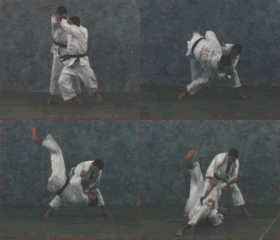
Myself I started judo when I was 10 years old. I trained at an amateur sport school in a small town near Beijing. Since not many people paticipated judo in China, we didn't have the rank system. I wore only white belt. After 5 years, I stopped because I went to a new school which is quite far from where I trained. Then I concentrated on my study... Eight years later, I started judo again because I still love this game. It is not in China this time, but in Belgium, in a club named JudoCentrum Leuven.� Judo is quite popular in such a small country as Belgium, so here has a good rank system. As I didn't know my rank, I was firstly given a brown belt (1st kyu) by the club. After half a year, I finished all the competitions required for a black belt. On 14 Jan. 2001 I took the qulification exam (a kind of tradition) and now I'm black-belt. (the movie above shows my favourate technique) |
 Principles
and Goals of Judo
Principles
and Goals of Judo