|
There
have been gunfights, thefts,
accusations of wide spread fraud, even mysterious disappearances of
highly trained dogs. Inquiries are underway across France, and
scientists have been called upon to help investigators to find the
culprits. All these investigations are conducted because of
truffle – a highly fragrant tuber which many wealthy gastronomes
consider the king of all fungi. In France, the truffle commerce has
always been secretive. Truffle “hunters” try to avoid the taxman as
much as drug dealers. Black truffles found only in
southeastern Var and Perigord regions of France are very expensive.
They are rare and very time consuming to find. They grow underground
and must
be “hunted.” These days a kilo costs US $750 in French markets.
By the time we get them in North America the price may be as high as
$1,250 to $1,500, pending on store location, and fame of the
establishment. Dean and Deluca in New York will not part with a
kilogram of truffles for less than $1,400, and Fauchon in Paris is
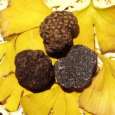
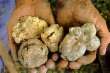
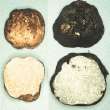
likely to charge $1,000. There are three types of truffles – black,
grey, and white. Black truffles generally come from France, white from
Piedmont and Umbria, Italy and grey can be found in North
America.Truffles grow on the roots of truffle
oaks, often less than 30 cm below the surface. To date, no one has been
able to cultivate truffles: they grow randomly in certain regions. The
more truffle oak seedlings are planted,
the more chances exist for harvesting some. Since truffles
cannot be seen, specially trained sows and dogs are employed to find
the elusive tubers, Sows love to eat them and have a keen sense of
smell, but because of their size, transportation tends to be
cumbersome, also once they start digging, it is difficult to stop them
to retrieve the truffle. Many “hunters” prefer specially
trained dogs that are easier to control. At least one French truffle
hunter is trying to train a Vietnamese pot-bellied sow for practical
reasons. Thus far, no success has been reported. The size of the
truffle varies considerably ranging from 10 grams to 100 grams. Large
truffles cost more because they are rare. Truffle oaks
thrive on soil rich in limestone, with good drainage. Truffles
are generally used in goose liver pates, in sauces, omelettes,
scrambled eggs, compound butters, and baked in puff pastry.
Connoisseurs consider truffles as aphrodisiac, but there is no
scientific evidence to this claim. Once
unearthed, truffle’s can be stored well packaged in a cool, damp place
for months. They can also be frozen, although after thawing, texturally
the quality becomes unacceptably soft and mushy. Black truffles are
highly aromatic, pungent and will even penetrate eggs stored next to
them, changing their taste. Italians consider the white truffle to be
superior in taste to black truffle. White truffles are abundant in Alba
and Monferrato,
Piedmont, and around Parma, Modena and Bologna in Emilia Romagna. They
have a penetrating, faintly garlicky aroma, with an intense flavour.
Generally, aficionados serve it in paper thin slices on risottos,
pastas, meats, egg dishes and cheese fondues. While white truffles may
be eaten raw, black truffles must be cooked. White truffles are more
expensive than black. Other less-valued truffles are grey
and red-grained
black truffle. Connoisseurs consider grey truffles found in North
America unworthy of their attention. Imitation
truffles consist of egg white, truffle juice and seasonings. Both their
texture and taste have no resemblance to the real truffle, except for
colour. Because black truffles are in such high demand, many
fraudulent dealers buy inferior truffles like fungi, colour them and
sell at exorbitant prices. Chinese truffles look like black French
truffles, and some dealers are known to colour and sell them for
authentic. Generally they buy the Chinese truffle for $30 a kilogram
and after colouring sell it whatever the going market is. True truffles
must be purchased from reliable dealers with established reputations.
|