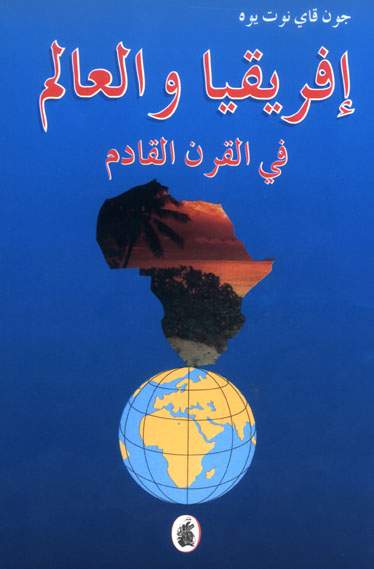
 Ifrigia wal A'lem
This book is divided into nine chapters:
Chapter one describes the political evolution of the continent from a
one-party system, to an era of military coups, down to the current period
of tribal or ethnic coalitions pretending to be multi-party experiments.
The future trends of political development in the continent are examined,
with emphasis on multi-partisan politics as the genuine long-term solution
to the instability in the region. The increased importance of the role of
intellectuals in the politics of the next century is one of thesuggested
recommendations.
Chapter two deals with the US-UN political and humanitarian roles in the
continent especially in the 1990s. A country-to-country study is provided,
especially of those countries undergoing political turmoil. The American
administrations' democratization mission in the continent, both in
Anglophone and Francophone nations, is explored. The US influence on the
IMF and the World Bank in pushing through the ongoing reform packages in
Africa, and the double standards the financial giants apply in different
parts of the continent are also discussed. The clash between US and UN
interests in Africa is alsoanalyzed.
Chapter three examines the United Nations humanitarian and political
role in Africa beginning from the 1960s up to the Rwanda disaster of
April 1994. The chapter also explores the role of the UN agencies in
developmental policies, human rights monitoring and relief work in the
continent.
Chapter four discusses the contributory role of human rights abuses in
Africa in shaping 21st century Euro-African relations. The emphasis of the
most European countries in linking financial and developmental aid to the
region with the human rights records of individual African nations seems
to be an alarming symptom of the future deterioration of relations between
Africa and the emerging 'united Europe'. The political and specially the
economic effects of 'united Europe' policies on Afro-European relations in
the 21st century are also examined.
Chapter five evaluates the political and diplomatic relations between OAU
and Arab League. After the Yemeni-Eritrean border conflict of 1996,
relations between the two organizations were severely affected to the point
of an open war of words between the twosecretaries general. Another
discordant issue is whether the North African members of the OAU, who
wield enormous powers in the organization, have the right to do so or not.
The chapter also discusses and evaluates Afro-Arab relations in the 1990s,
with emphasis on what seems to be 'restrained economic cooperation',
coupled with low standard of joint trade and investment activity, especially
after some Arab citizens have been asked, in the 1990s, to leave some
Western and Central African states due to their 'inappropriate' investment
activities in those countries. Other contentious cases are the Southern
Sudan civil war, the Africans' fear of Islamic radicalism, relations between
Israel and African states, and the Western Saharan conflict, toward all of
which the views and the policies of the two regions are clearly conflicting.
Chapter six discusses regional and international treaties on the Nile
River and future of relations between the Nile Valley states. Since water
shortages on the continent are likely to raise political and security
tensions in the Nile valley region in the 2000s, the treaties between
Britain and Italy in 1891, Britain and Imperial Ethiopia in 1906,
Anglo-Egyptian Sudan and Egypt in 1929, and Sudan and Egypt in 1959, are
considered in this study as possible legal precedents for any future
conflict between these countries. This is especially true now that Egypt
and Ethiopia have openly, for the first time, disagreed over the
construction of irrigation dams along the Blue Nile. On the other hand,
the dispute over the digging of Jonglei canal in Southern Sudan,
interrupted in the 1980s by the ongoing civil war, may well lead to an
open conflict between Egypt and Southern Sudan in the future, as already
some Southern Sudanese intellectuals have expressed their open opposition
to the resumption of the digging of thecanal.
Chapter seven deals with the negligible role of the OAU in solving the
problems of African refugees in the continent. In this chapter, I argue
that the OAU has distanced itself from dealing with the refugees crises
in the region, leaving these refugees and their problems at the mercy of
the UNHCR and NGO officials, some of whom turned some refugee camps into
trading centers for their financial gain. A practical step toward solving
this acute problem would be the revival of the active role formerly played
by the OAU Refugee Department, transforming it into an active participant
-a watch dog
- in solving refugee
-related problems,
whether in terms of the peace-making process or of
relief work, in close cooperation with UN agencies and
NGOs operating in the region.
Chapter eight is a survey of the effects of 'globalization' or the
'Clash of Civilizations' on Africa in the 21st century. In this chapter,
I try to explain the socio-economic and political dynamics of globalization
as framed by American and European theoreticians, and evaluate its
imminent impact on the political and economic decision-making process in
Africa in the 21st century. Here the role of religion and politics, the
globalization of the world economy, and the West's cultural domination of
most aspects of inter-cultural exchange are explored. The possibility
of the world becoming a multi-polar platform with the active participation
of Asia, Europe, the Americas and the Middle East, is emphasized. The role
of Africa in the emerging world order, is the question left forAfrican
leaders to answer.
The last chapter, entitled 'Africa: Fear of the Future', examines African
socio-economic and political life as it stands today, with emphasis on what
the future may hold for it in the 21st century. In this section, I argue
that civil and tribal wars may well carry on to the middle of the 21st
century, so long as power struggles between African politicians remain the
supreme goal of their politics. Border disputes between African states may
also pose a real problem in the same way that the questions of
self-determination, Islam versus Christianity, the hidden rivalry between
Sunni and Shiite Muslims in West and East Africa and organized tribal or
religious terrorism, will all dominate the political agendas of the
continent in the 21st century. Unless the continent's emerging regional
economic blocs are strengthened and institutionalized, it is unlikely
that the badly needed political and economic reforms in the continent,
which must be self-generated and self-regulated, will be carried out
successfully.
The book was published in Beirut, Lebanon in November 1998 (143 pages),
and you can purchase it through your local bookstore from the following addresses:
Mu'asesa al-Arabiyya Lil Darasat wa al-Nashr
P O Box 11-5460
Beirut
Lebanon
Tel: 00961 1 807900
Fax: 807901
Dar al-Faris Lil Nashr wal Tawzia
P O Box 9157
Amman
Jordan
Tel: 00962 6 5605432
Tel/Fax 5685501












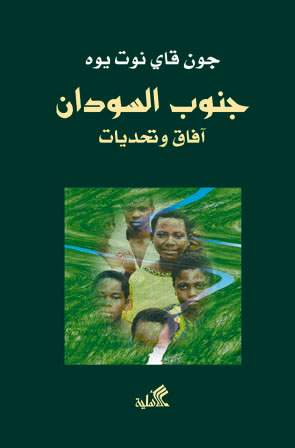 Junub al-Sudan: Afaq wa Tahdiyyat