The
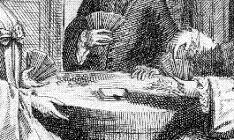
Yellow Dwarf is a card game from the family of hoc games.
Its rules, published during the last quarter of 1760 in the weekly journal
L'Avantcoureur (The Forerunner), are very different from those used
nowadays, making the game at once the heir to the games
of Poque, of Hoc Mazarin
and of the Comète.
Today's
rules are identical to those published in 1792 in
Lacombe's Dictionary of Games, in the article entitled
Lindor or Yellow Dwarf. Lindor
uses the same equipment as the Yellow Dwarf but its
play of the cards is far simpler than that described in The Forerunner,
with the stakes and payments there also showing notable differences.
Preamble: The Yellow Dwarf in The Forerunner
The Forerunner
was a weekly journal of the 18th century, published every
Monday, starting on 21 January 1760. Each issue comprised 16
pages in octavo format. The current-affairs subjects it covered concerned literature,
the sciences, the arts, and entertainment.
Issues
no. 41 and 42 present what may well be the earliest
precise information about the game of the yellow dwarf. One can see from them that
today's rules are far simpler than those of the time.
THE FORERUNNER,
Monday 27 October 1760 (no. 41)
"If the natural inconstancy of our nation can sometimes be
justified, it is when its only aim is to vary our
amusements; quadrille and piquet have long held the privilege
of amusing polite company; a way has been found
to rejuvenate them by multiplying their favorites, and quite recently a new
game has been added to them, less ruinous than brelan. This game can occupy up to five people
at once and is called the Yellow Dwarf, which is the name given to the seven of diamonds.
A layout of five cards is placed on the table, among which is this seven. These
cards are loaded with stakes by whoever deals, and whoever holds the
matching cards in their own hand draws the stake that is upon them, and has the right to make hoc with each
of them. This is, moreover, a sort of elaborate comète
that calls for memory and attention in order to get rid of
one's cards at the right moment, the last player receiving from the others the value of all the cards
that remain in their hands.
This
game is very much in fashion and will no doubt last longer than the old comète,
unless another one comes along to overturn it."
THE FORERUNNER,
Monday 3 November 1760 (no. 42)
"Some people having asked for a fuller account
of the Yellow Dwarf, which was discussed in our last issue, we believe we
can satisfy them.
Before
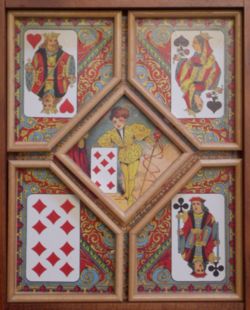
playing this game, one takes five cards, namely the king of hearts, the queen of
spades, the jack of clubs, the ten of diamonds, and the seven of diamonds that
we have said is the dwarf, being the lowest card. These cards are placed
on the table in a layout, and they remain there for as long as the round lasts,
which is set at ten or twelve turns, as desired.
This
game is played with a full deck of fifty-two cards. Whoever deals puts on
the layout fifteen chips distributed in this way: one
on the ten, two on the jack, three on the queen, four on the king, and five on
the dwarf; they then deal each player nine cards, if there are five players,
or fifteen cards, if there are only three, so that seven always
remain in the stock.
Once the
cards have been dealt, the first to play leads as in comète,
one, two, three, etc., skipping the four if they do not hold it; if one of the
five players has the four of that suit, they must play it, otherwise the first player calls hoc as
at comète, and takes back whichever card they wish, and so on, for
each player, who always calls hoc whenever the card following
their own, always in the same suit, is not supplied.
It
should be noted that when one of the layout cards is played, whatever
is upon it is collected, and that card always calls hoc — queen, jack, or ten; for the
king, by its nature, calls hoc as at comète, and the seven of diamonds
which is the dwarf, has the privilege, as the comète card once did, of standing in for
all the missing cards, and of calling hoc anywhere.
The
last [meaning: the first] player who has no cards left makes the others pay, as
we have said, for what remains in their hands; and when the dwarf is
left over, whoever holds it in hand pays double everything
that remains in their hand; when some of the other layout cards remain
in hand, a bête is made from what is upon it, over and above
the payment for the cards, and the bête is sometimes quite considerable;
an opéra is paid double and whoever holds the dwarf consequently pays quadruple. This
game, as one can see, involves a great deal of action and has its difficulties."
I.
Rules of the game of the Yellow Dwarf (1760 version)
The
Yellow Dwarf is a hoc game.
The first player to get rid of all their cards is the winner.
To learn how to use the cards called "hoc,"
see the corresponding chapter on
hoc games.
1. Number
of players : 3 or 5.
2. Deck
of cards : a complete deck of 52 cards.
3. Game board :
5 differently decorated boxes bearing the king of hearts,
the queen of spades, the jack of clubs, the ten of diamonds, and
the seven of diamonds called the dwarf.
4. Fine
cards : these are the 5 cards represented on the board.
5. Complete
sequences :
5.1. a
sequence in hearts, a sequence in spades, a sequence in diamonds
and another in clubs.
5.2. order
of the cards within each sequence : ace, 2, 3, 4, 5, 6, 7, 8, 9, 10, jack, queen,
king.
6. Hocs :
6.1. permanent
hocs : the queen of spades, the jack of clubs, and the ten of diamonds.
6.2. main
hoc : the seven of diamonds.
6.3. end-of-sequence
hocs : the kings.
7. Deal :
the dealer deals to the right, one at a time, 15 cards to the three players,
or 9 cards to five players.
8. Stock : after the deal,
a stock of 7 face-down cards remains, which is not used during
play. Through their absence from the players' hands, these stock cards generate
accidental hocs, and can also randomly remove
a certain number of the other three types of hocs from play.
9. Stakes :
9.1. only
the dealer puts 15 chips on the board (a game is therefore played over a
number of complete rounds fixed in advance, commonly 10 or 12)
9.2. distribution
of the 15 chips : 1 on the ten of diamonds, 2 on the jack of clubs,
3 on the queen of spades, 4 on the king of hearts and 5 on the seven of diamonds.
10.
Payments :
10.1. During play :
10.1.1. hocs : each time a player plays a hoc and announces it, they
receive 1 chip from each of the other players.
10.1.2. fine cards : when a player plays a fine card, they take
the contents of the corresponding box.
10.2. At
the end of the game :
10.2.1. card values : each card is worth a number of points equal
to its printed value, face cards are worth 10 points and the ace 1
point.
10.2.2. the player who is first to get rid of all their cards
is paid by each of the other players a number of chips equal to the
total point value of the cards remaining in their hands.
10.2.3. if this occurs, they receive from whoever still holds
the seven of diamonds in hand double the number of chips specified in the previous article.
10.2.4. if they have gotten rid of all their cards without any of the
other players managing to play even one — this is called making
opéra — the losers then pay double what
is specified in the two preceding articles.
10.2.5.
for each fine card they still hold in hand, a losing player must put into the
corresponding box as many chips as it already contains —
this is called making the bête.
II.
Rules of the game of Lindor (1792) : the version of the Yellow Dwarf
in use today)
Jacques
Lacombe published these rules in 1792 in his Dictionary of Games,
published by Panckoucke, in Paris, in an article entitled
Lindor or Yellow Dwarf.
The
articles below indicate only the differences between the 1760
version and the 1792 version. Articles not listed are common to both games.
1. Number
of players : 3, 4, 5, 6, 7 or 8.
5. Complete
sequence :
5.1. a
sequence of cards that is not necessarily of the same suit.
6. Hocs :
6.1. permanent
hocs : none.
6.2. main
hoc : none
7. Deal :
the dealer deals to the right, one at a time, 15 cards to three players,
12 to four players, 9 to five players, 8 to six players, 7 to seven players,
or 6 to 8 players.
8. Stock : after the deal, a stock
of 7 cards remains with three or five players, 4 cards with four,
six or eight players and 3 cards with seven players.
9. Stakes :
9.1. all
the players put 15 chips on the board.
10. Payments :
10.1. during play :
10.1.1. hocs :
none.
10.2. at the end of the game :
10.2.3. holding the seven of diamonds in hand does not require the
winner to be paid double.
10.2.4. in the case of an opéra, the losers do not pay the winner
double the points in their hands ; however, the winner takes the contents
of all the boxes on the board.
 This page is a translated archive of the original Académie des jeux oubliés, created on July 1, 2026, from the French original at salondesjeux.fr.