This page is a translated archive of the original Académie des jeux oubliés, created on July 1, 2026, from the French original at salondesjeux.fr.
|
This page is a translated archive of the original Académie des jeux oubliés, created on July 1, 2026, from the French original at salondesjeux.fr.
|
The Hoc Mazarin
The Hoc Mazarin is a card game presumed to have been invented by Cardinal Mazarin. Several mazarinades during the Fronde mention it, and in one, entitled La Troisième Lettre du chevalier Georges à monsieur le Prince, the author declares, speaking of the cardinal: “ [...] and the only statue that will remain of him in France will be the jack of diamonds in the Hoc mazarin” — this card is one of the most important in the game. It belongs to the family of hoc games but is played in two stages: the first consists of three bidding phases, on three types of combinations borrowed from the game of Piquet, the second is the hoc-style trick-taking game proper.
With two players, each receives 15 cards, and with three players only 12.
The descending order of the cards is as follows: king, queen, jack, 10, 9, 8, 7, 6, 5, 4, 3, 2, ace.
2.
Deal
The dealer thus designated shuffles the cards, has them cut by the player seated to his left, and deals clockwise 15 or 12 cards to each player depending on the number of players, one at a time.
The remaining cards will neither be used nor may they be consulted by the players.
The player seated to the dealer's right is called the eldest hand. He is the first to speak during the bidding phases, and the first to play in the card game. Players speak and play in turn in a counter-clockwise direction.
At
the start of the game, each player receives a set of 20 chips and
8 tokens. Each token being worth 10 chips, the players' stake is equivalent
to 100 chips. This stake may be adjusted as desired. First stage: bidding
The first stage takes place in three phases in which the players bid successively on three chances, namely the point, the sequence and the tricon. It ends with the declaration of blank hands.
After presenting the various chances, we will discuss the stakes, the bidding, the double game, the different payments related to the chances, and blank hands.
3.1
Th
The point is the greatest number of cards of the same suit (spades, hearts, diamonds or clubs) held in a player's hand. A player declares the number of cards without specifying the suit — for example, one would say “6 cards”. If several players have thus made the same highest declaration, they are separated by the value of the point, which is the sum of the values of each of the cards that make it up; face cards count 10 points and other cards their numerical value, the ace being worth only one point. For example: jack, eight, seven and ace of spades form a point of 4 cards worth 26 points; the player now declares “26”. It is important to note that the number of cards in the point takes precedence over its value. If, now, several players have points with the same number of cards and the same value, the winner is determined by precedence: it is the eldest hand who wins, or failing that, the second.
3.2 The sequence
The sequence is a run of 3, 4 or 5 cards of the same suit, called respectively a tierce, a quatrième and a quinte. A run of 2 cards is worth nothing, and one of more than 5 cards is worth no more than a quinte. A player may have several sequences in hand, but he declares only the strongest, the quinte being higher than the quatrième, which is higher than the tierce. The sequence is declared by its name, “quinte”, “quatrième”, or “tierce”. If several players have made the same declaration, they are separated by the height of the sequence, which is determined by the highest card that makes it up — for example, a tierce made up of a 10, a jack and a queen of spades is said to be “to the queen” when one is required to specify its height. A sequence to the king is called “major”, another beginning with an ace is called “minor”. If, now, several players are still tied, the winner is determined by precedence: it is the eldest hand who wins, or failing that, the second.
3.3 The tricon
The tricon is a set of 3 or 4 cards of the same rank (3 or 4 queens, 3 or 4 aces, etc.). The tricon of 3 cards is today called a brelan, while that of 4 cards, formerly called a fredon in the game of Ambigu, is called a carré (square). The tricon may be declared — using the current names — by its name “carré” , or “brelan” depending on whether it is made of 4 cards or 3 cards. A player may have several tricons in hand, but he declares only the strongest, the carré being higher than the brelan. If several players have made the same declaration, they are separated by the height of the tricon, which is determined by the rank of the cards that make it up — for example, a carré made up of four jacks is said to be “of jacks” when one is required to specify its height. A tricon of kings is said to be “major”, a tricon of aces is described as “minor”. The particular nature of the tricon means that its height is the last criterion for separating players, and precedence does not come into play. 4. Initial stake
Before
the first hand — a hand begins with the deal and ends
before the next deal —, each player puts on the table 3 chips, one
for the point, the second for the sequence and the last
for the tricon. 5. Bidding
Bidding takes place independently on each of the three chances, beginning with the point, continuing with the sequence and finishing with the tricon. It proceeds in the same way for the three chances. 5.1 How bidding proceeds
The first to speak, who is the eldest hand, has three options: declare, raise or pass.
—
declare: the player declares his hand regarding the chance
being played. This closes off bidding, and the other players in
turn to the right must also make their declaration. If a player
has a hand lower than that declared by at least one
of his predecessors, he declares nothing but simply announces
“that's fine”. The winner
is the one determined as explained in chapter 3.
— raise: the player adds one or more chips to the pot (this or these extra chips make up a raise)
— pass: the player passes the turn to his neighbor to the right, who then finds himself with the same three options as the first player. If all players pass, no one wins for the current chance, and the chips in the pool reserved for it remain for the next hand. Play proceeds to the next phase.
If a player has opened the bidding by raising on the initial stake, those following in turn have three options: call, raise, or pass.
— call: the player puts into the pot as many chips as whoever put in the most before him.
— raise: the player calls by matching the last raise, and again adds one or more chips.
— pass: the player abandons the hand for the current chance.
It is not permitted to raise on oneself, that is to say that after a player's raise, if none of the following players wants to do the same, the bidding phase ends. When the bidding phase has ended, two cases may arise:
— only one player remains in the hand, no other having called his last raise: he is the winner but is not obliged to show his hand (although in the sequence and the tricon, it is preferable for him to do so in order to collect the payments detailed in chapters 7.2 and 7.3);
— several players remain in the hand: these players, starting with the eldest hand or, failing that, the second, declare their hand corresponding to the current chance, and the winner, who must show his hand, is determined according to the criteria defined for that chance in chapter 3.
The amount of raises is limited to a maximum number of chips set at 20. When it is a player's turn to speak, he can therefore not raise by more than 20 chips over the last stake. 5.2 Passing, its consequences, effect on precedence
Note that passing does not have the same consequence before the bidding has been opened by a raise and after. In the first case, if at least one of the following players raises, the one who has passed can return to the hand by calling or even by raising; in the latter case, the player abandons the bidding and loses any chips he may have put into the pot.
When the eldest hand passes, he yields the floor to the second, who may do the same with the possible third player. It then seems normal, in the case of the declarations being forced by the second or third player, that precedence in the event of a tie should not be given to the eldest hand but to whoever initiates the declarations, his predecessor(s) having in fact yielded him the privilege. 6.
Following stakes
If all players have passed on a chance, the corresponding stake remains in play, and each player again adds three chips to the pool on the next hand. Play will be double during the bidding for the chance that was not played previously. It is best to form three pools, one for each chance — each of the three pools initially contains three chips for three players; on the next hand the pool corresponding to the chance not played will contain six and the two others still three; for these last two the play will be single, and for the first it will be double.
The old rules do not provide for a triple or quadruple game. This may be due to the already low probability of encountering a double game, and therefore to the even more improbable one of moving on to a triple game. To be more thorough, it seems to me a good idea to extend the rule by allowing a triple game after a double game in the case where, for a second consecutive time, the same chance has not been played. 7. Payments to the winner of the bidding
The winner's payments depend on the type of chance played, as well as on whether the game is single or double. 7.1 The point, the sequence and the tricon
For each of the three chances:
— if the game is single, the winner takes the chips from the corresponding pool, and all those that were put into play during the bidding;
— if the game is double, the winner does the same.
In the case of the point, there is no other payment, unlike the sequence or the tricon. 7.2 The sequence
In addition to the payment provided for in chapter 7.1, the winner is paid by each of the other players, even if they have abandoned the bidding, a number of chips depending on the type of sequence he shows, and on whether the game is single or double.
If the winner does not want to show his hand — which is only possible when he remained alone in the hand, and therefore was not required to declare his hand —, he is paid only what is provided for in chapter 7.1. Two reasons may lead such a player not to show his hand: either he has no sequence, or he does not want to reveal too much of his hand for the tricon phase and the card game.
If the winner shows his hand — forced because he declared it, or voluntarily as the only one remaining in the hand —, he has the option of claiming, as payment, in addition to the announced sequence, by showing them, all lower ones that he holds in his hand. Any sequence higher than the one declared is worth nothing.
Table of sequence payments :
7.3 The tricon
In addition to the payment provided for in chapter 7.1, the winner is paid by each of the other players, even if they have abandoned the bidding, a number of chips depending on the type of tricon he shows, and on whether the game is single or double.
If the winner does not want to show his hand — which is only possible when he remained alone in the hand, and therefore was not required to declare his hand —, he is paid only what is provided for in chapter 7.1. One reason may lead such a player not to show his hand: either he has no tricon, or he does not want to reveal too much of his hand for the card game.
If the winner shows his hand — forced because he declared it, or voluntarily as the only one remaining in the hand —, he has the option of claiming, as payment, in addition to the announced tricon, by showing them, all lower ones that he holds in his hand. Any tricon higher than the one declared is worth nothing.
Table of tricon payments :
7.4 Special case of bluffing
A case may arise where, several players having called, there turns out to be nothing of value at the moment of declaring. This can happen in the case of a bluff in the sequence phase or more often in the tricon phase, players having raised and/or called without having a sequence or a tricon. The winner is then determined by precedence, and he is paid only what is provided for in chapter 7.1. 8. End of the first stage: blank hands
Once
the three chances have been dealt with, if a player has
no face card (king, queen, jack) in hand, he may declare it by saying “ blank
hand”. If he is the only one to declare a blank
hand, he shows it and each of the other players gives him 10 chips.
However, if two players were to declare a blank hand, they would have to
show them but would not be paid for it. Second stage: the card game 9. The hoc game
The card game is of the hoc game type, however the first stage may have given each player important information about the contents of the others' hands. 9.1 The principle
The goal is to be the first to get rid of all one's cards. To do this, the eldest hand places a card of his choice in the middle of the table, which he must, if possible, immediately cover with another of the next higher rank, regardless of suit. He continues to stack cards in the same way, face up, until he no longer has a card of the immediately higher rank — for example, he plays a 6, then a 7, but not having an 8, he does not have the option of continuing the sequence and must announce “7 without 8”, and the player to his right, if he has an 8, may continue by playing it, but if he does not have one he will pass his turn by declaring “without 8”, leaving the lead to the possible third player, who will act in the same way. If no one can play, whoever played the last card starts a new sequence with the card of his choice, placing it on the pile of cards and saying “hoc!”. Play continues in this way until a player has no more cards in hand.
It is mandatory to play if one is able to. If a player announces that he lacks a card when he actually has it in hand, he must pay a penalty of 5 chips to each of the other players if they notice it.
This last rule does not, however, apply to a type of card, called a hoc, whose use is presented in the following chapter. 9.2 Hocs and their payment
The last card of a sequence that cannot be covered is called a hoc. This hoc, which is the result of the absence, in the players' hands, of the next card, is called accidental.
In addition to the accidental hocs, there are 6 so-called principal hocs. These are the 4 kings, the queen of spades, and the jack of diamonds. The holder of a principal hoc is not required to play it for the card it represents — for example, a player who plays the jack of spades, then the queen of clubs, may announce “queen without king” even if he has one in hand. This way of playing makes it possible to save a principal hoc and possibly force an opponent to spend another. The principal hocs therefore have no fixed rank.
Whether it is accidental or principal, a hoc allows whoever played it to start a new sequence, beginning with the card that seems most advantageous to him. It also allows him to obtain a payment from the other players.
When a player has played a hoc, accidental or principal, he must announce it clearly by saying “hoc!”, thereby requiring the other players to give him a chip. For an accidental hoc, the announcement is made at the moment of starting a new sequence. 9.3 Payment to the winner of the card game
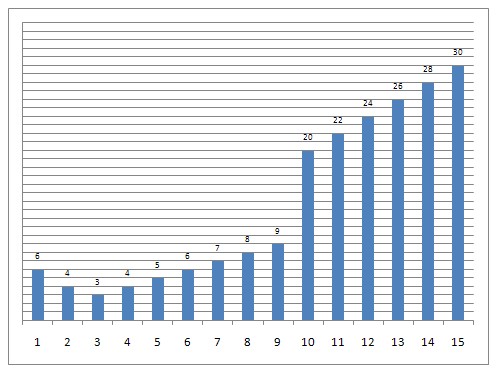
As soon as a player has gotten rid of all his cards, play stops and the others each give him a number of chips depending on the number of cards remaining in their hand: for 1 card in hand, they pay 6 chips; for 2 cards in hand, 4 chips; for 3 to 9 cards in hand, 1 chip per card; for 10 cards or more, 2 chips per card.
The table below summarizes the number of chips to be paid based on the number of cards in hand.
Attention should be paid to the drop from 10 cards to 9 cards, which causes a fall of 11 in the number of chips owed for a single card of difference. It is also preferable to lose with 3 cards than with fewer. Knowing this table is important for trying to optimize one's gains or minimize one's losses. It seems necessary to make it mandatory for each player to keep the back of his hand visible to the others so that everyone can play in a more tactical way.
References
Louis de la Marinière, La Maison academique, chez Robert de Nain et Marin Leché, Paris, 1654
Académie universelle des jeux, Legras, Paris, 1730
Le Salon des jeux - Académie des jeux oubliés

|