In every basic atom, there is a nucleus, which is made up of protons and neutrons. Along with this, there are orbitals which consist of electrons. Atoms have something called electronegativity, which is the measure of affinity an atom has for another. If one element has a greater electronegativity than another when they are bonded, that element will have a greater magnetic pull. This will cause the electrons to orbit around the atom with the larger scale of electronegativity. Electrons have a negative charge. With a negative charge on one side of the molecule and a positive charge on the other side, the atom becomes polar. That is, there is both a positive and a negative end.
Polar molecules can dissolve other polar molecules because they both have compatible ends that "stick" to each other (the negative end attracts that positive end while the positive end attracts the negative end). However, polar molecules cannot dissolve non-polar molecules. An example of this is water and oil. As a common observation, water almost repels oil. Water is polar and oil is non-polar.
If molecules only dissolve other molecules with compatible charges, then how can you wash oil away with water? The answer is, use soap. Soap has a remarkable ability to attract both water and dirt, grime or oil at the same time. In order to understand why this happens, you first have to become familiar with the soap molecule. Soap is technically defined as a water-soluble alkali salt or fatty acid. Soap is the bi-product of the reaction of fatty acids and an alkali base. The fatty acids generally come from tallow or oils, while the alkali base is sodium hydroxide. Sodium hydroxide is also known as lye. This alkali base is used for hard soaps, but is replaced by potassium hydroxide or "potash" for soft soaps.
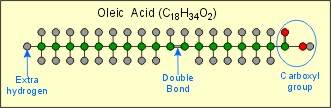
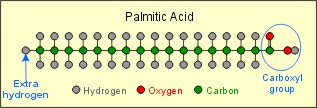
With knowing what reacts to produce soap molecules, it is now important to understand the chemistry involved in the both individual components: Fatty acids, and the alkali base. A fatty acid is constructed by a long chain of hydrogen and carbon atoms,. The carbon is in a sense the "back bone"of the chain and the hydrogen are then bonded to the carbon. The chain almost resembles a centipede with the carbon as the body and hydrogen as the legs. On this fatty acid is an extra hydrogen at one end; the head of the centipede, and at the tail is something called a "carboxyl group." This group is made up of two oxygen, one hydrogen and one carbon atom.
H
|
H--C--H
|
H
O
/ \
H H
An unsaturated fatty acid has one or more double bonds. This means that a carbon atom is bonded to another carbon atom. They together share two sets of electrons as opposed to being bonded to hydrogen atoms. An unsaturated fatty acid is also known as an Oleic acid. (C18H34O2)