
Lancelot and Dante
The Divine Comedy and Lancelot were both products of the medieval period. Yet, Dante and Chrétien de Troyes wrote in two very different styles. Lancelot was written in a common medieval style, with knights and castles and maidens fair. The Divine Comedy was written in quite a different style, taken from Virgil's style and that of the classical poets. Yet the two medieval works do have a few things in common. The most outstanding would be the presence of courtly love.
Courtly Love was a code of behavior that defined the relationship between aristocratic lovers in Western Europe during the Middle Ages. The theme of courtly love was developed in Dante's Divine Comedy and the sonnets of the Italian poet Petrarch. Literature in the courtly love tradition includes such works as Lancelot, by Chrétien de Troyes. Influenced by contemporary chivalric ideals and feudalism, courtly love required adherence to certain rules elaborated in the songs of the troubadours between the 11th and the 13th centuries.
According to these conventions, a nobleman, usually a knight, in love with a married woman of equally high birth-or, often, higher rank-had to prove his devotion by heroic deeds and by amorous writings presented anonymously to his beloved. Once the lovers had pledged themselves to each other and consummated their passion, complete secrecy had to be maintained. Because most noble marriages in the Middle Ages were little more than business contracts, courtly love was a form of sanctioned adultery, sanctioned because it threatened neither the contract nor the religious sacrament of marriage. In fact, faithlessness of the lovers toward each other was considered more sinful than the adultery of this extramarital relationship.
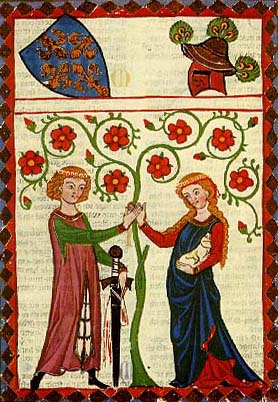
In the Divine Comedy there are many references to Lancelot and his story. This link provides a picture by William Blake that refers to Canto V of the Inferno, which we looked at in class.
http://www.bc.edu/bc_org/avp/cas/ashp/blake_inferno5-6.htm
The romance of `Lancelot of the Lake,' where Lancelot became enamored with Queen Guinevere at the court of King Arthur, was a favorite one in Dante's time. As mentioned before, Dante was strongly influenced by the beautiful romance, with its idea of courtly love. In the Inferno, Canto V line 137, Dante mentions Gallehault, a knight who was intimate with Lancelot, and was the intermediary that brought Lancelot and Guinevere together. Gallehault arranged a secret meeting between him and Guinevere, and in the course of this urged the queen to give Lancelot a kiss, which was the commencement of their guilty love. Gallehault was a model prince and knight, type of the faithful friend and discreet helper in love.
In the Second Circle of Hell where the lustful are, Dante meets Francesca and her brother-in-law Paolo, who tell a tale of love and death. Dante wonders what it was that brought to an end the long sweet conflict and uncertainty of their `dubious desires'. Francesca, weeping bitterly at the memory of the happy day, tells him it was the reading together of the medieval Romance of Lancelot and Guinevere. One day she and Paolo were reading Lancelot and how love had overcame him. They were alone and suspected nothing that the future held. Many times the reading made their eyes meet. The reading changed the color of their faces, and finally defeated them. When they read of Lancelot being kissed by such a noble lover, Paolo trembling, kissed Francesca. Paolo and Francesca's romance itself had been their Gallehault, the pander that led them to the fatal sin. It was Dante's judgment concerning the evil influence of the romances of love so popular in his day, and his warning to the writers of them: their guilt is greater and will set them in a much lower Circle.
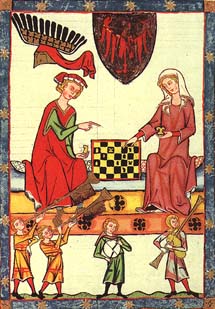
A second reference to Lancelot is in the Inferno, Canto XXXII line 61. Modred was the son of King Arthur. He tried to kill his father treacherously, but was discovered and slain by him. According to the romance of Lancelot of the Lake, the wound inflicted by Arthur's sword was so wide that the sunlight appeared through it.
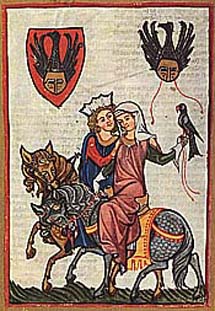
Moving on to Paradise, the Lancelot story is again mentioned in Canto XVI lines 13-15. Dante says that Beatrice seemed like the woman who had coughed at Guinevere's first fault. Dante is referring to the Lady of Malehault; Guinevere's lady- in waiting in the story of Lancelot of the Lake, who coughed when she first perceived the familiarity between her and Lancelot. This Lady of Malehaut was in love with Sir Lancelot. When she saw the Queen give him the first kiss, she coughed to let them know she was aware.
Additional Images of Courtly Love: http://www.multimedia.calpoly.edu/libarts/dschwart/engl513/courtly/images.htm