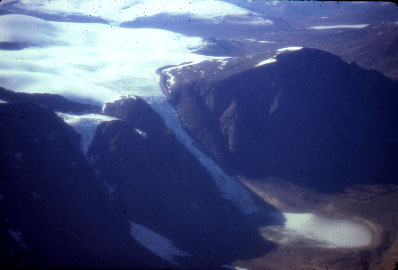
Compound Glacier: These glaciers are formed when two or more glaciers flowing down different valleys join each other and make one glacier.
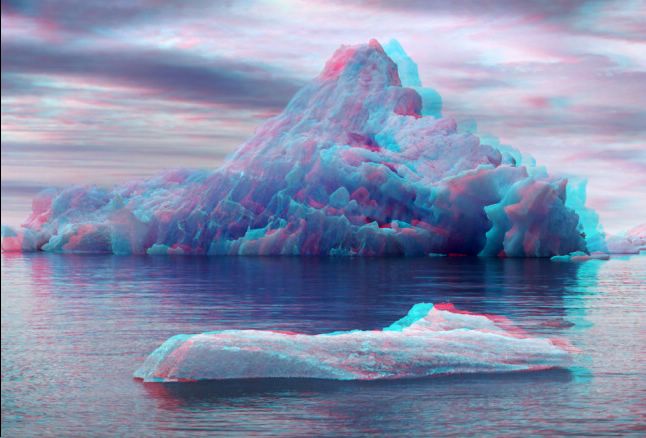
Ice Bergs: Large masses of ice can break away from the lower end of a land glacier and fall into the sea or a lake.
Ice Cap: An ice cap is a permanent glacier over an area that slopes down on all sides from the center. Icecaps are formed when snow and ice fill a basin. Icecaps are less than 50,000 square kilometers in size. An example is the upper part of Mount Wrangell in Alaska. One of the biggest Ice caps is in Greenland, which covers 1,833,900 square km, which is equivalent to 85 percent of Greenland�s total area.
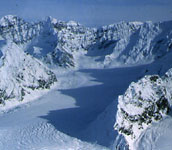
Ice Field: Ice fields are places where large valley glaciers run into each other and the mountain tops stick through the ice. The Stikine Icefield is northeast of Petersburg, Alaska.
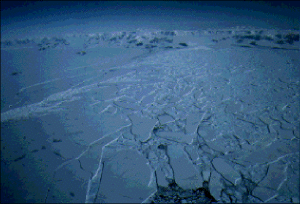
Ice Sheet: Very thick glacier ice that covers a large area is called an ice sheet. They have to be bigger than 50,000 square kilometers in size. Antarctica and Greenland have ice sheets today.
Piedmont Glacier: When an ice stream from a mountainous area flows onto flat land it may spread out into a broad sheet called a piedmont glacier. It is also called a "foot of the mountain" glacier because it looks like a wide, flat boot.
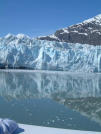
Tidewater Glacier: When a glacier reaches the ocean huge pieces of ice fall off into the water with a hiss and a crash. The broken chunks are called Ice Bergs. After they break away from the lower end of the glacier they float off. Only a little bit of the ice berg shows above the water. The biggest part of the ice berg is hidden under the water.
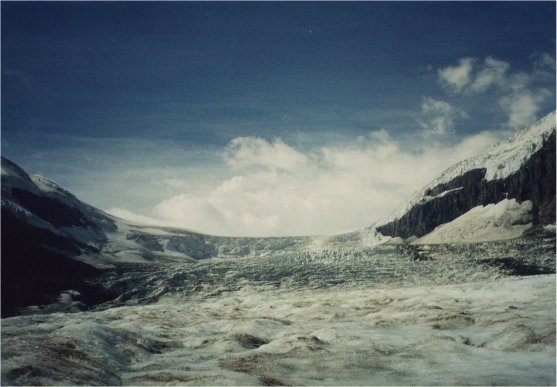
Valley Glacier: A glacier that starts from snow that collects in a high basin and then flows down a mountain valley is called a valley glacier. Muldrow and Kahiltna valley glaciers are in the Denali National Park area, which is located in Alaska.
Global warming is affecting all these glaciers because the glaciers are beginning to melt, which can cause water levels to increase up to 1.8 millimeters per year or more. This is bad because towns that are surrounded by glaciers could eventually become flooded killing many if this global warming continues to increase.