 |
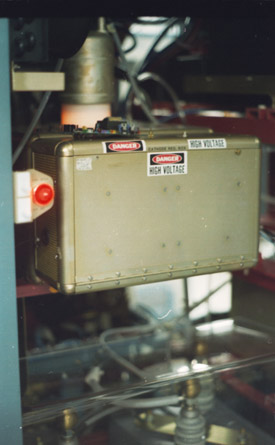
| Cathode Supply Regulator |
| Our chief engineer, Gunnar Wik, unified my efforts with the work of others by putting 4CW 30,000 tetrodes into all of our designs. Gunnar knew unprofitable lines get spun off and key people quit. Lackluster production volume might eventually threaten availability of tubes our customers would continually need. By channeling all our needs through the single production group, he most likely perpetuated that group. At one time, I think I counted over a hundred 4CW-30,000 sockets and tubes, all purchased in one bulk order. A steady stream of business should follow. With ongoing production lucrative, key people will stay on. We'd done it for the 4CW 10,000; having installed thousands of sockets worldwide. This was our next-generation offering, a quantum leap of sorts. Twenty and thirty Kilowatt outputs suddenly looked quaint. I was to regulate a Megawatt in five places and 250 KW in 15 places. I'd be dissipating 60 KW in six places and 25 KW in 15 places. My cohort Wade would be delivering a line of 18 pulsers, each capable of 20 KV, 40 Amps peak, high duty. Customers across the board wanted more--more current, more voltage, less ripple, the list went on. |
| The 4CW 30,000 had the most to offer. But the high gain grid geometry was a double edged sword: we could control much more power with little more input swing. But when it came to oscillation, nothing could prepare us for what we'd face. |
| Chuck liked putting pure resistances in series with grid leads, to keep tubes from oscillating. This worked because the miller effect rolled-off gain well above line frequency; and well below resonant frequencies of parasitic circuit elements. Abruptly, systems became physically large. Parasitic resonances fell squarely where error amps needed to have gain (in order to regulate). Power level, ringing, and gain skyrocketed simultaneously. Add to that a pulsed load. Nor could we use big capacitors. Cober, our competition, tended toward choosing huge capacitor-banks as opposed to responsive regulators. We choose to regulate with agility. It's nicer because you don't have the stored energy on board--capacitors are scary. Crowbars last longer. It costs less. Lighter, cleaner, and sleeker, you get a naturally soft supply. But if you had capacitors, you'd be done now. Smarter is harder. |
| Wendel Boucher was the feedback-loop analyst on this job. He provided excellent services. I provided system integrity. He took data and made the regulator board. We had to float the network analyzer at 20 KV sometimes. He's pretty tough. Those regulators came out nice. Good work Wendel! |
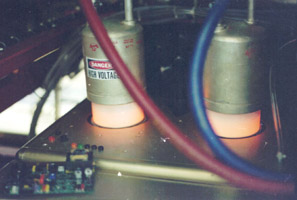 |
| This box is essentially a 60KW power zener. Rated zero to negative twenty KV, its for an electrode called the collector. Some electrodes "source" current to you. Negativity emerges from a collector lead. We can let it float up somewhat, reducing collector electrode power dissipation. |
| My cohort Wade had two tubes like these on each of his switchboxes. He was having trouble beating his pulse-to-pulse ripple spec. So I whipped up a little DC supply for his heaters. Wade's a proud guy. Asking for help must have been hard for him. I'd been harrassing him for not having DC-heaters to begin with. His spec called out "a water-cooled oil tank for the switch-tube fillament rectifiers." Gunnar duped him into trying to "get by" with AC-heaters anyway. Smitten for at least six months by that gag, maybe he hoped his call for help would fall on deaf ears. I say this because he didn't seem to like what he saw the next morning. He wheeled it straight into the junk room. Finally he did come around though. It was a monstrosity: sporting hockey-puck diodes and the whole works; producing 10 VDC at 280 Amps. |
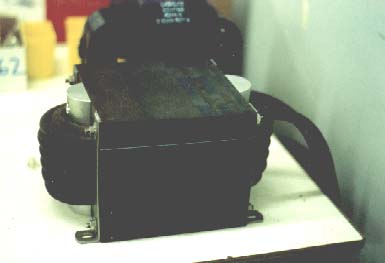 |
| I looked at the cross-sectional area of Wade's fillament transformer core. And I gave the center-leg of the choke core equal cross-sectional area. Diesel cable made winding it a snap. I tinkered with the gap a bit and got the capacitor ripple-current down to 25 amps. I also had to add an extra wrap to the 300 Amp secondary of the fillament isolation transformer, thus compensating for rectifier losses. |
| I imposed transmitter construction guidlines. ETM upholds Marten Marietta standards. |
| Wendel did this reg-board too |
| Cheap Knockoff |