 |
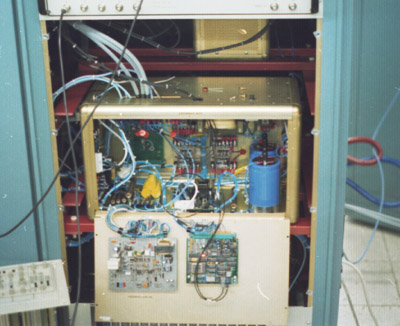
| This is my rendition of a repetitive-firing crowbar. The trigger-pulse generator puts out 400V capacitive-discharge pulses, 4 microseconds wide at the base, 3 microfarads total, at 1 KHZ, for a half second, with each firing. Chuck's ignitron alternative uses a big capacitor feeding a "holding anode" through a resistor; for a discharge beginning at 20 Amps and lasting about a second. Cober, our competition, uses repetitive firing with ignitrons. The Navy uses the Microwave Products 7512 triggered-vacuum-gap in the Aegis fleet. It features triggering by hydrogen-plasmoid-injection. The trigger electrode looks like a metal-film resistor with a groove cut around the center. A titanium hydride mandrel blows hydrogen-plasma outward-radially around the groove, driven by high voltage trigger pulses. After each, getter-pumping sucks residual hydrogen back into the titanium hydride mandrel by affinity. On SN 804, trigger electrode breakdown voltage peaked at 1,500 V. A year later, it had stabilized at around 1,300 volts. We've just hit the ten-year point. Another check should be made out of curiosity, for plotting trigger breakdown voltage over time. My pulse transformer secondary has an open-circuit voltage of about 12KV, with a short-circuit current of 40 amps. I like to use the same trigger polarity as that of the opposite electrode (reducing any tendency for the main discharge to initiate across to the ignitor, as it appears this is a failure mode). The old GE gaps fired easily in all four quadrants of operation. The MPD gaps "like" having a negative baseplate. Usable range is from a couple hundred volts to over the rated 55KV. Leroy Karthman of MPD touts 70KV indefinite holdoff. After ordering, I found an old GE specification saying the 7512 was to be run at a maximum of 45KV. These are the things that make us sweat. Our tube runs at 47 KV, for a total of 48 KV inboard the output resistor. EG&G makes pin-for-pin compatible models with ratings ranging upwards of 100KV. So the design is scalable. But in tinkering with an EG&G gap, I could swear the trigger-pin breakover voltage steadily increased with use. This is indicative of internal ignitor erosion and limited life. The EG&G rep used the term scintilation to describe emergence of plasma from within the EG&G trigger element, composed of graphite. The EG&G design also contains mercury. Spurrious firing is somehow avoided. Ignitrons appear poised for nearly indefinite lifespan. Triggering is done by a tungsten ignitor that pokes the mercury-puddle cathode. Positive ions, given sufficient mean-free-path, pick up enough kinetic energy in a discharge to pack a wallop on impact: typically vaporizing cathode material. Mercury puddle cathodes recover from being vaporized quite nicely. This is a good argument for using ignitrons. The argument against is that high-pressure mercury vapor is an insulator. If you are in the middle of a sustained discharge and current suddenly becomes discontinuous, restrike will be unlikely, no-matter what's done. A good example of this is given by the high-intensity-discharge mercury-vapor lamp: cool-down preceeds restrike. Lawrence Livermore engineers series-up ignitrons for big jobs. They only accept ignitrons that "tick" on a hipotter. If a seriesed NE-51 neon-lamp glows continuously, the ignitron is rejected. In use, Lawrence limits operating voltage to 17.5 KV. Richard Ziskowski, at Litton Electron Devices, uses a single Richardson 50-KV ignitron for 45KV. It's probably a nussance whenever cosmic-radiation flares up. For Group-14, ambient barnyard-appeal means anything goes. And anything is better than the old open-air triggered-gap they had before. That thing'd scare the dickens out of you; always firing when least expected: the LOUD report finished with a zing. |
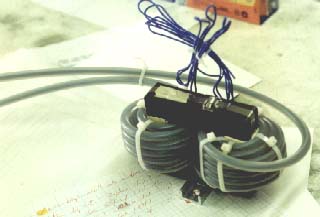 |
| I whipped this up in a pinch. 100KV secondary wire gives it plenty of isolation. It sits under oil and drives the triggered vacuum gap. |
| My repetitive Firing Crowbar Box |
| My chosen quadrant of operation vanished when GE spun-off the triggered vacuum-gap line to Microwave Products (MPD). Edgerton suggests in Vacuum Arcs, it hadn't actually vanished: it was just the hardest of the four modes to trigger. Using an "easy" mode meant giving the ground-referenced baseplate 100KV isolation (because the raw supply can fly up to 95KV no load). So I found a big ferrite core, some nomex, and some oil-compatible high-voltage wire. I used two-turn ribbon-type primaries on both legs of the core, driving them in paralell. The secondary on this baby kicks out a whopping 400 volts per turn! The core material is 3C8. I used a little 100 Ohm resistor-board, in series with the ignitor. It was made of 10 ea., 10 Ohm, 1 Watt, Allen and Bradley, carbon-comp resistors. I tried using Carborundum brand resistors made for oil-duty (free samples). They degraded upward in resistance until open. No new contender appears ready to fill the void left by Allen & Bradley's departure from resistor production. But there seems to be another lesson here too. I should have been suspicious when Dixie Sincovich of Carborundum Corp. stared blankly into space and recited: "resistance values decrease markedly with imersion in oil." I should have asked defiantly: "HOW?" The resistor in question had an incredible energy-withstand rating. I seem to recall it was on the order of 1,200 Joules. Putting it in oil evidently piggybacks a low resistance paralell phantom resistance onto the structure of the device. The devil's advocate would ask how many joules the phantom resistance will withstand. If typical, the vendor will say "what phantom resistance?" My oil does it. How could they know what it does? As usual, I was on my own. Having unwittingly characterized the phantom resistor, I offer this: at some current-density threshold, carbon atoms shared by the oil and the resistor choose the stronger bond. They appear to blow-free of the resistor, clearing like molecular fuses. Resembling electric discharge machining (EDM), resulting errosion likely also contaminates the oil with carbon and arc byproducts such as acetylene and hydrogen. Nobody, it appears, thought these implications through. It's an example of how high the bar is set in this field. Due-dilligence was redefined by a single resistor, which in failing, made a long and agonizing mockery of me. Finally I did exorcize it. |
| Having dabbled in more than my share of tanks, I'd rather have advance warning of when there's trouble brewing. Left to fester, salvage-value dwindles. Offering new promise, this marketable phenomena is just-now being packaged into sensors: |

|
| It's a tankless job. --Jake Thampan (tankless, I must've looked forlorn) |