 |
| Chuck Hayse called me in for a meeting. He had two runs of units he wanted built for Naval Surface Warfare Center, in Crane Indiana. I pointed out that he had people who'd perfected modules similar to those needed. He wasn't interested in delegating this thing out. He asked me to head it up. Jake Thampan would be at my disposal. The future of the company was at stake. Our industry was in decline. Chuck wanted to launch a satellite-uplink line with the proceeds. I was honored. So I accepted and got down to business. |
| Initial euphora vanished when I read the specification. At least ten requirements bordered the impossible. It was the wish-list from hell. These guys shopped around until they found the best contender in each field. They pasted all the boasts and exagerated claims into one specification. I, an impostor, was facing a 500 picosecond pulse-to-pulse jitter spec plucked from a pulsed-laser-driver data-sheet. A 5 millivolt RMS pulse-top ripple-specification echoed that of a 3KV Hewlett Packard DC power supply. But this was a 3KV pulse. Proving compliance looked harder than implementing industry-wide best practices. And the spec put the burden of proof on us. The compilation was an inch thick and relentless. ETM's tradition was to throw "any old thing" in there, to then address complaints piecemeal. It had worked with desperate customers at the dawning of the age. But this was the end of that era. All identified buffoonery was being shunned by name. |
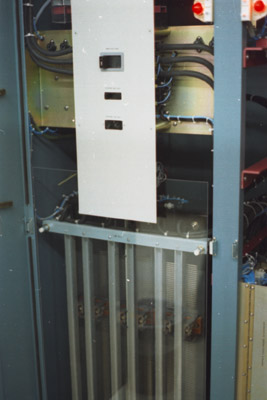
| AC Distribution bay, SDR |
| The kickoff meeting had a shock in store for each of the senior engineers. People who'd "perfected" modules insisted I take them, and "just touch them up." It was hell breaking the news. We didn't have anything passable--not by a long shot. People took it personally. Some injected more bad ideas. Everyone wanted to play the visionary. Each knew "the hot setup." But I'd played with competing designs. Each fell short, some by orders of magnitude. Everyone downplayed my fears. So we spot-checked samples in test. Slapped in the face by reality, emotional retaliation ensued. I faced an angry mob. It was like I'd used trickery to get my way. And I wasn't using ignitrons, long considered "ETM Blue." This was like a personal attack on Chuck. The triggered vacuum gap in my proposal was one that had dogged him. Electronic crowbars must be fast and reliable: one operator reported seeing an arc hit his hand. He didn't feel a thing. The thousand-amp-jolt was only present a few microseconds. Given fast rise and fall times, a four microsecond pulse yields odd harmonics of 250 KHZ. At these frequencies, the skin-effect spares us from internal conduction--barring unforseen follow-on current. With human-life at stake on one side; the flip side had our bias-undervoltage fault instigating main-supply discharge within five microseconds. Our existing ignitron-based archetecture would eat-up four microseconds. And our undervoltage faults were traditionally slow: I needed more than one-microsecond to do the sensing. We also had a "one-hour without spurious-firing" requirement. Ignitrons were notorious for nussance tripping. There was no choice. Everyone left that meeting irritable. And we hadn't started talking about our real problems. Like how to do peak reading volt metering with a one microsecond pulse to .01% accuracy. NIST Traceability died at 10 KV for DC--we had to do 50 KV. And we'd be achieving that accuracy on six electrodes, under pulsed conditions. Overshoot for our 3KV pulse was specified as "reducing to less than one volt within 250 nanoseconds." The spec' was loaded with doosies like that. The other engineers had a lot to balk at too: I was clinging to relay logic. The others had "advanced" to TTL logic. I was using software to detect "over" and "under" conditions for all but the few fast faults. I'd eliminated all meters, dials, and comparator-boards stacked three deep. Our computer-interface expanded to handle those duties. Chuck coined the descriptor "monolith-aproach." Without valid alternatives, the mob fell silent. I was check-mated into doing what I did. I'd been duped every other way. Retracing ill-fated footsteps had fallen from vogue. |
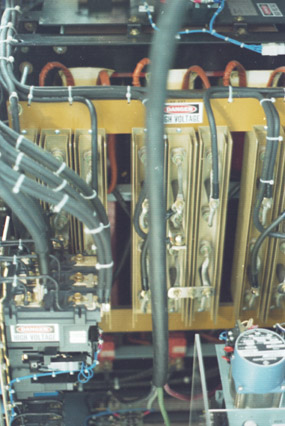 |
| The Powerstat brand variable voltage transformer (VVT) in the lower right is for line regulation: immunizing to +/- 15% line variation. Allen & Bradley's 225 Amp contactor, pictured here, disconnects primary-power to the Peschel VVT in 28 milliseconds. Neither VVT moves much. Both come on with a resistive step-start. Motor-drive reverts to regulator control with final-contactor closure. The raw supply VVT has a 10-turn position-feedback-pot added to it: feeding a VVT-preset board. Slap-on/zero-start are selectable for both VVTs. Once high-voltage comes up and on, a pass-tube "drop" regulator-board takes over; featuring "valley-reading:" to assure 6.4 KV drop for one-second output pulsewidth. (A "detector-diode" catches the bottom of each excursion to form the regulator feedback.) |
| Perhaps I was a bit hard on my pal Jake. I made him meet the +/- 15% line variation spec' on all power supplies, system wide. Only afterwards, did I tell him about the line regulator. But this way, we can use the Eimac Fillament Life Management Plan (by backing-off on reg-tube heater voltages until degradation is noticed, then to bump 'em up a little). This avoids unnecessary thorium depletion from within the tungsten fillament material, thus greatly extending the life of cathode-emissivity. |
| The Peschel VVT uses back-to-back paralelled diode strings in series with each brush. Make-before-break tap-changing thus avoids shorting a turn. An internal secondary winding is brought out and paralelled with each "boost" section (the top portion of each core-leg). This shores-up source impedance above the boost tap. |

|
| brush assy. |
| winding face |
| Brush diodes |
| Internal secondary leads |
| Line Regulator |
| HV VVT |
| HV contactor |
| Preset Bd. pot |
| Phase LED xfmr. fuses |