| We did an 85 KV 40 A peak pulser for Naval Research Labs. It left me more determined than ever to beat switch-tube-oscillation. Based on the groundbreaking work of Dave Harpe, I demonstrated a scalable 50KV "hard-tube" cathode modulator for a Swedish job Larry Rodenbeck was doing. Alas, as jobs got bigger, increasing complexity was taking a toll. Larry Rodenbeck quit after the Swede Job. It had five ignitrons in it. Tom Hayse, Chuck's son, was tinkering with them. He had one disconnected and got bit bad--went out on a stretcher. He recovered fully. But the designs coming into test were becoming increasingly finicky. Problem areas included electronic crowbar circuitry; haphazard use of TTL logic in electrically noisy areas; and parasitic oscillation with the 4CW30,000 tetrode. |
| My second full-blown engineering project was a little built-to-price job for the University of Southern California (USC), It was a cathode pulser for experimental Gyro-Klystrons. We cleaned out our overstock with that job. It got a year-old grid-modulator and a spare GE 7512 triggered vacuum gap. We bought the switch-tubes, a Powerstat, and a Hipotronics 60KVDC supply. Three paralelled Eimac 8960 tetrodes were strapped for triode duty, forming the switch. Maximum output was 50KV, 20Amps peak, 5KW average. Rise time was well under a microsecond. Regulation afforded by a simple motor-drive Variac (Powerstat brand) looked flawless on the analog panel meter. The switch-tubes can be set to provide some transconductance amplification: given a few extra KV drop and reduced drive. The constant current characteristic is helpful for low noise measurements. Capacitive divider and internally-terminated current transformer outputs rout through front-panel BNC jacks for external oscilliscope viewing. The triode configuration minimized extraneous noise. We beat Barkhausen, Dynatron, and Parasitic oscillation with this one. |
| There was exessive radiation near the switch tubes; and "ticking" red-glass (structural fiberglass), which caused spurious tripping. It turned out an assembler substituted half-thickness lead when making the radiation shields. And the leakage current just had to burn off. Moisture must have gotten into it in transit. We tried using better-rated GPO-3 redglass, only to find it "ticked" worse! |
| I was impressed by the performance of the GE 7512 triggered vacuum gap on this job. I'd seen our traditional electronic crowbar using ignitrons behave badly. This was clean: no spurious firing--and fast--1.2 microseconds versus 4 for our pulse-transformer/ignitron combo. |
| SN 784 |
| USC |
| The customer was Alan McCurdey, a physics professor. He'd seen our gyroklystron test set at NRL and wanted one for his lab at USC. This was a little lower in voltage and a lot lower in price. He lucked out: it was cleaner, RF wise. |
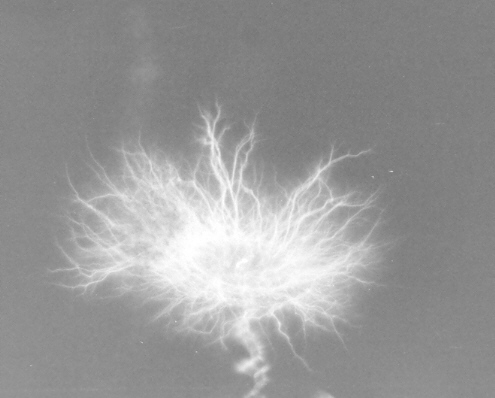 |
| Tesla Coil, 400KHZ, 500KV? |
| 10 KV 20 MA from a Jefferson Electric ignition transformer is connected directly across the capacitor: 2,500 pF 10 KV Mica, 13 A. RMS Current rated. The cap drives through 1/4"air gaps into each end of a 10 turn primary, 10" dia, 10 AWG, 600V, loosely bundled. Secondary is 500 turns enamel #29 magnet wire, under high-voltage glipt, on 5" *14" PVC mailing tube. |

|