 |
| Icing |
|
|
 |
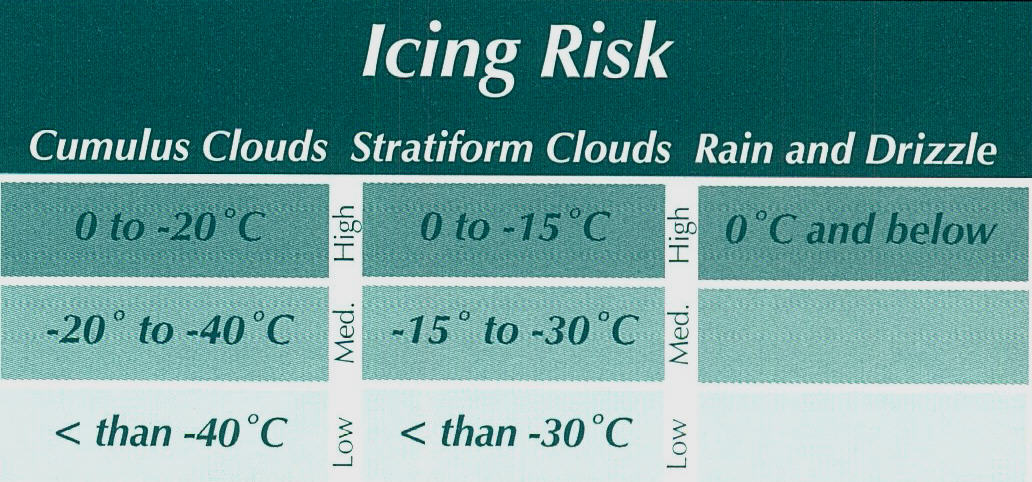
| Perhaps one of the most unnerving experiences in aviation is flying in icing conditions. There are two major types of aircraft icing, structural and induction. This page will focus mainly on structural icing. Structural ice is just what it sounds like, ice that forms on the structure of your airplane. For this to take place two things must be present, visible moisture, and an airplane surface below freezing. There are three types of icing, rime, clear and mixed. Rime ice is rough in texture and resembles the white frosty stuff on the roof of your freezer. Clear ice is clear and smooth and resembles the ice in the ice cube tray. Mixed ice is a mixture of rime and clear ice and has a texture and weight somewhere between the two kinds of ice.The type of structural ice that forms depends largely on what kind of moisture you are flying through. Regardless of what type of ice forms on your airplane the same basic things happen, your airplane gets heavier, and the ice accumulation on your wings reduces the amount of lift they can produce. Now you have a heavy airplane with less lift to hold it up. . . . .that is a bad thing. Before we dive into the different kinds of ice and their effects take a look at the table below so you know where you are most likely to encounter ice. |
| As stated earlier clear ice is clear and smooth in appearance much like the ice cubes in your freezer. You are most likely to encounter clear ice in cumulus clouds, freezing rain, and below warm front inversions where water droplets are large in size. Clear ice is the worst kind of ice because of its rapid rate of accumulation and the great difficulty with which it is removed. Clear ice forms when water drops strike the aircraft instantly freezing part of the drop while the rest flows back from the point of impact and freezes away from the de-ice equipment. Clear ice is very heavy and can quickly turn your airplane into a flying brick. If freezing rain is the contributing factor to your icing woes you may be able to climb above the freezing level into the warm air above you. Don't count on it though especially if you are in a light single the added weight and drag of the ice could leave you unable to climb. A much better idea is to reverse course and hope it isn't raining where you came from. |
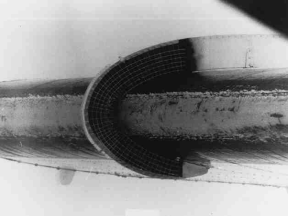
| Rime ice forms as small water drops normally found in stratus clouds freeze instantly to the aircraft surface. Because it freezes so quickly it traps air in the ice thus giving it a white frosty appearance. The major concern with rime ice is that it rapidly changes the airfoil shape which destroys lift. Wind tunnel tests have shown that ice accumulations with the texture and thickness of sand paper can reduce lift by 30% and increas drag by 40% clearly a bad combination. Below are pictures of rime and mixed ice. |
 |
 |
| RIME ICE |
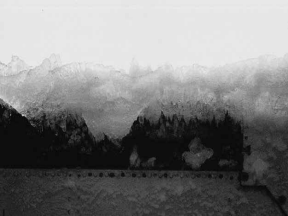
| MIXED ICE |
| As you can see mixed ice can rapidly make a mess of your airfoil. Mixed ice forms in conditions where small and large water drops are present, or where snow ice and rain are falling at the same time. It has a very rapid rate of accumulation and can be described as ice and snow frozen in clear ice. Now that you are sufficiently scared of ice let's take a look at how to stay out of the stuff. As was stated before, all we need for ice to form is visible moisture (clouds, rain, fog, etc.) and a freezing temperature at the point of impact. Obviously, the best way to avoid ice is to avoid areas where you can see the water. Second best is to stay out of areas where the temperature is below freezing (although this does not matter if there is no visible moisture). Remember ice can actually form on your airplane above freezing due to the cooling effect of the air flowing over your aircraft; this becomes a concern within 5 degrees of freezing. Other areas where ice likes to hang out are fronts and low pressure centers. Mountains should also be approached with caution due to the increased hieght of clouds over mountians. Above all have the big picture before you go flying know where the fronts and pressure centers will be when you leave and when you get to your destination. Know how high the clouds are and especially where the freezing level is. |
 |
|
 |