Fog is every VFR pilots' adversary even pilots who are instrument rated have to be concerned with fog because of icing or visibility below approach minimums. Last winter alone we had over 80 days that were not flyable because of fog. Unfortunately you as a pilot really have no choice but to wait it out. Even though we can't do anything about fog, we do need to know the conditions under which it forms so we don't get stuck up above it. Fog forms in two ways, either the air is cooled to its dewpoint or we add moisture to the air. There are five major types of fog that you will encounter throughout your flying career. We will now take a look at each.
Radiation fog also known as ground fog is formed by radiant cooling of the ground. As the sun sets on calm nights the ground cools very rapidly by radiation. The air ajacent to the cold ground is cooled to its dew point and the water vapor contained in the air condenses. Normally this phenomenon takes place in areas with high humidity such as the east coast of the United States.
Advection fog is formed as warm moist air is blown inland. As the air moves further inland it encounters cool ground where it is cooled to its dewpoint. Of course once the air reaches its dewpoint fog forms. Advection fog can be very wide spread and stick around for long periods of time. Unlike radiation fog, advection fog requires wind to form.
Upslope fog also requires wind to form. Upslope fog forms when moist air is blown up a mountain slope. As the air ascends it is cooled to its dewpoint thus forming fog.
Precipitation fog requires that moisture be added to the airmass for fog to form. Warm rain or drizzle falls through cold air and as it does so it evaporates and saturates the surrounding air. This kind of fog can be very dense and will stay around until the precipitaion moves on. Warm fronts are the most common cause of this kind of fog.
Steam fog forms when cold air imoves over warm water. The fog looks almost like smoke rising off of the water. This type of fog is usually not very dense.
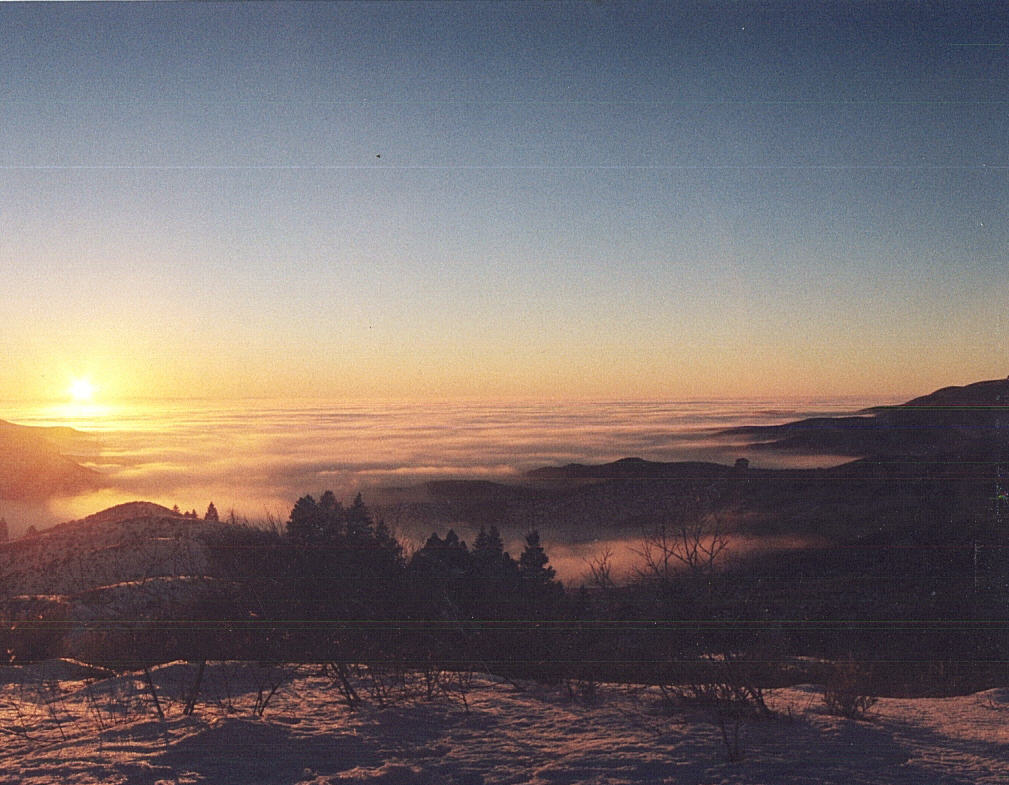
Below is a picture of some very tenacious radiation fog that hovered over the Treasure Valley for nearly a month because of a temperature inversion.
|