 |
| Turbulence |
|
 |
 |
| Turbulence can range from a minor annoyance to an airplane breaking hole in the sky. There are several different causes of turbulence such as, weather systems, terrain, convection and airplanes. This page will focus on weather system, mechanical and convective turbulence, wake turbulence gets its own page. We will start with mechanical turbulence. Mechanical turbulence is a very simple form of turbulence formed when wind blows accross ground structures and terrain. As it does so it is deflected in different directions, and as you fly through that area all the different wind shards hit your airplane. Most of the time it is a minor annoyance but occasionaly mechanical turbulence will cause some very large and painful bumps. This is most likely to happen in mountainous areas where the wind is deflected by mountain peaks. If conditions are right mountain waves can form. This is where Stable air is forced up and over a mountain ridge, as this happens the air rises on the windward side of the ridge and falls on the lee slope. The oscillation of the air can continue up to 100 miles downwind. If wind speed at the summit is 15 knots or more and the wind direction is within 30 degrees perpindicular to the ridge expect mountain waves. To up your odds of not hitting the mountain as you cross you should give yourself at least 3000 feet above the ridge and approach at a 45 degree angle when coming from the downwind side of the ridge. Below you will find a trusty FAA diagram of how mountain wave turbulence is formed. |
 |
| As you can see aircraft approaching the ridge from the windward side will likely experience an updraft while those approaching from the lee side will hit turbulence and recieve a free trip into the rocks. It should also be obvious that as your airplane crosses the ridge you will be in a downdraft that you may not be able to out climb that is the reason for flying at least 3000 feet above the terrain. |
| Like mechanical turbulence, convective turbulence is fairly simple. We all know from 8th grade science that warm air rises. Convective turbulence is more commonly referred to as a thermal. A thermal is simply a column of rising air. Usually thermals form on hot summer afternoons as the ground is heated by the sun and thus heats the ajacent air. The ajacent air now being less dense rises and hits your airplane forcing it to climb and descend as it goes into and out of the thermals. If you are lucky there will be a layer of cumulus clouds in the sky. These usually mark the top uf the unstable layer of air that contains the thermals, if you climb above the clouds you should get a smooth ride. Below you will find a diagram of how different surfaces affect thermals. |
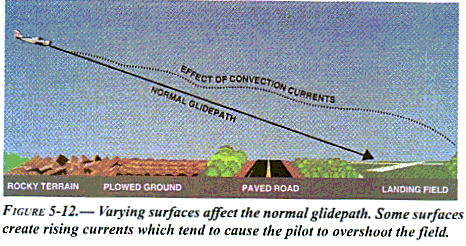 |
| The final kinds of turbulence we will talk about are generally generated by weather systems. Frontal turbulence is air that is stirred up by fast moving frontal systems. The biggest hole in the sky I have ever hit was right as a front was blowing through my area. Frontal turbulence is usually good for moderate turbulence in flat land areas and in mountianous areas or where convection is present turbulence can be much greater. |
| Clear air turbulence is generally found at altitudes above 15,000 feet but it can occur at any altitude. As the name suggests there is usually little warning about the impending bump, but with a little knowledge of where the jet stream is and what the upper level winds are doing CAT can be avoided. Clear air turbulence will usually occur where upper level winds are blowing at different speeds thus causing a shear zone and turbulence. Another favorite place for CAT to hang out is on the Polar side of the Jetstream near deep upper level lows. |
|
|
 |