| Types
of Semiconductors
1. The Elemental Semiconductors
For more information on this topic, please visit the links page!! |
As mentioned before, there are many
different types of Semiconductors available. However, they can be broadly
categorised into two groups.
The intrinsic semiconductors are those, whose properties are those associated with them in their natural state. In other words, they are intrinsic to the material's nature. The extrinsic semiconductors are those whose properties can be altered using various physical and chemical processes according to the user's requirements. Extrinsic semiconductors are therefore much more common. Semiconductors are available as either elements or more often, compounds. Silicon and Germanium, to a lesser extent, are the most common elemental semiconductors. Compound Semiconductors include InSb, InAs, GaP, GaSb, GaAs among others. In this section, we shall examine the various types and the properties
associated with them. Many of the properties stated would be the direct
result of the complicated experiments and results described in the properties
section of this website.
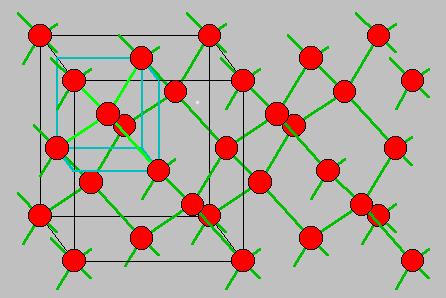
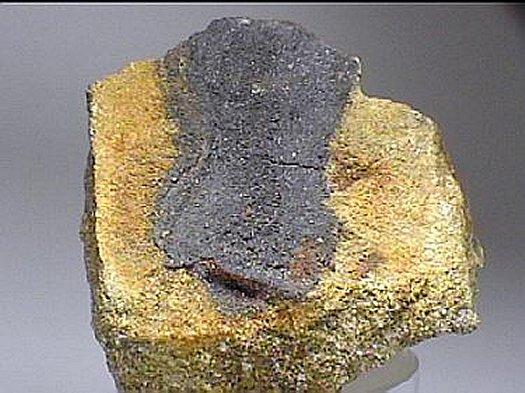
Si and Ge both have a crystalline structure called the diamond lattice. That is, each atom has its four nearest neighbours places at the corners of a regular tetrahedron with the atom itself being at the center. The number of atoms per unit volume for GE is equal to 4.45e22 cm^-3 and for Si, is equal to 5.00e22. The atomic number of Silicon is 14. In many models like the Bohr model, it is composed of a positive nucleus surrounded by 14 negative electrons. Germanium on the other hand has an atomic number of 32. It is directly below Silicon on the periodic table. Selenium is another important semiconductor. It is mainly used in rectifiers and photo cells. However, very little is known about this element because it is notoriously difficult to refine. Also, its amorphous phase is difficult to dope with impurities. Tellurium has many physical properties similar to Se but is a
much more satisfactory material to work with. Perfect crystals are easy
to grow and it crystallizes in an hexagonal form.
In addition to the pure element semiconductors, many alloys and compounds are semiconductors. The advantage of compounds is that they provide the deivice engineer with a wide range of energy gaps and mobilities, so that materials are available with properties that meet specific requirements. Gallium Arsenide (GaAs) is a compound semiconductor material which has super electronic, optical, mechanical and chemical properties providing high electron mobility and low power consumption. Indium Phosphide (InP) is a compound semiconductor whose properties
are important in a number of opto-electronic and electronic applications.
|
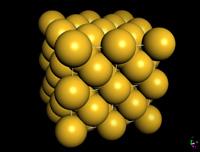
Crystal structure of Silicon
|