| Applications
of Semiconductors
1. Rectifiers
For more information, please visit the links page |
As mentioned before in the introduction
section of this website, semiconductors are the basic materials used in
the manufacture of Integrated Circuits and various digital devices.
Semiconductors cover a wide range of applications and in this section
of the website, we will be examining a few of the more common ones and
discuss each briefly.
Se, Ge and Si are commonly used as rectifiers because of their properties
as p-n junctions. Rectifiers are devices that convert alternating current
(a.c) to direct current (d.c). For example, this process is necessary in
the charging of batteries.
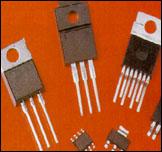
Transistors are very important in today's digital world. Their invention had a profound change on the computer industry. They are primarily devices that perform the same functions are electron tubes but are much smaller and therefore use a lot less power. This has made it posible to reduce sizes of computers from the that of a whole room as was the case whan they were first invented to the size of a human palm or less as they are today. There are many different types of transistors among of which are junction
transistors, bipolar, conductivity-modulated and MOS field effect transistors.
The diode is a device consisting of 2 semiconductor elements that act as electron tubes through which current may only pass in one direction. The first diodes were crystals used as rectifiers in home radio kits.
A weak radio signal was fed into the crystal through a very fine wire called
a cat's whisker. The crystal removed the high frequency radio carrier
signal, allowing the part of the signal with the audio information to come
through loud and clear. The crystal was filled with impurities, making
some sections more resistant to electrical flow than others. Using the
radio required positioning the cat's whiskers over the right kind of impurity
to get electricity to flow through the crystal to the output below it.
The concept behind an integrated chip is relatively simple: an entire electrical circuit with numerous transistors, wires, and other electrical devices all built into a single square of silicon. These chips are smaller than a centimeter-by-centimeter square, yet they can hold millions of transistors. If one person sat down to build all those miniscule parts and then connect them, it would take a whole year. But companies turn out several million integrated chips every few seconds -- that's about the time it took you to read this sentence. The reason integrated chips are possible at all is because engineers
learned ways to build layers, making mllions of transistors across the
chip all at the same time. The first ideas on how to build the chips
were developed by Jack Kilby and Robert Noyce in 1958, and they've been
developed further over the years.
|
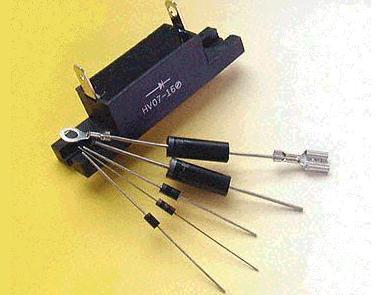
A collection of rectifiers
|