| Technical Information |
|---|
| Total Length: 132' 10" Total Weight: 560 tons Grate Area: 151 sq. ft. Cylinder Diameter: 23 3/4" Piston Stroke: 32" Driving Wheel Diameter: 68" Power: 6360 HP at 42 mph Maximum Service Speed: 80 mph Tender Coal Capacity: 28 tons Tender Water Capacity: 25,000 gal. |
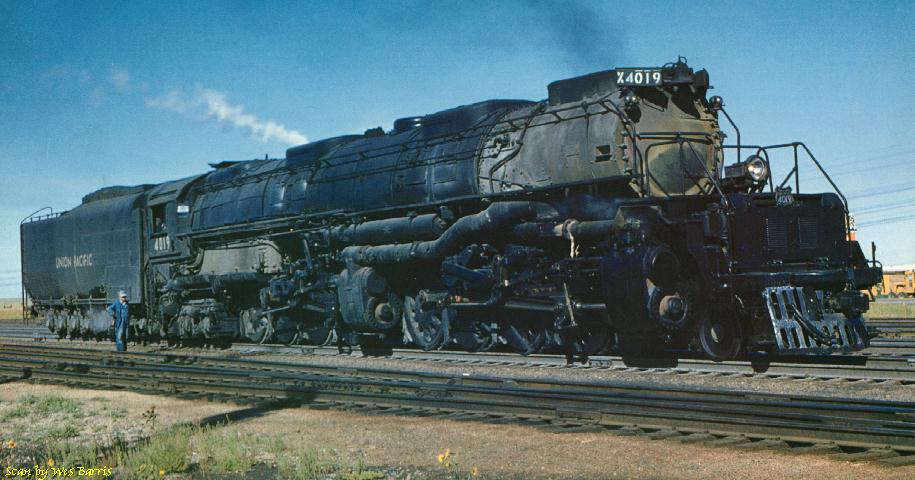
Perhaps no other locomotive had a more appropriate name than the legendary Union Pacific "Big Boy". Measuring nearly 133 feet long, and tipping the scale at almost 1.2 million pounds, the Big Boy was the world's largest steam locomotive. The incredible size, and massive weight of the locomotive made necessary the replacement of the lighter rails, the rebuilding of turntables, and realignment of curves. The Big Boy's value to the railroad quickly justified these expenses, as the locomotive displayed its remarkable strength negotiating the infamous grades found on Sherman Hill and other points along the Union Pacific rails.
Twenty-five Big Boy's were built exclusively for the Union Pacific, the first of which was delivered in 1941. The 4-8-8-4 wheel arrangement, including from front to back, a four wheel leading truck, two groups of eight driving wheels each and a four wheel trailing truck. The tender was a 14-wheel "centipede" model. Because of their great length, the frames of the Big Boy's were "hinged", or articulated, in order for them to negotiate curves. The locomotives were articulated according to the Mallet System, which was named after the Swiss engineer who invented it. The second group of driving wheels was firmly attached to the locomotive, while the first group could pivot and move laterally in curves.
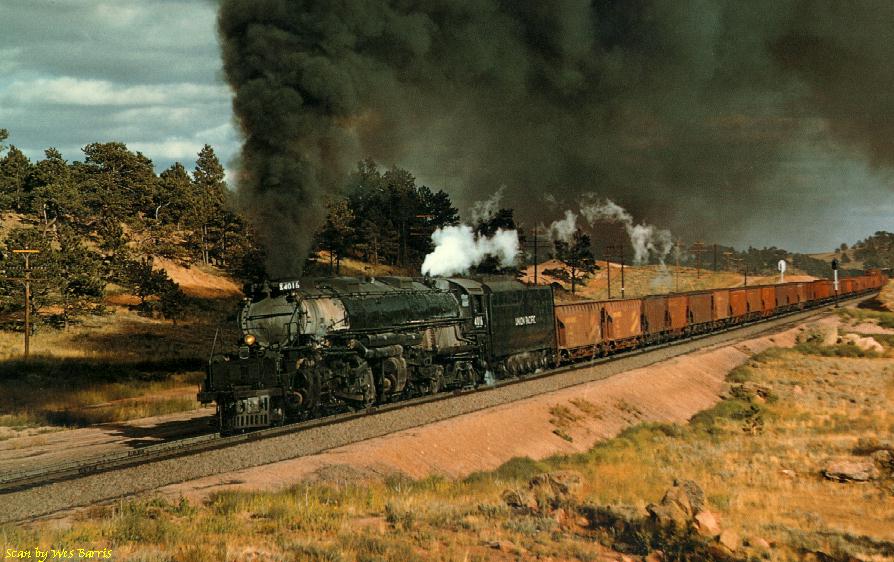
Capable of running at speeds up to 80 mph, which was exceptional for those types of locomotives, the Big Boy's provided their maximum power at 60 to 70 mph. They were seen hauling 4,400-ton trains at 20 mph on steep grades and 3,300-ton trains at 70 mph on flat ground. The 58 miles that separated Carter from Green River on the Wyoming main line were covered by Big Boy's hauling 3,000-ton trains at average speeds of 48 mph. Under those conditions, the 28 tons of coal and especially the 25,000 gallons of water in the tender would be consumed in two or three hours. These massive locomotives normally operated between Ogden, Utah and Cheyenne, Wyoming.
Although there are no Big Boy's left in operation today, eight of them have been donated for public display at various sites across the country. They can be found in Los Angeles, California; St. Louis, Missouri; Dallas, Texas; Omaha, Nebraska; Denver, Colorado; Scranton, Pennsylvania; Green Bay, Wisconsin; and Cheyenne, Wyoming.
| In the early 1940's, railroads were faced with a heavy increase in freight traffic. The powerful Union Pacific company, which then ruled much of the west, had to solve the problem of traction for heavier and heavier trains that traveled without helpers over the 1.14% grades of the Wasatch Mountains. However, even the Union Pacific's excellent track had its limits. As a result, if powerful locomotives were needed, it was necessary to lengthen them to support the weight on the largest number of wheels possible in order to protect the track. The idea of an articulated locomotive was certainly not new, but the Union Pacific perfected the idea with the Big Boy. |
 NEXT
NEXT