Klipspringer
| Common name | Scientific name | Average weight of adult male | Average length or shoulder height | Diet | How do they live | Feeding time | Gestation period | Number of young at birth |
| Klipspringer | Oreotragus oreotragus | 10 kg | 60 cm | herbivorous browser | solitary or pairs | dawn/dusk | 5 months | single lamb |
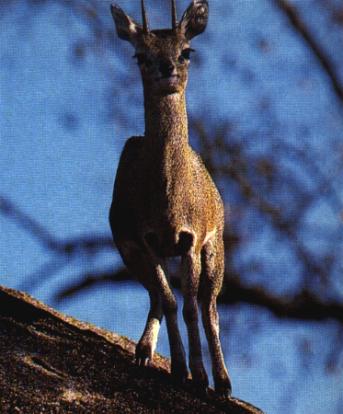
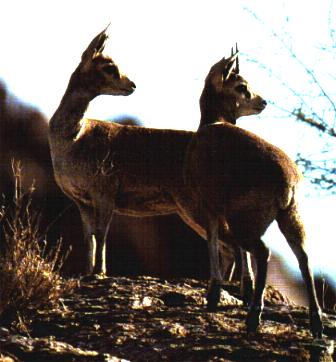
The Klipspringer is adapted to live in a rocky habitat and move around with ease on cliffs and mountains. Their hooves are oval shaped and have long narrow soles and blunt tips allowing them to bounce from rock to rock with ease almost like a ballerina on the tips of their toes. These rubbery hooves leaves distinctive oval, almost round tracks.
Another distinguishable and unique feature is their hair. They are long (almost 20mm), hollow, flat and spiny and insulates the Klipspringer's body from extreme temperatures almost like a thick fur coat. The hair is easily shed and maybe gives the animal some protection against predators such as Leopard. In the European colonial times their hair were used to stuff saddles.
They are territorial, monogamous and are seldom seen in groups of more than three (ram, ewe and lamb). Both sexes mark their territory with secretions from glands just in front of the eyes and dung heaps. They will rub their faces against shrubs to get some of the black secretion onto it. Both sexes will defend their territory. The male Klipspringer will also make his presence known by visual displays and sometimes even challenge predators.
Researchers have found that a tick commonly found on the red rock rabbit completes its cycle on the Klipspringer. The tick is attracted to the black secretion on the twigs and as the Klipspringer reaffirms its territory is ready to climb on.