Gemsbok
| Common name | Scientific name | Average weight of adult male | Average length or shoulder height | Diet | How do they live | Feeding time | Gestation period | Number of young at birth |
| Gemsbok | Oryx gazella | 240 kg | 1,2 m | herbivorous | herds | day | 9 months | single calf |

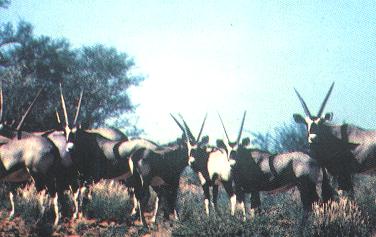
These antelope occurs in the most arid western parts of South Africa and even thrives in the central Namib desert of Namibia. They travel great distances in search of food and have an outstanding ability to go without water. Succulent desert plants, fruit, underground rhizomes and morning dew on leaves provide them with enough moisture.
They evolved a special ability to concentrate their urine and their faeces is very dry. During daytime they have the ability to survive a body temperature increase of 3 to 4°C above the normal 37°C that is normal for most mammals and that helps to prevent moisture loss as well. At night when the temperature drops dramatically in the desert this heat is then lost through radiation, once again with no moisture loss.
To survive such a temperature increase during the day the blood in the brain has to be kept at normal body temperature. This is achieved by a series of capillaries in the nose where the blood flows through and is cooled down by evaporation as air is drawn in through the nostrils. The cooled blood then flows and surrounds the arterial network below the brain. Heat is then exchanged with the warmer blood on it's way to the brain and in this way the brain is kept cooler.
Both sexes have horns but those of the cows are longer and thinner than those of the bulls. These horns are used as very effective weapons. I've heard of an occasion where a Gemsbok was wounded and lying down. The hunter and trackers threw little stones at it and time and time again the Gemsbok would knock these stones away with a flick of the horns.