 |
|
|
 |
| . |
 |
| 1789 - 1793 |
| . |
 |
| Questions? Comments? |
|
|
|
|
|
| Main Events During the French Revolution |
| Tennis Court Oath |
| After that National Assembly was denied access to their old meeting place by the king, they were forced to find another metting place. So, they ended up meeting at a tennis court, called the jue de paume. Here, each member of the National Assembly took an oath on June 20, 1789 not to leave until France had a constitution. It became known as the Tennis Court Oath. This caused and uprising with the Paris mobs, who tormented the king. Finally he agreed to the demands and the Estates-General officially became the National Assembly. Their new Constitution was sent in place in 1791. |
| Fall of Bastille |
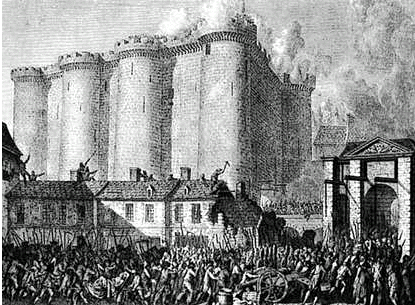
| The Bastille was a prision in which the King could imprision any prision under his own will, without reason. To the people of France, this prision represented part of the Old Regime. After hearing rumors that the King had an army to help break up the National Assembly, Paris mobs stormed and destroyed the Bastille on July 14, 1789. This date has become a National Holiday to the French, reigning as the turning point in the downfall of the Old Regime. When people around France heard the news the peasants were overjoyed and began attacking the nobles and their castles. They destroyed all the records of their fuedals dues that they payed to the nobles. Now it was evident that the commoners wanted freedom and they were willing to fight for it. The National Assembly now knew that they had the peasents on their side and king knew what would happen if he were to resist once again. |
| Declaration of the Rights of Man |
| The immoral part of the constitution finished by the National Assembly was known as the Declaration of the Rights of Man. Basically, this said that: |
| 1. All men are born free with equal rights |
| 2. All citizens have the right to take part in electing representatives to make the laws. |
| 3. Every person shall be free to speak, write, or print his opinion provided he does not abuse this privilege. |
| 4. The amount of taxes which a person is called upon to pay, shall be based on the amount of wealth he possesses. |
| This document was based upon the ideas of the English Bill of Righs and the American Declaration of Independance. It also became known as the charter of democracy. It was just another step away from an absolute monarchy for the French people. |
| The National Assembly gathered and made up a constitution which encouraged a limited monarchy to be setup for France. It also called for an elected Legistlative Assembly to make the laws for the people of France. But the members of the assembly had to be property owners who paid taxes. This constitution was not, however, very strong. The limited monarchy did not last very long for the French due to the opposition. The buorgeoisie and many peasants were satisfied with the new change, but there were more opposition groups. Groups such as the Girondist and Jacobins wanted a Republic, while the King, Catholics, Monarchs of other countries, and nobles all favored the Old Regime. The Limited monarchy came to an end with foreign armies invaded France. The Frech legislature decided to elect a National Assembly to run the country, however it was later taken over by the Jacobins. |
| Constitution of 1791 |
| Reign of Terror |
| The radical political party, the Jacobins, were in control of the Committee of Public Safety, which they created to centralized all governmental powers. But in order to project France and the revolution, the Committee put into effect the Reign of Terror. The Reign of Terror was a time period in which the committee was able to succeed only by frightening the people. They arrested everyone accused of treason, without a trial and sentenced many thousands to death. Finally, the French became so scared that they hated the Jacobins. The end of the Reign of Terror was here, when the leaders of the Committee of Public Safety, Danton and Robespierre were guillotined. After this, the moderates were able to take control of the National Convention. |
| The New Directory |
| The National Convention, after having being led by the Jacobins made yet another constitution for France. This was the third one during a small period of time. This constitution made way for another type of government to be tested for France. It was a republic that was to be headed by a five-man body called the Directory. Although it was smooth and well ran, the directory only lasted for four years before being taken over by a military dictator. |
| Napoleon's Coup D'Etat |
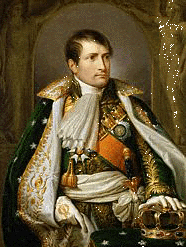
| Coup D'Etat means a swift overthrow of a government by force and that's exactly what Napoleon did. He was able to grow within the people and overthrow the government. Napoleon was agreed to rule as a part of a republic, but later became a military dictator, and crowned himself over his empire. Pleased with the job that Napoleon was doing and finally having somewhat of a comfort period, the people of France agreed and voted to allow Napoleon to rule over France. |
| King's Attempt to Flee |
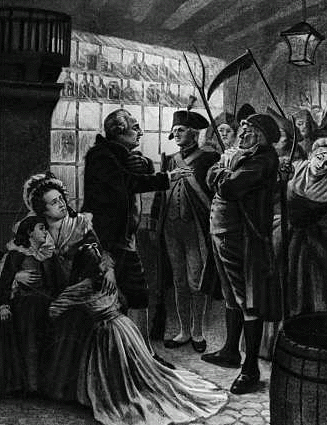
| Suspicions grew as the governmental situation grew harder. The King and Queen were becoming more and more questionable. So, in order to watch over them closely, they were brought to Paris where they could be watched closely. After not accepting the constitution made up by the National Assembly but regretting the loss of his power, the king tried to flee the chaos in France. However, he and Marie Antoinette were caught and returned to France. He was now forced to accept the constition, or fear that another mob would again attack him and his nobles. As France grew more towards abolishing all royalty, the king was accused of treason and behead in 1793. |
 |
| Storming the Bastille |
 |
| King and Queen |
 |
| Napoleon |