 |
|
|
 |
| . |
 |
| 1789 - 1793 |
| . |
 |
| Questions? Comments? |
|
|
|
|
|
| Causes of the French Revolution |
| The main cause of the French Revolution was the abuse of the Old Regime, the social and governmental system in France during the 18th century. The breakdown is as follows: |
 |
| Political |
 |
| Absolute Monarch |
|
| Inefficient and unfair government |
|
| Lack of people's voice in government |
|
| Social |
|
| Social Classes |
 |
| First & Second estates were wealthy |
|
| Third estate was underprivelaged |
|
| First and Second estates had special treatment |
|
| Economic |
|
| Third estate payed all taxes |
|
| King gave money to help in American Revolution |
| Political Abuses of the Old Regime |
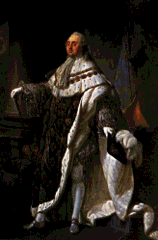
| Before the revolution broke out the king was ruling as an absolute monarch over the people of France. His powers were unlimited and he believed he ruled by 'divine right.' The king was in charge of foreign affairs, enforcing and making laws, taxes, spending money, and all other governmental powers. The king at the time was able to select his ministers on his sole opinion. Most of the time this was done by favoritism and not based on ability. The king was also able to take away freedom of speech for the people, by censoring certain things. He was also able to put his enemies in prision unfairly, though they might be innocent. But most of all, the king denied the common people the right to voice their opinion in their government. The government was totally run by the king and the people had little or no say in how things were. This was really upsetting the French, as they saw their country on the decline. It did not help the fact that King Louis XVI and his queen Maire Antoinette were not considered strong advocators. Both were weak rulers and were very indecisive. They were not exactly the type of people France needed to have running their country during this crucial time. |
| Social Abuses of the Old Regime |
| The French people were divided into three social classes. The first two being of higher importance and coming with special benefits. The first and highest was known as the First Estate. These people consisted of the clergy, and even the poor priests were considered members of the First Estate. The second was known as the Second Estate, or the nobles. Together the first and second estates made up only three percent of the population. This left the most populous, but most underprivelaged, the Third Estate, or commoners. This estate was made up of the bourgeoisie (merchants, bankers, manufactors, and other professionals), city workers, and the peasants. The Third Estate was responsible for paying all the taxes (see economic abuses) while the First and Second Estates owned most of the land, collected dues from the peasants, were exempt from most taxes, and were able to hold the best working positions. The First and Second Estates were treated well in the face of the government and were given special benefits by the King. By this time, the Third Estate was getting furious with these indifferences and was ready to do something about it. |
| Economic Abuses of the Old Regime |
| As mentioned above, the Third Estate, who was essentially the most underprivileged was also forced to pay most if not all of the taxes. The peasents who were some of the lowest people in the class system were forced to pay the taille (land tax), corvee (labor for bridges and roads), and gabelle (tax on salt purchases) all to the government. But the churches also looked to collect taxes from the peasants like the tithe. They were also forced to pay taxes to the nobles, their fuedal dues. By the time all was said and done the peasants were only left with about half of their income, which was small to begin with. The buorgeoisie did not get away easy either. They were forced to pay money for trade, guild restrictions for manufactoring, and had strict regulations on economic life. Towards the end of the 18th century, the king was also not shy to send money to help the colonists in the American Revolution. This hampered the money flow as well, making the Third Estate pay more and only begging for help. |
| Other Causes of the French Revolution |
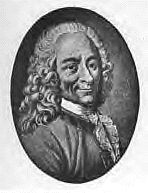
| Although this type of system had been in place for years, the people of France were now begining to think about their lives and their natural rights thanks to the Enlightenment. Many philosphers were now coming out and sharing their viewpoints on government and people's natural rights. People such as Montesquieu, Voltaire, Rousseau, and Diderot were able to greatly influence the minds of people during this time. Each one of these philosphers insisted on a shared governmental power, with more than one branch. With their wriitings being published, the French began to become influenced and believe in these ideas. This created an strong urge for natural rights in the people and the urge for towards democratic system. |
| Through time, the above occurances were added to a pile, and later one would come a long and be the last straw that would set the French over the edge and ready to fight. |
 |
| The French were also greatly influenced by the English and American Revolutions. Since the countries of England and France were closely related, the French took notice to the changes that were occuring during the Glorious Revolution and with what the Puritans were trying to obtain. During the English Revolution many english were migrating to France in order to escape the chaos. Also, the many philosphers that had influenced the French to strive for natural rights were also encouraging the new English parliamentary system. The French were also beginning to realize their that many French were strong advocators of the American causes. Soldiers, like Lafayette, were able to help the Americans in significant ways during their revolution. They were spreading their ideas througout the country. Also, the ever popular Ben Franklin and Thomas Jefferson were als able to influence the French thought. |
 |
| Voltaire |
| King Louis XVI |