













| Discover
Thailand
The
lost world This was also a significant area during the Ayutthaya period and, although its legacy is not as glorious as past days, it's still important in its own right.
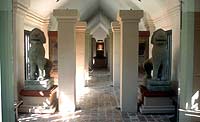
Phanom Rung sandstone sanctuary is the most well-known historical attraction in Buri Ram, but there are also others which are equally fascinating. The Phanom Rung historical park offers visitors a chance to learn more about the history of Buri Ram and the site will soon open an information centre at its entrance. With a budget of 11 million baht, the information centre is expected to be one of the best in the country. The centre will present an interesting display of Dvaravadi and Khmer sculptures, arts and historical background, the most impressive of which are sculptures of workers constructing sandstone sanctuaries. There will also be a visual presentation of restoration work at the site, said Professor Sanchai Maiman, head of the restoration project. The area surrounding Phanom Rung historical park is also said to be very relaxing. Visitors have to pass through a nook in the trees to reach one of the most impressive sandstone sanctuaries of the Khmer era.
Another not-to-be-missed site is Muang Tam Sanctuary (the Lower City), located just 8km from Phanom Rung. With the help of the Fine Arts Department and the Office of the Budget Bureau, Prasat Muang Tam was restored and is now one of the most impressive "green" historical sites in the country. Few visitors come here despite the fact the site is well shaded by large ancient trees and served by a good road. Built between the 9th and 10th centuries, the sanctuary pre-dates Phanom Rung. It was an important sacred religious site for Hinduism at the time. The Muang Tam sanctuary contains the largest examples of Baphuan art in Thailand and is the only sandstone sanctuary to have "baray", or sacred ponds, surrounding the prasat. The sanctuary is a brick structure with five pagodas surrounded by laterite ponds, at the corner of each is a sandstone five-headed Naga that stretches around the four directions of the pond. The sandstone lintel and doorway are beautifully carved and the compound is encircled by a crooked terrace and a laterite wall. Historically, there is no evidence who built this sanctuary but lintel shows a Hindu deity characterising Khmer Baphuan style of the 11th century. It might be argued that the temple was built for the Hindu community. |
 Buri
Ram contains some of the most fertile land in the country and
is especially famous for top quality jasmine rice. After Nakhon
Ratchasima, the province boasts the highest number of historical
remains, most of which are from the Khmer culture and date back
a thousand years.
Buri
Ram contains some of the most fertile land in the country and
is especially famous for top quality jasmine rice. After Nakhon
Ratchasima, the province boasts the highest number of historical
remains, most of which are from the Khmer culture and date back
a thousand years.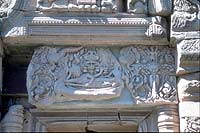 Considering
its location, Phanom Rung was one of the most powerful regions
in the Khmer empire. A guide told us Phanom Rung is one of only
four sandstone sanctuaries built on top of a mountain, reflecting
its significance in ancient times.
Considering
its location, Phanom Rung was one of the most powerful regions
in the Khmer empire. A guide told us Phanom Rung is one of only
four sandstone sanctuaries built on top of a mountain, reflecting
its significance in ancient times.