













| Discover
Thailand
The
lost world JARUNEE TAEMSAMRAN Budding
archeologists would be forgiven for thinking a trip around the
ancient Khmer sites of Nakhon Ratchasima and Buri Ram is like
negotiating a jigsaw puzzle.
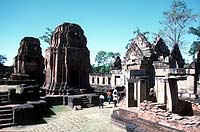
With the Khmer civilisation and its greatness still burning in my memory, I felt further explorations were needed closer to home. The scattered pieces of historical masterpieces helped me get a clearer pictures of the influence of the Khmer empire in the region. It was as if I was following a historical path into the ``lost world.'' Archeologists are well aware of the influence the Khmer empire once had on the Isan region of Northeastern Thailand _ comprising Nakhon Ratchasima, Buri Ram, Si Sa Ket, Surin and Ubon Ratchathani. Nowhere in Thailand are Khmer influences more apparent than in Nakhon Ratchasima and Buri Ram, which contain Thailand's two most important Khmer sandstone sanctuaries _ Prasat Hin Pimai and Prasat Hin Phanom Rung. Many visitors are intrigued to discover these two provinces also house many fascinating examples of the Dvaravadi period (12- 13 Century AD), which pre-dates the Khmers. Our trip began with a visit to Wat Sema Dharmachak, where we were led to the remains of the ancient city of Sema, the temple stone markers of the Dvaravadi period. Also within the temple's compound was an image of a gigantic reclining Buddha made from petrified wood, believed to be the largest of its kind in Thailand.
After a lecture on the Dvaravadi period at Sema, we followed the historic route on the well-paved road to Prasat Muang Khaek. In archeological terms, the remains of the ancient Khmer sanctuary here were no less important than other such sacred sites. As we travelled along this historic route we were shown further evidence of the extent to which the Khmer culture influenced the people of the region. Buri Ram's low tourism profile will undoubtedly get a boost with the development and restoration of Khmer architecture in the region and its close association with the popular Khmer attractions in Angkor Wat. Although the archeological sites in Buri Ram have not been included in the Unesco list of World Heritage Sites, the Khmer legacy is bound to put the province at the forefront of tourism. The history of Buri Ram is actually far more intriguing than most people think. The province's historical significance can be dated back 900,000 years, when lava from an ancient volcano made the area suitable for human inhabitation. |
 Just
two weeks before embarking on this trip, I visited the Unesco
World Heritage Site of Angkor Wat, and was captivated by the
impressive sandstone sanctuaries created by highly-skilled ancient
artisans.
Just
two weeks before embarking on this trip, I visited the Unesco
World Heritage Site of Angkor Wat, and was captivated by the
impressive sandstone sanctuaries created by highly-skilled ancient
artisans. 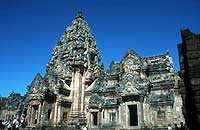 Archeologist
Samart Sappaen said the area was a good example of the early
establishment of Buddhism in Thailand.
Archeologist
Samart Sappaen said the area was a good example of the early
establishment of Buddhism in Thailand.