 |
|||
 |
|||
 |
|||
 |
|||
 |
|||
 |
|||
 |
|||
 |
|||
 |
|||
| Copyright 2002 © Showdog Designs | |||
|
|||



|
|||||||||||||||||||||||||||||||||||||||||
|
|
|||||||||||||||||||||||||||||||||||||||||
| The magnificent physical appearance of the Akita coupled with its loyal steadfast temperament has ensured the breed's popularity outside its native home. America was the first country to adopt the Akita, and one of the first dogs to emigrate was Kamikaze (Divine Wind), which was given as a gift to Helen Keller. Helen, an American was blind, deaf and mute. | |||||||||||||||||||||||||||||||||||||||||
| She travelled the world teaching others who were similarly affected, to lead a fuller life. In the late thirties she was lecturing in Japan and she expressed a wish to own an Akita. She had discovered the breed's rare quality of being able to communicate through body language. This is something apparent in all dogs, but most Akita owners would agree that the breed is peculiarly sensitive. For someone as severely handicapped as Helen Keller, this extra degree of communication was all-important. An officer in the police force, Ichiro Ogasawara, presented Miss Keller with an Akita in recognition of her work with the handicapped. This was a rare and precious gift; for at this time there were very few of the breed left, save in their northern home of the Akita Prefecture. | |
||||||||||||||||||||||||||||||||||||||||
| Above: Helen Keller with her Akita ”Kenzan-Go”. | |||||||||||||||||||||||||||||||||||||||||
| Kamakazi travelled to America with Helen Keller but became ill when he was only eight months old and died from distemper. In 1939 some friends from Japan sent her another Akita and the dog, Kenzan-Go, remained with Helen Keller until his death in the mid-Forties. In her characteristic gentle style, she referred to her Akita as an Angel in Fur | |
| The number of Akitas reaching the United States grew rapidly after the Second World War when servicemen who had been stationed in the Japanese Islands took dogs home with them. Some of these imports found their way to dog enthusiasts and these formed the basis for present-day Akitas, not only America but in Canada, Australia, some European countries, including Scandinavia, the islands off America, Great Britain and its colonies. There were numerous lines of development stemming from these early imports, and these have been well documented. Today the influence of these early pedigrees is minimal and there are just a few old photographs that have survived. Many of the early dogs went to novices who did not understand about breeding livestock, and so lessons had to be learnt. Some did stick with the breed and eventually the numbers grew and some good dogs came to the fore. Breeding lines were established and a specialised club for the breed was set up. In 1955 the American Kennel Club gave permission for the Akita to be exhibited in their miscellaneous class, but it was seventeen years before it was given individual status |
| It was comparatively soon after this office recognition that the first akitas were imported to Britain in 1981. Skilful breeding in the United States has produced Akitas which were strikingly beautiful, and which carried the characteristics of the breed. But because their pedigrees were a mixture of all the early imports, there had not been enough time remedy all of the inherited faults or establish a perfect type. As a result there was a great diversity in the Akita which arrived in Britain. . Some representatives of the breed were exported direct to Japan, and in Scandinavia these formed the basis of their initial breeding stock. | ||||||
 |
||||||
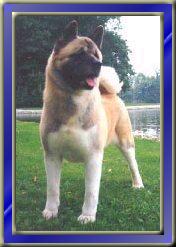
| CH. The Widow-Maker O'BJ | ||||||
|
||||||
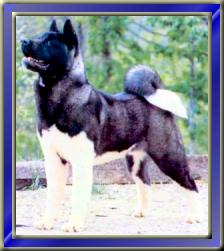
| CH. Goshen's Chariots Of Fire | ||
| The Akita is certainly becoming an International
dog, with many countries now playing a part in its future.
Let us hope that the emigration of the breed to other lands will serve it well, and preserve the Akita in its purest form. Written by Gerald and Kath Mitchell.
|
||