English - Portuguese
Universal gravitation
 |
1-Law of the Universal Gravitation
1.1-Newton and the universal gravitation
1.2-Cavendish and the determination of the constant of the gravitation
2-Principle of the overlapping
2.1-Rind Spherical
2.2-Tunnel in the center of the Earth
3-Laws of Kepler
3.1-First Law of Kepler - Law of the Orbits
3.2-Second Law of Kepler - Law of the areas
3.3-Third Law of Kepler - Law of the periods
4-Energy of an object in a gravitational field
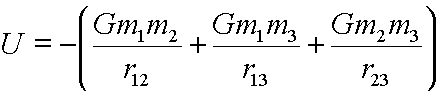
4.1-Gravitational Potential Energy
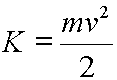
Kinetic 4.2-Energy
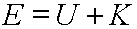
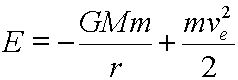
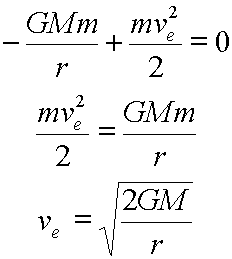
4.3-Mechanics Total Energy
5-Object trajectory in a gravitational field
5.1-Orbit of satellites, planets and objects
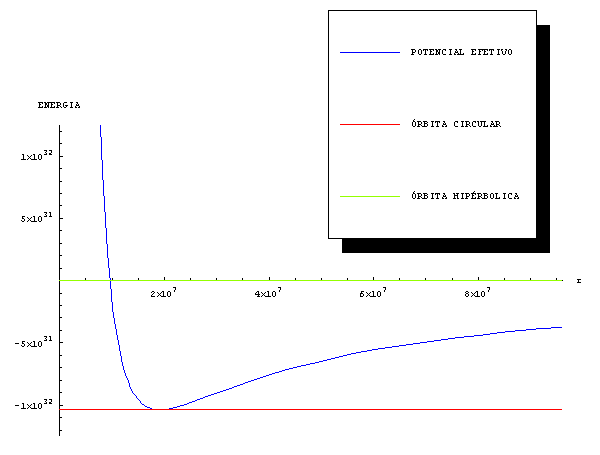
5.2-Effective potential
5.2-Orbit and energies
6-Tide Forces
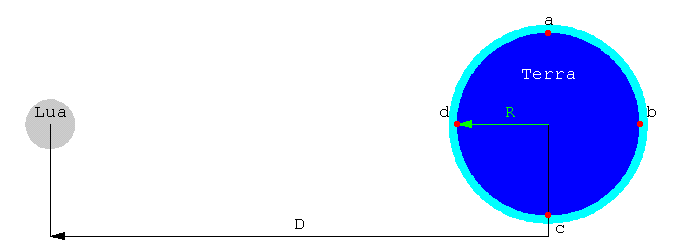
6.1-Origin of the problem of the tides
6.2-Understand the phenomenon of the tides
Bibliographical references
1-Law of the Universal gravitation
1.1-Newton and the universal gravitation
He was between middle of century XVII that the physics got a great advance in the mechanics. E one of main the responsible ones was then the physicist and mathematician Sir Issac Newton (1642-1727). With the publication of the book Philosophae Naturalis Principia Mathematica (1687), Newton approached questions on the laws of object movement, between them, movement of celestial bodies.Such book appeared of a sufficiently curious fact. Christopher Wren (1632-1723), mathematician, architect and one of the founders of the Royal Society, considered a challenge to others two members: Robert Hook (1635-1703) and the astronomer Edmond Haley (1656-1742).
That one that obtained to explain the system world, through a force (inversely proportional to the square) that it influenced in the trajectory of the planets, gained the publication of a book in the value of 40 xelins. The time stipulated for reply was two months.
Halley wise person of the existence of a person who could help to decide it to it such challenge. This age Isaac Newton, titular professor of the lucasiana chair of mathematics of the University of Cambrigde. However, Halley had a certain distrust. Exactly that Newton possessed the reply of the challenge, that reasons would make to deliver it it?
In contrast of what Halley waited, Newton received it very well. He said that already if he had questioned on the use of this force in the explanation of the movement of the planets. However, as it did not remember where such demonstration had left, it promised to send the reply when it found it.
Three months later Newton send Halley a manuscript with the reply of the question. Apartir from there, also for influence of proper Halley, Newton starts to work in what the three volumes of the Principia´s had later become.
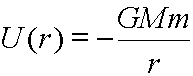
In them, specifically in the third volume, Newton it demonstrated then that the attractive power between two bodies was proportional to the product of the masses of these bodies divided for the square of in the distance between them. Currently we know that moreover a constant of proportionality called constant the gravitation exists which in allows them to write the law of the universal gravitation of Newton as:
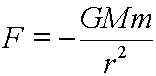
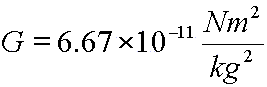
Where M and m are masses of particles, r is in the distance between them and G the Gravitational constant with value of:
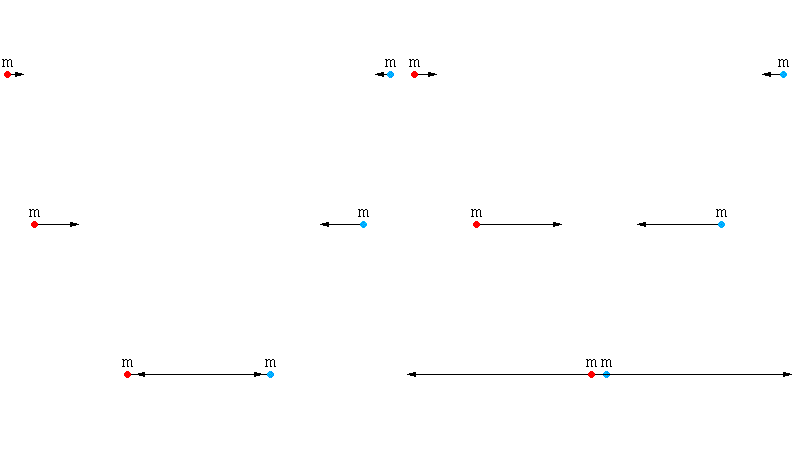
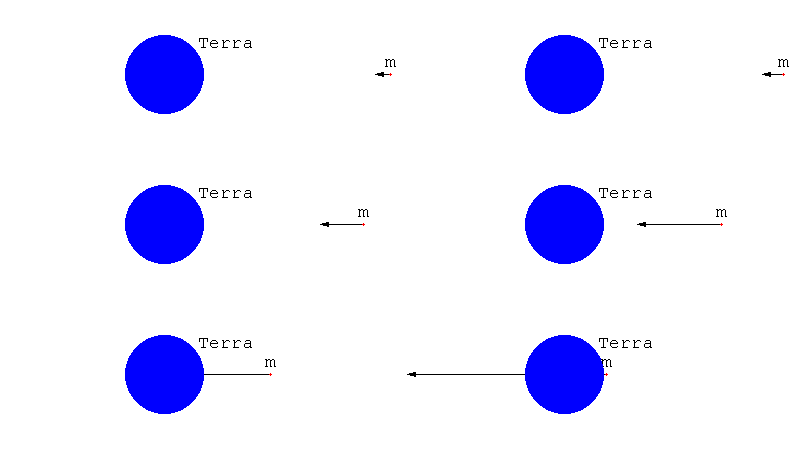
 Click to use the simulation here that helps to understand the equation.
 Although to know of the existence of the constant G, Newton never it measured it. Such proesa was only carried through in 1778 by the physicist and English chemistry Henry Cavendish (1731-1810), using a torsional scale constructed by proper it.
1.2-Cavendish and the determination of the constant of the gravitation
|
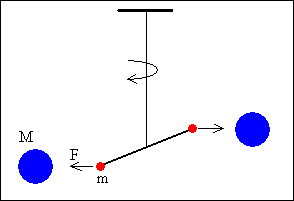
Resumidamente, this experiment uses two small lead spheres with mass m and two great lead spheres with mass M. The small lead spheres are imprisoned to a fine bar that is suspended for its average point for a fine fiber. In this fiber a mirror meets that reflects a ray of light in a wall with a bigger angle two times that the incident angle.
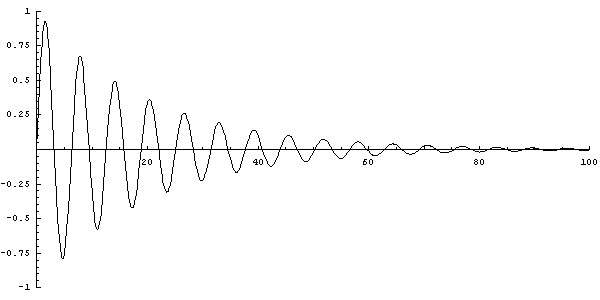
The experiment consists of leaving the suspended spheres of mass m in rest total and after that to modify the position of the spheres of mass M. Being written down the values of the amplitude (which decreases in function of the time) of the ray of light reflected by the mirror in the wall, will be determined then the value of G.
Graph of the Amplitude in function of the time
 It finds the value of the gravitational constant.
To come back
2-Principle of the overlapping
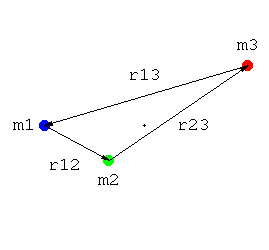
How if it holds the gravitational force in a group of particles?For an amount of n distributed particles in discrete way (made use in random way and distant one them others - as in a gas), we can represent the gravitational force on a Fi particle as the addition of the operating forces on particle i.

Being able to be written in a compact form:
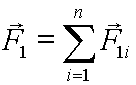
We can exemplificar this equation above, using the solar system. Considering that the Sun is the object number 1, the too much planets are in the sequência (Mercury, Venus-3, Land, Mars-5, Jupiter-6, Saturn, Uranus, Neptune, Pluto-10).
 it is the force that Mercury exerts on the Sun,
  is the force that Venus exerts on the Sun, following the sequência of the too much planets. The somatório represents then the force that all the planets exert together on the Sun.
Spherical 2.1-Rind
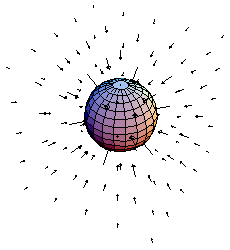
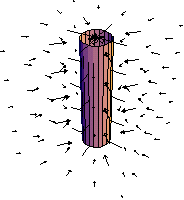
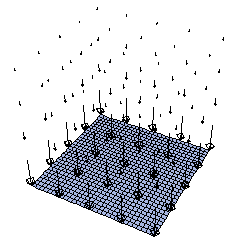
For an amount of infinetesimais particles, that if distribute in continuous way (they are organized side by side, to a distance very small - joined situation easily in solids), the addition of the gravitational force results in different equations, which depend on the form and of the density of we infinetésimos them in solids.Below we have the field of force for three types of solids, which possess constant density:
| Sphere | Cylinder | Plan |
|
|
|
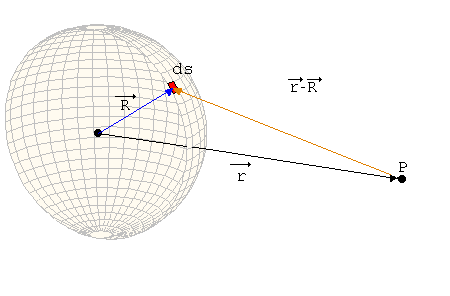
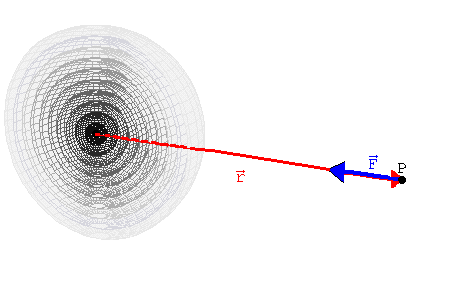
One of the problems very studied in the physics is of the spherical rind. This consists of determining the equation of its gravitational force. Below it follows the illustration of the problem:
Illustration of the problem of the spherical rind in 3 Dimensions:
|
In this figure, the small polygon spotted of red ds represents one of diverse infinetesimais particles. Each one of them contributes with a small parcel of force in point P.
Newton found a way to the same add the force of all infinetesmais particles in point. Curiously it discovered that in any point of it are of the rind, the resultant force always points with respect to the center of the same one, whereas, in any point inside of the rind, the resultant force is null. He comments yourself that the deduction of this condition took years to be decided.
Using then the results of Newton, we can imagine the Land as an overlapping of spherical rinds. In the measure where an object advances in the direction of the center of the Land, the rinds for which this it passes leave to exert gravitational force on it.
 |
Simulation of the beginning of the overlapping 2.2-tunnel in the center of the Land
What it would happen if we dug a tunnel in the center of the Land well? As we comment previously, the fact to consider the Land as a set of mass rinds, implies in the reduction of the gravitational force as advances in direction of the center of the Land. Thus, we need to find an expression for the gravitational force that depends on the mass between the nucleus and the position where it is the object.When an object of mass m will be to a distance r of the center, the amount of mass that will exert gravitational force will be M `. Assuming that the density of Land r is constant, we can determine the value of the M´ mass in function of the total mass of Land M.
Illustration of the example:
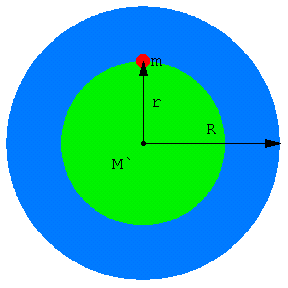
The green area represents partial mass M `, whereas total mass M represents the areas blue and green.
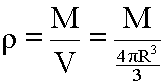
The value of the density of the Land is:
To a distance r of the nucleus the Land, we can write the density of the Land as:
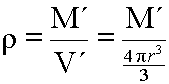
Now it comes the part most important, where we must attempt against the fact of the density of the Land to be constant, we can equal the two expressions to find the value of the mass that exerts gravitational attraction to a distance r:
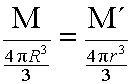
Where we find then the value of mass M `in function of r.
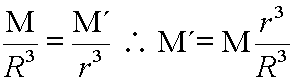
Finally, we substitute the expression of the mass in the equation of the gravitational force:
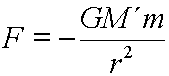
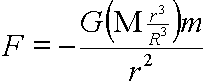
We can observe that this if holds as a restoring force, equal of a spring:
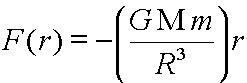 Simulation of an object in a tunnel in the center of the Land
 To come back
3-As laws of Kepler
Johannes Kepler (1571-1648) was of great importance for the development of the Universal Gravitation. Son of poor parents and member of a family very conturbada, passed many difficulties during the primeros years of life. But although all difficulties, Kepler was very dedicated to the studies. It obtained to conclude “secondary” education in 1588, getting in the following year a scholarship in the University of Tübingen (Wurtenberg-Germany). The course age of theology, composition for you discipline them of ethics, dialectic, Greek, Hebrew, astronomy and physics.In 1594, incomplete Kepler leaves the study in Tübingen, to lecionar Mathematical in the University of Graz (Estíria-Austria). There, he developed one failed model of solar system, based in solids of Platão, where the planets occupied spherical surfaces that were incritas and circumscribed in such solids. Mathematical Lecionou up to 1598, year where the University of Graz locked up its activities. Kepler was dismissed and in very delicate a financial situation. However, the invitation of another famous astronomer of the time, Tycho Brahe (1546-1601), was the Plague to work as its assistant.
Both waited this meeting very. Kepler wise person who Tycho was excellent observer, possessing many data on the positions of the planets. On the other hand, Tycho reads the Mystery of Kepler and believed that it would be capable to use its data to confirm its model of solar system.
But in contrast of the Kepler it imagined, Tycho would not supply to its data other astronomers to work its hypotheses. Initially it assigns to the Kepler the “Mars challenge”. With the supply of few data, Kepler would have to solve, in accordance with the model of Tycho, the problem of the Mars orbit. Kepler found that the problem would be decided in some weeks, however this cost it six years.
This “partnership” enters the two did not last much time. In the year of 1601 it dies of Tycho and kepler finally has access to all its data. The fear of Tycho Brahe was these was used to demonstrate the veracity of the copernicano model, which Kepler had certain affection. However, as Kepler promises the Tycho, published a book using the data in its model. E together of this, added the results for the models of Ptolomeu and Copérnico.
It is as soon as to kepler writes New Astronomy during the years of 1600-1606 and publishing in 1609. The study of the Mars data it evidênciou true the characteristics of the orbits. It was born thus 1ª and 2ª laws of Kepler.
3.1-A first Law of Kepler - Law of the Orbits
Initially Kepler started to study the orbit of the Land. It wise person who any error in the determination of this could hide some Mars regularity or law of movement. To each measure of the Mars position, it was necessary to measure the position of the Land in relation to the Sun. Thus she would find the orbit of the Land for calculations of triangulation. Possúia Kepler ten measures that Tycho had supplied to it, counting on more two proper ones. These however had not been enough.Another more necessary way to elucidate the problem would have to be found. The constatação of that the ray vector of the planets sweeps equal areas in intervals of equal times (2ª Law of Kepler), was the step necessary to find the orbit of the Land.
In return to the problem of the Mars orbit, Kepler initially found a stranger forms oval. It still insisted on finding an orbit circular, exactly after understanding that the planets did not dislocate the circular movement in accordance with uniform. The belief in this dogma, made with that it created a great amount of hypotheses, which went being discarded one to one.
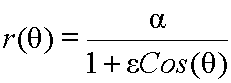
Finally, it obtains to arrive at an equation that described with exactness the Mars orbit:
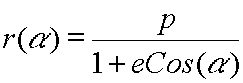
This equation above represents an ellipse in polar coordinates, where a point is represented by 0 variable q and r. It follows below an illustration:
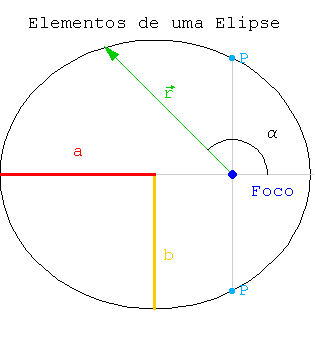
Where it it is the angle between vector r and the horizontal axle, p is the points where the ellipse cuts to the vertical axle two times and and the eccentricity of the ellipse calculated for the reason of the lesser half-axles biggest and the b. The blue point represents one of the focos.
Currently we know 1ª Law of enunciated Kepler from the following one:
Any planet that turns around the Sun, describes an elliptical orbit with Sun occupying one of the focos.
Simulation of the first law of Kepler. 3.2-A second Law of Kepler - Law of the areas
As we saw previously, Kepler created the law of the areas to demonstrate the law of the orbits. 2ª Law was conceived in the year of 1602 and appeared of a questioning made for Kepler.“If the rapidity of our planet is not constant, as we can foresee its position in one instant definitive”.
As solution, Kepler divided the half orbit in infinite parts of rays vectors. The following step was to determine that the necesário time Land to cover one given distance would be proportional to the addition of the rays vectors that are understood in the portion of considered orbit. That is, the more rays vectors, faster if dislocate the Land in one same interval of time.
Law appears thus 2ª of Kepler
The straight line that joins the planet to the Sun, sweeps equal areas in equal times.
Simulation of the second law of Kepler. The third law only came in 1618 in 5ª edition of books Harmony of the World.
3.3-A third Law of Kepler - Law of the Periods
After the publication of New Astronomy, Kepler decides to dedicate the study to it of the Universe of its harmonic laws. In its workmanship Harmony of the World, Kepler presents in five volumes divided in:1º Geometric: regular figures and harmonic proposals that these form;
2º Architectural: regular and solid plain figures;
3º Harmonic: on “what it is pertinent to it I sing”;
4º Metaphysical, psychological and astrological: Harmony of the spirit and rays of the celestial objects that fall on the Land;
5º Astronomical and Metaphysical: Harmony of the celestial movement.
Kepler looked for to find a harmonic relation between eccentricity of the orbit of a planet and its average distance to the sun. After diverse attempts, it perceive that it would have to use angular speeds in the place of in the distance. These were calculated from the maximum speeds (perihelion) and minim (aphelion) of the planet.
In 5º volume, Kepler indicates four stages to arrive its 3ª Law. In these, it makes an association enters the movement of the planets and intervals of musical times.
E thus Kepler defined 3ª law as:
The squares of the periods of revolution of the planets are proportional to the cube of the half-axle biggest of its orbits.
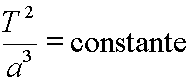
| Planet | Period of Revolution (t) in years | Half bigger axle of the òrbita (a) in u.a | T ² /a ³ (year) ²/(u.a) ³ |
| Mercury | 0,241 | 0,387 | 1,002 |
| Venus | 0,615 | 0,723 | 1,000 |
| Land | 1,000 | 1,000 | 1,000 |
| Mars | 1,881 | 1,524 | 0,999 |
| Jupiter | 11,86 | 5,204 | 0,970 |
| Saturn | 29,6 | 9,58 | 0,996 |
| Uranus | 83,7 | 19,14 | 1,000 |
| Neptune | 165,4 | 30,2 | 0,993 |
| Pluto | 248 | 39,4 | 1,004 |
Law of Kepler verifies 3ª. To come back
4-Energy of an object in a gravitational field
Gravitational potential 4.1-Energy
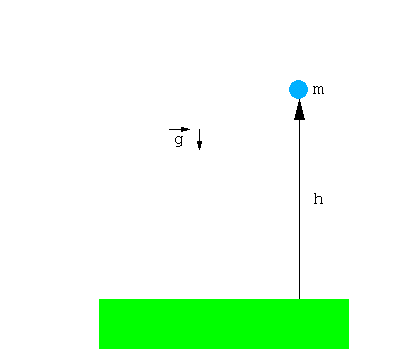
We saw in the mechanics that, the gravitational Potential Energy of an object in the neighborhoods of the surface of the Land, depends:
|
- Distance enters the surface of the Land and object h; - Mass of object m; - Value of the acceleration of gravity g. |
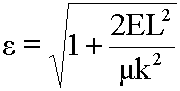
E can be dercrita for the equation:
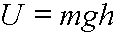
However, some considerações exist to be explained:
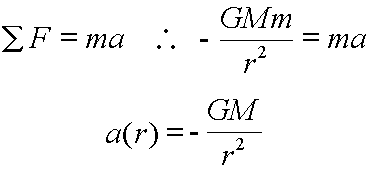
- The acceleration of the gravity is considered constant under the surface of the Land. Using the equation of the gravitational force, we verify that the acceleration in the reality is inversely proportional to the square of in the distance enters the centers of gravity of the Land and the object.
- The value of the potential energy of an object, under the surface of the Land, is only the energy spends to raise it. In a generalized situation more, the calculated value of the potential energy is referring to the set of two objects, where both are put into motion when untied. Why then, when we free an object under surface of the Land only this if it puts into motion? This happens for the fact of the Land to possess greater inertia. We have the impression of the object to possess all potential energy, when in the reality who is only it obtains to modify the kinetic energy of the set.