|









| |
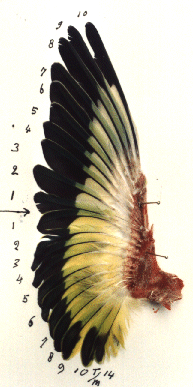
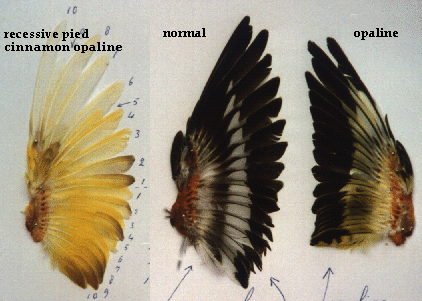
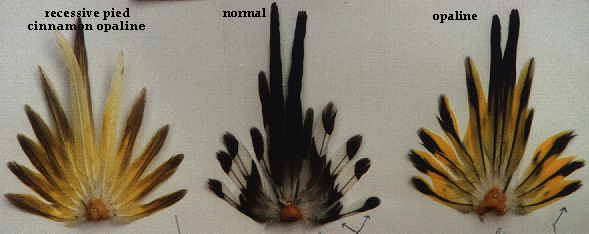
This page includes photographs of different wings and tails of budgerigars.
The standard talks about there being 7 flight feathers on the wing of a
budgerigar. Seven flight feathers are seen when the wing is closed and resting
on the rump, but when opened, there are 10 flight feathers, which can be seen on
the following pictures. The wing consists of ten primary and ten secondary
flight feathers. The flight feather of a Normal budgerigar has two dark parts,
whilst the flight feather of an Opaline has only one dark part. The budgerigar
tail is made up of 12 tail feathers. In the Normal variety, it has two dark
parts and the two longest feathers, are completely dark. The tail feathers in
the Opaline have only one dark part.
I find this helpful when I look at my recessive pieds. It is sometimes difficult
to determine the Normal recessive from the Opaline variety. By looking at the
tail feathers, I am able to confirm this.
The majority of all budgerigars have ten flight feathers, however I have noticed
a few exceptions. In my own stud of birds I have observed birds with as many as
twelve flights and some with as few as nine. I am unsure if the number of flight
feathers has any bearing on breeding of quality show birds, but this is
something that I will be looking at.
 . . 
Skeleton
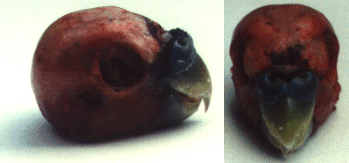
On this page are photographs showing two views of the skull of a budgerigar.
Years ago, I measured the skeletons of dead budgerigars, in an effort to find
out what influences the skeleton and the feathering have on the quality of our
budgerigars. In the skulls,I measured only a slight difference in size between a
good bird and a poor bird. However, I found a difference of as much as 10% on
the sternal keel of a good bird, compared with that of a poor bird.
Unfortunately, I do not have any photographs to illustrate this.
Following my examination, I concluded that the feathering and the direction that
it grows, is of more importance than either the skeleton or the skull, for
producing better budgerigars.
|