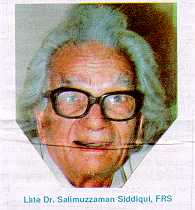
Dr. Salimuzzaman Siddiqui was the founder of Pakistan Council of Scientific and Industrial Research (PCSIR). But he possessed immaculate research record in chemistry to his credit well before joining PCSIR.
Dr. Salimuzzaman Siddiqui
|
Dr. Salimuzzaman Siddiqui, the world renowned
scientist of the sub-continent and a brilliant name in the Hall of Fame
is no more in this mortal world. He proceeded for eternal heavens in the
early hours of the 15th April 1994. Dr. Siddiqui was an enlightened example
of dedication, enthusiasm and a set of diversified capabilities.
Dr. Salimuzzaman Siddiqui was the founder of Pakistan Council of Scientific and Industrial Research (PCSIR). But he possessed immaculate research record in chemistry to his credit well before joining PCSIR. |
He was a learned man by all means; an enthusiastic and untiring researcher in the field of science and an artist with several exhibitions of his paintings to his credit. The unique combination of arts and sciences in his person made him even more popular in the world. He was the first Pakistani scientist to be awarded the Fellowship of Royal Society of London, UK.
Dr. Siddiqui is no more in this world, but has left many examples to follow. A brief life history of his is described here under.
Dr. Salimuzzaman Siddiqui was born in the small town of Subeha, of Barabanki District, U.P. in the former British India on October 19, 1897. His father's name was Chaudhri Muhammad Zaman. Late Chaudhri Khaliquzzaman, the renowned Muslim Leaguer was his elder brother. His early education comprised learning of five books of basic Urdu by Maulvi Ismail Meeruthi followed by study of Persian. He learnt 'Amadnama' and the famous Gulistan and Bostan by Sheikh Saadi. After completion of his schooling at Lucknow he moved to M.A.O. College, Aligarh (now, the Muslim University, Aligarh), where he graduated in Philosophy and Persian language in 1919. Thereafter he proceeded to England to study medicine at University College, London at the wishes of his family. There, he pursued a one year premedical course. Later on the advice of his elder brother, Ch. Khaliquzzaman, he left for Germany in 1921 to study chemistry. The Germans were then the best in chemistry. There, he studied at the University of Frankfurt on-the-river-Main under the pupilage of Prof. Julius Von Bram. ln 1924 he married his classmate a German girl, Ethel Wilhelmina Schneeman (renamed Talat). He obtained the degree of Ph.D. in organic chemistry in 1927. Although, he did his doctorate in chemistry, he was keenly interested in fine arts, painting, music and literature as well. He also translated the work of German poet Rainer Maria Rilke into Urdu; these versions were regularly published - by Muhammad Mujib in the journal "Jamia" of Jamia Millia, Delhi.
The great physician of Unani Tibb and Muslim leader Hakim Muhammad Ajmal Khan utilized his services on his return to the subcontinent in 1928. Under an arrangement with Hakim Ajmal Khan, Dr. Salimuzzaman agreed to establish "The Ayurvadic and Unani Tibbi Research Institute" at the Tibbia College, Delhi for conducting research in the therapeutic constituents of medicinal plants. However, it took sometime in setting up of infrastructure of the proposed Institute. In the meantime Dr. Salimuzzaman conducted his work at the Indian Institute of Technology (IIT) at Bangalore. On establishment of the Ayurvadic and Unani Tibi Research Institute at Delhi he relinquished the IIT and joined it in September 1929. There I commenced his work with the analysisof Chand Buti (Rauwolfia serpentina) which, in the indigenous system of medicines, was used for the treatment of snake-bites, stomach ulcers, certain types of fever and mental ailments After intensive search and investigation, l succeeded in the isolation of a main ingredient of a new medicine which he named, after his patron Hakim Ajmal Khan, as Ajmaline. This medicine is, now, being prepared in Germany and is one of the most prominent medicine, used for the treatment of hypertension and some mental illnesses and as a tranquillizer. Dr. Salimuzzaman concentrated his research mainly on the isolation of alkaloids, which, later on, opened many new avenues for further researches on medicinal plants. His work was so important that the greatest organic chemist of his time, the late Sir Robert Robinson and German botanist and physician, Leona Rauwolf also furthured the research upon 'Ajmaline'. Later, Dr. Salimuzzaman diversified his researches to other plants of medicinal and industrial importance. Some of these include Holarrhena antidysenterica (Kurchi) Cassia absus, Peganum harmala, Semecarpus anacardium (Bhilawan), Melia azadiract (Neem) and Cicer arietinum (chick peas).
During Second World War in 1940 the services of Dr. Salimuzzaman were requisitioned by the Indian Government for the new established Council of Scientific and Industr Research (GSIR) in Calcutta and he was made its Director. In CSIR, he continued his efforts and one of his outstanding achievements was the development of indeilble ink which was first used in the elections of 1946. The same product is still being used in India and Pakistan.
In 1947, when Pakistan came into being, Dr. Salimuzzaman Siddiqui was still the Director of Indian Council of Scientific and Industrial Research; at that time forty students were pursuing their-researches under his supervision leading to Ph.D. degree. In 1948, his services were requisitioned by the then Prime Minister of Pakistan, Liaquat Ali Khan, through the Indian Prime Minister, Jawaharlal Nehru. Mr. Nehru advised him to goto Pakistan. On his arrival in Pakistan, Dr. Salimuzzaman was appointed Director of the Department of Research in 1951. He managed to obtain four barracks in the Naval Hospital Complex Karachi through Dr. Mahmood Hussain, the Central Ministerof Education and started setting upthe research laboratories. In due time the Department of Research was upgraded and Pakistan Council of Scientific and Industrial Research (PCSIR) came into being in 1953. The same year Dr. Salimuzzaman was designated Foundation Fellow of the Pakistan Academy of Sciences.
The newly established PCSIR laboratories at Karachi were named as Central Laboratories while five regional Laboratories were set up at Dacca, Rajshahi, Chittagong, Lahore and Peshawar. Research work was started at all the laboratories. By 1954, his work on the desulphurization of coal had succeeded in yielding an insecticide as a by-product of processed coal. Work on upgradation and beneficiation of Kalabagh iron ore was also conducted by him for its possible use in the future steel industry. Alongwith practical research work, he pioneered research management at the state level and was elected General President of the Pakistan Association for the Advancement of Science. In 1956, he was nominated a Member of the Pakistan Atomic Energy Commission. In PCSIR, he established a modern scientific documentation Centre, PANSDOC, in collaboration with the UNESCO in 1956. In recognition of his services'Tamgha-e-Pakistan' was conferred upon him in 1958. The President of Pakistan nominated him member of the Scientific Commission and he was elected the Chairman of its Drafting Committee. The Commission recommended his proposal for the formation of six research councils. In 1960, he was elected President of the Pan-lndian Ocean Science Association. In these capacities he made efforts for better service conditions and better pay scale for the scientists of the country in general and for Ph.D scientists in particular.
At PCSIR, Dr. Salimuzzaman Siddiqui, continued his work on the isolation of various alkaloids from Rauwolfia and isolated another active principal 'Serpajmaline'from it. Now, Ajmaline and Serpajmaline are recognized drugs used in cardiac ailments the world over. Ajmaline is being manufactured in Germany and Serpajmaline in Bangladesh.
Dr. Salimuzzaman had the rare honour, in 1961, when he was elected the Fellow of the Royal Society, London. A number of universities conferred upon him honorary doctorate degrees and an award of the large Gold Medal of the Soviet Academy of Sciences. In 1964 he was made the Member of the Vatican Academy of Sciences.On his retirment from the Pakistan Council of Scientific and Industrial Research(PCSIR),
In 1966, he was appointed Professor of Chemistry and the Director of Post Graduate Institute of Chemistry at the University of Karachi and, later on as Professor Emeritus.
In consideration of his outstanding services to the science and learning, Latif Ebrahim Jamal of Husain Group of Industries made a generous grantof Rs.5 million to him for the establishement of a research institute in Karachi University in memorium of his late father Hussain Ebrahim Jamal. Due to his personal efforts, the German, British and Japanese Governments also donated millions of rupees for this institute through the Government of Pakistan. The foundation stone of the Institute was laid down on March 10, 1975. Dr. Salimuzzaman Siddiqui established the Institute on such a sound basis that now, it is regarded as one of the best three institutes of Chemistry of the world with unique stature of conducting researches in the chemistry of natural products. At the age of 93, Dr. Salimuzzaman retired as Co-Directorof HEJ Research Institute of Chemistry, but continued to work in his laboratory. On the March 15,1990; the Pakistan Association of Scientists and Scientific Professions (PASSP) hosted a reception to pay him tributes. Recognizing him as a versatile vega and the founder Chairman of PCSIR, one of the centres at PCSIR Laboratories Complex Karachi was named after him on the April 24,1990.
As an Artist
As a man of diversified interests and capable of performing various functions side by side, Dr. Salimuzzaman Siddiqui proved his skill equally well in the field of arts. He was actively interested in literature, poetry and calligraphy. He was involved in drawing, painting and even in sculpture right from his school days. He used to watch his elder brother Samiuz-zaman at his painting work for hours. With this background, he became keenly interested in various modern trends of painting in Europe when he was studying chemistry in Germany. He was overawed by the paintings of VanGogh, Franz Marc and the early period of Picasso. He ventured on his first drawing at the age of 24 in early 1922. In 1927, he managed to hold the exhibition of his paintings at the Uzielli Gallerie in Frankfurt and earned about a 1,000 gold Marks, from the sale of his paintings. Before this he held his first paintings exhibition at Gallerie Schames also in Frankfurt-on-the-river-Main in August 1924. In 1928, he sent some of his drawings and paintings to an exhibition in Bangalore; his unorthodox representation of the sitting Buddha created quite a law and order situation, while the art critic of 'The Hindu daily 'Venkatachalam wrote a charming critical appreciation in his defence. He also held occasional exhibitions of his paintings in Delhi. His visit to Jamini Roy's exhibition in Calcutta in 1940 led to a highly productive period.
Dr. Salimuzzaman Siddiqui also took keen interest in poetry. Having a flair for Arabic and :Persian, more specially for Ghalib and Meer, he also compiled his own 'Intekhab-i-Meer'.
After migration to Pakistan Dr. Siddiqui continued his indulgence mostly in drawing in charcoal and Chinese ink. His selected works were reproduced in a folder by M/s Elite Publishers. He `released his portfolio of 15 charcoal drawings on April 7,1983 which covers his collection from 1920 to 50s. A painter par excellence, the Goethe Institute in Pakistan, issued his painting of Amir Khusro on its greeting card in 1985.
By 1989, Dr. Siddiqui had attained the age of 92 years and his general health conditions were not good. He fell seriously ill and was hospitalized at the Aga Khan Hospital, Karachi. The same year he underwent an operation for cataract. He was not suffering from any major disease but of deteriorating physique. He was re- admitted in Aga Khan Hospital in the last week of February 1994 due to cardiac arrest. He breathed his last in the hospital in the early hours of April 14, 1994. His Nimaz-. Jinazawas attended by the elitesof the city and notable persons belonging to all walks of life.
Dr. Salimuzzaman Siddique contributed more than 400 research papers, developed about 50 formulations of pharmaceutical in portance and guided a large number of Ph.D students in the field of natural products chemistry. The span of his research activities spread over 65 years.
His demise is an irreparable loss for the scientific community as well as for the Nation.

