|
THE
MYTHOLOGY OF PLACE:
JAMES
K. BAXTER'S OTAGO WORLDS
Lawrence Jones
I
|
 |
 |
| The
Brighton World |
|
Page 5
|
|
As that statement implies, there were also other
sources of images than Brighton: other places in Otago, India (from his
1958 journey there), such North Island places as Wanganui, Kai Iwi Beach
(sounding very much like Brighton in 'At the Bay'), Akitio, Waipatiki Beach,
and. towards the end, especially Jerusalem. But the concern
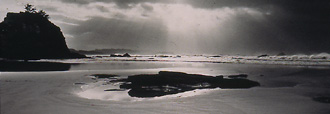
here is that little world of Brighton, a fallen Eden fronting the sea,
flanked by two other Otago worlds representing those two opposing images
that he considered to be 'of peculiar cogency for New Zealand poets', the
City and the Wilderness. While in his later poetry the City
became Wellington and then Auckland, in his early and middle poetry
it is Dunedin, 'a different place' from Brighton, 'the town I ventured
into when I first came of age . . . . the place where (as all people have
to) I broke away from my first family and began the somewhat agonising
search for a tribe of my own'. And the Wilderness is often the mountain
country of Central Otago, especially the Matukutuki Valley, 'the mirror
and symbol of the power of God which cannot be contained in human thought
or human society'. The three worlds together form a mythical
structure, a spatial myth against which the temporal myth of his life in
his poetry is acted out.
|
|
|