|
THE
MYTHOLOGY OF PLACE:
JAMES
K. BAXTER'S OTAGO WORLDS
Lawrence Jones
I
|
 |
 |
| The
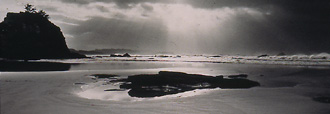
Brighton World |
|
Page 4
|
|
This Romantic poetic clearly underlies Baxter's
poetry and is an apologia for it. In that poetry he uses a
store of natural images drawn from childhood experience, using 'local places
or events as a focus for legend', to form an animistic pattern that
coalesces into myth. In a crucial passage he relates that formation
of natural myth in childhood to literary myth, both forming part of his
education as poet: Waves, rocks, beaches, flax bushes, rivers, cattle
flats, hawks, rabbits, eels, old man manuka trees . . . provided
me with a great store of images that could later enter my poems.
Among the books at home were one or two of Norse and Greek mythology. I
became the companion of Odin and Thor and Jason and Ulysses. That
was an indispensable education. When he returned to Otago
in 1966 to take up the Robert Burns Fellowship at the University of Otago,
he spoke of the importance of that store of local images from childhood:
More than half of the images that recur in my poems are connected with
early memories of the Brighton township, river, hills and seacoast
- especially the seacoast. Sitting down to write in a room in Wellington,
again and again my mind would make an imaginary journey
over the neck of the Big Rock, across the mouth of the Brighton River,
and wander round the domain, or up to the boathouse, or along the sandhills,
or out to the fishing rocks where the swells came straight in without interruption
all the way from Peru.
|
|
|