|
THE
MYTHOLOGY OF PLACE:
JAMES
K. BAXTER'S OTAGO WORLDS
Lawrence Jones
I
|
 |
 |
| The
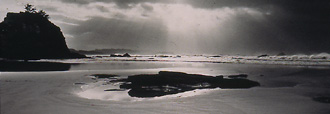
Brighton World |
|
Page 3
|
|
These sense experiences become symbolic by
a process of 'natural contemplation' upon 'the testament of sand and the
parables of rock - those very humble, very obscure communications
from nature'. As he wrote in an early poem to his
parents, 'For me all earth is symbol'. These symbols coalesce into myth
as the poet intuitively discovers 'a sacred pattern in natural events',
a 'pattern which lies, unknown, like the bones of St Peter under
the surface rubble of events'. The artist in his 'double
vision . . . expresses through an artistic medium, at one and the same
time, selected portions of objective reality and a subjective pattern which
these are able to signify'. This subjective 'animistic
pattern which underlies civilised activity' the poet attempts to 'lay .
. . bare, and draw upon its strength without being submerged by it'.
Since the pattern is animistic, 'Animism is an essential factor in the
artist's view of the world', a factor available to 'the child and the savage',
but lost in 'a materialist technological civilisation', its 'generative
power' to be gained only through 'the rediscovery and revaluation of childhood
experience'. 'The Dark Side' vividly presents the child's animistic
vision, built 'Upon the grave of savage animism' as experienced by his
tribal forebears. Such animism involves the 'passionate sympathy
with natural objects' that Baxter admired in Alistair Campbell's poetry,
and it provides the 'peculiar power' of Denis Glover's landscape poetry,
as 'mountain, river, bushland and sea assume . . . the proportions
of animistic powers'.
|
|
|