|
JAMES K. BAXTER'S OTAGO WORLDS Lawrence Jones
|
Page 6
|

|
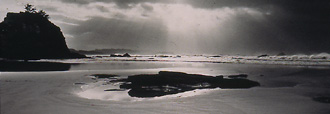
At the centre of this poetic universe is the Brighton township. It was a 'usual enough' place, this 'small town of corrugated iron roofs / Between the low volcanic saddle / And offshore reef where blue cod browse', a town with 'A creek, a bridge, a beach, a sky / Over it', a town of 'gravel roads . . . School, store, and bowling green'. But for the young Baxter, 'the town stood plain, huge at the world's centre'. He observed his 'small stretch of coast on a large island' from a hill-top, noting 'shore, islet, reef'. Or from 'the macrocarpa tree, the child's look-out' he took in 'the sea, the tide-river, chief vista of content', or looked inland to the 'gorse on ridged hill-side blown clean by the sea-wind'. From 'sea, hills, cattle island', the adolescent felt 'calmness expands; vast sanity'. This Wordsworthian world was primarily the child's Eden, the place which he experienced as a 'natural paradise' in growing up, loading his 'inner mind with images purloined' from it: 'the first cigarette tasted in the top branches of the macrocarpa tree, the mud-eels hooked or gaffed from the creek below the house, the limestone cave where somebody reckons the Maoris used to bury their dead, the girls undressing in the bathing sheds, seen through a crack in the wall. . . .' This 'natural paradise' is of course a psychological state associated with the place, not the place itself, as his definition makes explicit: |
 |
 |