|
JAMES K. BAXTER'S OTAGO WORLDS Lawrence Jones
|
Page 32
|

|
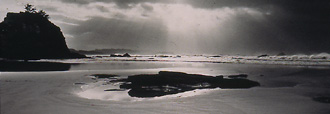
In 'The Waves' 'the slow language of the waves' seemed to the adolescent to 'give hope of truth to come' in a sexual encounter, a 'dark meeting / With a woman with a body like the moon'. However, the moon became 'Goddess of sexual pain' and left the young man contemplating the sea with 'poison crystals' whirling in his blood. The middle-aged poet hopes to find some ruler beyond 'the flux of fire, / Salt tides and air' other than the goddess of sex, a way to share the 'fluid motion' of the waves instead of fighting it, and acknowledges that 'the flesh I love will die, / Desire is bafflement.' He ends by identifying with Noah, hoping that true knowledge will come as he is keeping watch 'while the dark water heaves'.In many poems 'the thunder of the obliterating sea' suggests death, but only in death will freedom be found: 'The ocean I / Once feared, I love more than the frozen land'. 'The unique left-handed saint', the dark creative force within him, tells him . . . that Sophocles Heard in the thunder of Greek seas On beaches grey with ambergris, On the recoiling serpent hiss A voice proclaiming to the land That men are banks of broken sand . . . . The October storm at Brighton, 'the great sea-devil or the wind of middle age', may induce in the poet 'bad dreams / In which the sea has taken charge of the land', but it is finally a liberating force, freeing him from 'the chains of Eros': . . . turn to watch The tide flood in at the river mouth, Washing under the bridge, making the canoes float Upside-down. Freedom by death is the chosen element. man's prayer. |
 |
 |