|
JAMES K. BAXTER'S OTAGO WORLDS Lawrence Jones
|
Page 24
|

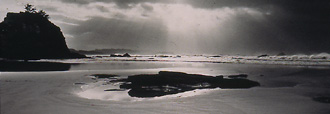
| Again, at the Otago Heads, he looks down from 'cliff-top
boulders' to see, not any Venus to be born / Out of the gulf's throat',
but rather the kraken of the fog, whose 'wide / Blinding tendrils
move like smoke / Over the rock neck, the muttering flats, the houses'.
When Venus does appear, she may be primarily a projection of desire. While the teen-age poet could see her as 'the birth of beauty' as she emerged 'shining from the sea-foam', the mature poet imagines the boys on the beach at Aramoana constructing 'their sensual fantasy, which is also sacred', transforming a girl with a surfboard into 'the image of Venus not rising from the sea but going into it'. He preaches to the men at of Holy Cross that 'That long- haired girl upon the beach / With her eyes half-shut' is there because he had 'found / A Venus in the heart', and if they judge her they 'turn her from a pretty girl / Into a demoness'. At Brighton, 'That girl in her beach suit loitering among the dunes is no longer a figure of Venus' to the forty-year old poet who is no longer 'fighting the wars of Venus'. At Long Beach, in contrast, the sleepy middle-aged poet is brought back to life by an 'apparition of the goddess Venus' in the person of 'A girl like a green hard stringy lupin pod', his 'venereal thought / Constructed out of air or nothing. . . .' The most positive revelation associated with a beach is sexual, when Horse and Fern make love on an abandoned gun emplacement above the surf: |
 |
 |