|
JAMES K. BAXTER'S OTAGO WORLDS Lawrence Jones
|
Page 23
|

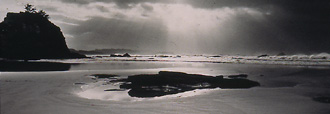
| Thus the beach as an 'arena for historical' change operates
for Baxter as a symbol within an ancestor myth. The beach's other
symbolic meanings tend to gather around the sexual one for him. If
the beach is a 'place where revelation may occur', the revelations are
usually of Venus.
Sometimes she refuses to appear, and the revelation is aborted. In 'Elegy at the Year's End', the poet walks down to the the Bay, but there is no revelation of 'green Aphrodite' rising from the sea 'to transfigure the noon'. Rather, he hears 'the Sophoclean / Chorus: All shall be taken '. When at 30 he revisits Brighton, 'Venus with her thunder slept / On tired dunes, in grey maternal / Macrocarpa branches'. When he returns ten years later to the 'smooth edge of the flax-covered cliff' below Big Rock that had tempted him to suicide when he was younger, 'gutted by / The opposites of sex and pain', 'No squid-armed Venus rose / Out of the surf', but rather he received from the 'hurdling water' the 'invisible spirit ' embodied in the poem. The uncollected 'Encounter with Venus', taking place at Tait's Beach rather than at Brighton, is more sardonic. The poet walks the beach, thinking of 'how great Venus . . . has lately abandoned our shore', when he sees an object bobbing in the waves. He wades out to it to discover 'our islands' emblem, a dead sheep' with 'a great swollen gut, putrefied': Yes, mate, indeed a sacred occasion! Through the surf I stumbled back, dumb- struck by shades of nationhood. |
 |
 |