|
JAMES K. BAXTER'S OTAGO WORLDS Lawrence Jones
|
Page 18
|

| These images of the river as the indifferent process
of Time, involving inevitable loss, are all from the Brighton River.
The neighbouring Taieri , 'the river that goes / Southward to the always
talking sea', also features in the poems, but is not so consistently
symbolic. Where it leaves the gorge and moves into the estuary at
Taieri Mouth the poet sees it as 'the old water-dragon / Sliding
out from a stone gullet', while further up the gorge it bends 'like a bright
sabre'. To the poet on his brother's boat in the river it seems
to speak, "Does it matter? Does it matter?" and its tidal nature
seems to symbolise his own inner state, 'carrying like salt and fresh inside
me / The opposing currents of my life and death'. On
the other side of the gorge, on the Taieri Plain, it takes on other significances.
When the poet looks down on it from Scroggs Hill when it is in flood and
has 'covered paddocks, sheds, and fences', the sight moves his 'inward
guardian' to say to him 'All / Knowledge, my son, is knowledge of the fall'.
The process of association is obscure (except that almost everything brings
Baxter to the Fall), but it is probably Noah's Flood that provides
the implicit link. At Henley, the river before it enters the gorge
becomes a perhaps overdetermined symbol to one of Baxter's dramatic
monologuists, a suicidal adulterous commercial traveller. He
sees the river first as 'Jehovah's book' and then dreams of suicide beneath
its 'serpent waves', swallowed by the 'bog-black stream'. In
his prose commentary on the poem, Baxter also refers to the Styx and to
the Norse world serpent in relation to the river, sees both it and
the Leith as symbolising 'the obliteration of the conscious mind by subconscious
forces', and points to the traveller's
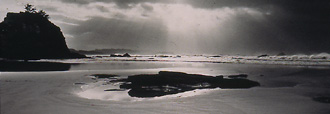
imagined view of himself as a decomposing corpse among the trout and eels as 'a very apt image for any South Islander acquainted with the Taieri and the Clutha rivers'. Here perhaps the literary mythology overloads the natural image. Less complexly, when the younger poet sees the rapid river in its other, steeper gorge, between the Strath Taieri and the Taieri Plain, the 'raving river' becomes a metaphor for the blood associated with sexual passion and pain. 'River, cattle flats' thus did supply Baxter with images, but 'waves, rocks, beaches' are even more significant in his mythology of place. Brighton is not only the fallen Eden, but its beaches are places 'at the fringes of the human domain, where the City encounters the Wilderness, [where] artists are able to discover those forms which become the treasures of their race and the real knowledge which liberates the intellect'. In 'Symbolism in New Zealand Poetry', he listed no less than four symbolic meanings for beaches: as an arena of historical change, the arrival and departure of races; as a place where revelations may occur; as the no-man's land between conscious and unconscious; as an arena for sexual adventure. |
 |
 |