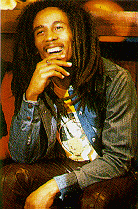
 In 1944 a 50 year old white
quartermaster, Captain Norval Marley, married an eighteen year old black girl called
Cedella Booker. They had a son, Robert Nesta Marley, who was born at two-thirty on a
Wednesday morning, February 6, 1945 in his grandfather Omeria’s house. Captain Marley
however, seldom saw his son although he provided some financial support for the family. In 1944 a 50 year old white
quartermaster, Captain Norval Marley, married an eighteen year old black girl called
Cedella Booker. They had a son, Robert Nesta Marley, who was born at two-thirty on a
Wednesday morning, February 6, 1945 in his grandfather Omeria’s house. Captain Marley
however, seldom saw his son although he provided some financial support for the family.
In the late fifties, Bob Marley and his mother moved from
St. Ann to Trench Town in Kingston. Bob spent most his time with his friend Bunny. They
often went together to Joe Higgs’s (a famous singer in Kingston) music class, and it
was there that they met Peter McIntosh.
In 1962 Marley auditioned for Leslie Kong, who took the
young singer into the studio to record his first single "Judge Not". The
following year Bob formed the Wailing Wailers together with Peter and Bunny. They were
introduced to Clement Dodd, a producer of the record company Coxsone.
On this label the Wailing Wailers released their first
single, "Simmer Down", which created a big sensation in Jamaica. By this time
three more members had joined the group: Junior Braithwaite, Beverly Kelso and Cherry
Smith. The Wailing Wailers began recording regularly and released some music that
established the group in Jamaica. When Junior, Beverly and Cherry left the Wailers were
back to the original trio.
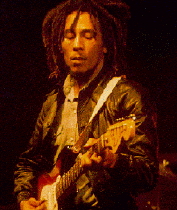 Around that
time, Bob joined his mother in the United States, but just before he left he married Rita
Anderson. In America he worked just enough to be able to finance his music and then he
returned to Jamaica. When Bob came back, he, Bunny and Peter reformed the group as the
Wailers. Since Jamaican music style was changing the group changed as well. This brought
them into conflict with Coxsone Dodd and the group formed the record label Wail 'N' Soul.
The label folded however but when they met Lee Perry, the group got back on their feet
again. Lee Perry and the Wailers produced great tracks like "Soul Rebel",
"Duppy Conqueror", "400 years" and "Small Axe". Around that
time, Bob joined his mother in the United States, but just before he left he married Rita
Anderson. In America he worked just enough to be able to finance his music and then he
returned to Jamaica. When Bob came back, he, Bunny and Peter reformed the group as the
Wailers. Since Jamaican music style was changing the group changed as well. This brought
them into conflict with Coxsone Dodd and the group formed the record label Wail 'N' Soul.
The label folded however but when they met Lee Perry, the group got back on their feet
again. Lee Perry and the Wailers produced great tracks like "Soul Rebel",
"Duppy Conqueror", "400 years" and "Small Axe".
In 1970 Aston "Family Man" Barrett and his
brother Carlton joined the Wailers. The band was, at the start of the seventies,
internationally unknown but famous throughout the Caribbean. Johnny Nash was in 1971
accompanied by Bob on his trip to Sweden and London. While in London, Marley recorded
"Reggae on Broadway" which was later released by CBS. When the rest of the
Wailers got to London to promote the single, they found themselves stranded there. With no
other way out, Bob Marley stepped right into the Island records Basing Street studios and
asked to see the boss, Chris Blackwell.
He knew of the Wailers and offered to record them. The
band were advanced a couple of thousand pounds so that they could return to Jamaica and
record their first album for Island records. The Wailers had now access to great recording
facilities and for the first time, a reggae group could compete with the already
established rock groups.
 The album was
called "Catch a fire" and was released in December 1972. It didn’t catch on
at first but the reviews were excellent in England and good in America. In April 1973 the
Wailers came to London and started a three month tour in Britain. After that they returned
to Jamaica and Bunny decided not to go on tour with the Wailers again. He was replaced by
Joe Higgs. On their American tour they even supported Bruce Springsteen for a weekend.
Later the Wailers were about to support Sly & The Family Stone for seventeen dates.
But after only four shows they were fired because they were too good. The album was
called "Catch a fire" and was released in December 1972. It didn’t catch on
at first but the reviews were excellent in England and good in America. In April 1973 the
Wailers came to London and started a three month tour in Britain. After that they returned
to Jamaica and Bunny decided not to go on tour with the Wailers again. He was replaced by
Joe Higgs. On their American tour they even supported Bruce Springsteen for a weekend.
Later the Wailers were about to support Sly & The Family Stone for seventeen dates.
But after only four shows they were fired because they were too good.
The band was stranded in Las Vegas without manager nor
money. Somehow though, they managed to get to San Francisco were they did a live concert
broadcast for the radio station KSAN-FM. Their second album "Burning", was
released in 1973. That included some older songs like "Duppy Conqueror",
"Small Axe" and "Put It On" together with "Get Up Stand Up"
and "I Shot The Sheriff".
In the beginning of 1975 the group released the
"Natty Dread" album that contained for example "Talking Blues",
"No Woman No Cry" and "Revolution". During that period Bunny and Peter
left the group to go solo (as Peter Tosh and Bunny Wailer) while the band was renamed
"Bob Marley and the Wailers".
Bunny and Peter were replaced by the I-Threes, Rita
Marley, Marcia Griffiths and Judy Mowatt, and these girls did a great job. When the band
performed at the Lyceum the show was recorded and later released as "Live!".
In a concert by Stevie Wonder on behalf of the Jamaican
Institute for the blind, Bob, Bunny and Peter did the song "Rude Boy". It was
the last time the original Wailers ever performed together. "Rastaman Vibration"
was released in 1976 and boosted into the charts in England and the United States.
"Rat Race", "Johnny Was" and "War" are a few of the tracks
that made the album so popular.
Bob Marley decided to hold a free concert at
Kingston’s National Heroes Park on December 5 1976. The idea of the concert was to
work for peace among the warring factions in Jamaica and to thank the people of the
country. The government called an election about two weeks before the concert and that was
a signal for renewed ghetto war. Gunmen broke into Marley’s house on the eve of the
concert and shot Bob, Rita and some of their friends. But they where lucky. Nobody got
killed although most of the wounds could have been fatal.
Bob was safely hidden at Strawberry Hill and had a hard
time deciding whether he was going to do the show or not. Eventually he decided to go on
and it was a show to remember. Except the fact that it was Marley’s last performance
in Jamaica in over a year, it also included Rita singing in only a night-gown and her
hospital robe. The crowd even got to hear an amazing version of "So Jah Seh".
Bob left Jamaica right after the concert, and in 1977 the whole group moved to London to
record and later release the album "Exodus". "Exodus" went to number
one in England and Germany and the singles "Exodus", Waiting In Vain" and
"Jammin’" sold in massive numbers.
The band toured Europe and also did a week of concerts at
London’s Rainbow Theatre. At the beginning of the tour Bob hurt a toe during a
football game and was later on diagnosed with cancer. In 1978 Bob Marley and the Wailers
released "Kaya", of which Bob was accused of going soft and selling out. Two
singles went into the charts: "Satisfy My Soul" and "Is This Love".
In April the band played the One Love Peace Concert in
Jamaica in front of the prime minister Manley and the opposition leader Seaga. Bob even
made the two leaders shake hands. On June 15, Bob received the Third World Peace Medal by
all the African delegations at the United Nations. Bob also made his first visit in Africa
that year and went to Kenya and Ethiopia. While in Ethiopia he started to work on a song
called "Zimbabwe".The earlier tour in Europe was recorded as the basis for the
band’s second live album "Babylon By Bus".
"Survival" was released in 1979 and it included
"Zimbabwe", "So Much Trouble In The World", "Ambush In The
Night" and "Africa Unite" amongst other great tracks. With its message of
black survival, the album was almost covered with flags of every African nation. These
were divided by a diagram that shows how Africans were packed like sardines on a slave
ship bound for the West Indies.
In the beginning of 1980 Bob Marley and the Wailers flew
to Gabon to make their African debut. It was here Bob found out that Don Taylor
(Bob’s manager) had defrauded him. Bob got so angry that he almost beat Don to death
and then fired him. The government of Zimbabwe invited the group to play at the
country’s Independence Ceremony in April the same year. This was a huge triumph for
Bob Marley and maybe even the greatest moment of his life.
The band’s last album "Uprising" received
mixed criticism. It featured songs like "Could You Be Loved", "Coming In
From The Cold", "Work" and the impressive ballad "Redemption
Songs". The group went on an European tour which included a concert in Milan with
over one hundred thousand people. The new album did well and plans were made for an
American tour that would later intersect with Stevie Wonder. Bob started at Madison Square
Garden and continued to the Stanley Theatre in Pittsburgh, which would be his last
performance.
At this point the cancer had spread out throughout his
body to the stomach, lungs and unfortunately even to the head. With the treatment of Dr.
Joseph Isles Bob lived longer than expected. But then, he had to be given the final news:
He had two weeks to live at most.
On his way to Jamaica, Bob died in a Miami hospital May
11 1981. The reggae star was put to his final rest ten days later. He was 36 years old.
His funeral took place at Nine Miles and was attended by both the Prime Minister and the
leader of the opposition.
Courtesy hem.passagen.se/mooseman
|