Chapter One:
Chaos Theory
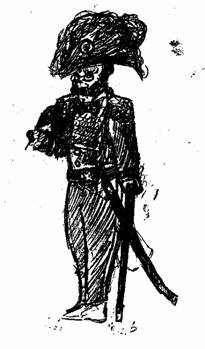
“GREETINGS, traveler! If it’s knowledge of our fair lands you seek, you’ve come to the right man. I was a relic hunter by trade, which means that I’ve done my fair share of exploring! In fact I think that I have tramped over, under, and around most of the surface of this globe Færith, and to tell the honest truth, it’s a big place.
“Perhaps it would be best to start with where you are now. This is Pensula, the Island Kingdom. We are in the capital, and a grand place it is, do you not agree? Pensula City isn’t the cleanest berg in the world, perhaps you are correct there, but is a marvel of progress no less! Her factories are most efficient in Lethandria, and her universities are the finest in the world! We are, of course, situated on the north Phœnix Ocean on the west coast of this great island... but on the east coast, you would be a scant hundred miles or so from the continent, the mainland of Lethandria; it’s just on the other side of the Gryphon Sea.
“Pensula may only be an island, but she’s interesting enough when you get right down to it... plenty of monsters for the aspiring adventurer to try and make a name for himself in slaying! ...Me? Oh, no, I’m from Eryia myself. Porte-le-Charle, the capital of my home country, just happens to be the mainland city closest to Pensula... our two nations trade so much, do you wonder why I speak the local tongue so well? Of course you don’t.
“What do I do? Well, er, I began in the wealth redistribution business... oh, very well, I was a thief if you like... but my later dealings as a treasure hunter earned me a reputation in the universities here, and since then I’ve had a turn of luck.
I’ve become the Royal Pirate-Chaser to King Clarence, you see... aha, now you recognize me, don’t you? Everybody does when I mention that part.”
—Sir Robin O’Connell
Royal Archaeologist
and Privateer of Pensula
Færith isn’t your traditional fantasy world. The Renaissance is practically over Lethandria, and in places like Pensula, it’s already a distant memory. Steam engines, ball-and-powder revolvers, and clockwork devices are appearing around the world and taking hold of the way people live and die. Truly, the technology level of Færith is an opportunity that your hero may explore, if he has the will and the brains.
Another feature of great importance is the fact that this is not a world of myth, but one of fairy tale. There are no pantheons or rival churches in the service of good and evil deities. In Lethandria, one Christian church has held dominion for nearly a millennium, and Separatist faiths are only now coming into acceptance. To the south, the great land of Al-Quahad is staunchly Muslim, and dotting the land in any country one can find strongholds of Druidic, Wiccan, and other pagan faiths keeping alive the memories of feys and nature spirits... as well as a Buddhist monastery or two training monks in kungfu!
Of course, there are still the classics: there are the fairy peoples, and though they are not as populous as humans they do dominate a number of countries in Lethandria. There is magic, and while the mages and the scientists may spend a great deal of time ridiculing one another, the two forces are not at odds. The natural growth of technology has had little to no effect on magic’s presence in Færith. And, of course, there are still knights, though most of them don’t bother with shining armor. Dwarf-made armor is still fairly resistant to musket-balls, but in this day and age the typical knight is a gentleman with a rapier, ready to defend his honor and the lives of the downtrodden. Feudalism may be long-gone, but chivalry isn’t.
Heroes of Færith
That’s right: heroes. Relative Entropy is a little unusual, but it’s still a story of high adventure and good versus evil. The players are supposed to be the good guys. That doesn’t mean your character has to be a lawful good boy-scout, or a paladin with perfect pearly-whites. It just means that you should avoid the evil alignment, for the health of your character and your DM. Angst-ridden anti-heroes aren’t much for action anyway.
Naturally, perfect heroes are not a good idea either. They’re really just not very fun to play. If you give your character a flaw of some kind, you give this fictional imagination a bit of humanity (and even non-human characters should have some humanity in them). It doesn’t have to be a weakness, just a trait that lets your character stick out. The degree is up to you. If you want a psychotic, pyromaniac sorcerer, that’s your problem... but enjoy yourself! If you like the idea of a rogue who’s just a bit too reckless or a fighter who became a drunkard because his true love was murdered, you’re more on track towards creating memorable character. As always, the cardinal rule is to just have fun with it.
Before you crack open your core rulebooks and start rolling your six-siders, there are a few basic rule variants that need to be addressed. Every world has its own rules, and Færith is no exception.
Ability Scores
The Relative Entropy setting assumes that you generate your starting ability scores in one of two ways. The first way is the standard method: roll 4d6 six times, dropping the lowest die each time, and assign the six numbers you generate to each of your abilities.
The other option is the simple point buy. You are given 75 points to distribute amongst your scores. Unlike the graduated point buy, one point from your pool equals one point added to each ability score. When all is said and done, your base scores should fall between 3 and 18, and the six scores themselves should total 75 when added up.
Nationality
Nation-states are a firm fact of life on the continent of Lethandria, and your character most likely comes from one. After choosing a race, class, and alignment for your hero, you have to pick a country. Table 1-1 shows a list of the nations of Lethandria, their most prominent populations, and the native language associated with that country. Note that all adventurers can speak, read, and write in their native language, bonus languages for intelligence, and in Connaian, the language of scholars and clerics which serves as a “common” tongue for those who travel a great deal.
Marquis Pierre des Champs-Gris, Eryian Noble
The nations of Lethandria are described in full detail in Chapter 8.
|
Table 1-1: Nations & Languages |
||
|
Country |
Language |
Dominant Race |
|
Al-Quahad |
Al-Quahadi |
Human |
|
Arettia |
Arettian |
Elf, Gnome |
|
Corscony |
Corscon |
Human, Faun, Centaur |
|
Dollo |
Dolloch |
Pech |
|
Ecadia |
Old Elvish |
Elf |
|
Eryia |
Eryian |
Human, Pech, Centaur |
|
Laomark |
Laomarki |
Human, Pech |
|
Lattéa |
Lattéan |
Gnome |
|
Mercutia |
Pensulan, Eryian, or Saridish |
All races |
|
Parus |
Parusan |
Elf |
|
Pensula |
Pensulan |
Human, Pech |
|
Ruloskiva |
Ruloskivan |
Human, Dwarf |
|
Rûne |
Rûnish |
Dwarf |
|
Sarid |
Saridish |
Human |
Alignment
Defense Bonus
All characters receive a small bonus to AC at every few class levels. This bonus is added to your AC regardless of whether or not you wear armor and even applies against touch attacks or when you’re flat-footed.
|
Table 1-2: Class Defense Bonuses |
|||
|
Level |
Defense Bonus A |
Defense Bonus B |
Defense Bonus C |
|
1st |
±0 |
±0 |
±0 |
|
2nd |
±0 |
±0 |
±0 |
|
3rd |
+1 |
±0 |
±0 |
|
4th |
+1 |
±0 |
±0 |
|
5th |
+1 |
+1 |
±0 |
|
6th |
+2 |
+1 |
±0 |
|
7th |
+2 |
+1 |
+1 |
|
8th |
+2 |
+1 |
+1 |
|
9th |
+3 |
+1 |
+1 |
|
10th |
+3 |
+2 |
+1 |
|
11th |
+3 |
+2 |
+1 |
|
12th |
+4 |
+2 |
+1 |
|
13th |
+4 |
+2 |
+1 |
|
14th |
+4 |
+2 |
+2 |
|
15th |
+5 |
+3 |
+2 |
|
16th |
+5 |
+3 |
+2 |
|
17th |
+5 |
+3 |
+2 |
|
18th |
+6 |
+3 |
+2 |
|
19th |
+6 |
+3 |
+2 |
|
20th |
+6 |
+4 |
+2 |
Defense bonus A is used by both heavy warriors (berserkers, knights, and monks) and light warriors (soldiers, explorers, and duelists).
Defense bonus B is used by both roguish experts (thieves, investigators, and professionals) and divine leaders (nobles, priests, and shamans).
Defense bonus C is used by arcane scholars (wizards, psychics, and scientists).
Action Points
Heroes especially need luck to be on their side. With the sort of wild stunts that adventurers have to pull in order to save the day, it’s a wonder they have time to save their own hides. But perhaps there’s more to it: perhaps adventurers are more than just crazy people with swords. Maybe fate and destiny give them the leg up. Maybe luck really is a lady, just when you need someone to blow on your dice the right way.
When a hero leaps into the air and seems to hang there for a moment while he spins upside down and squeezes off that perfect pistol shot, that’s an example of a heroic stunt. Martial artists do this sort of thing routinely, as do all true swashbucklers. Action points are there to help characters pull off stunts and feats of heroic proportions.
Characters receive a supply of action points at 1st level, and replenish their supply when they level up. A character starts with 3 action points at 1st level, and gains 3 + half his new character level every time he levels up. Action points not spent over the previous level are kept, not lost, but a character's total of reserve action points may never exceed his Charisma score. Thus, if a character levels up and earns enough action points to raise that total above his Cha score, the excess points are lost.
A character may spend one action point in order to add a bonus of +1d6 to any single d20 roll. An action point may not be used in this manner when taking 10 or 20, or if the result of the d20 roll has already been announced (though the player may decide to spend an action point after seeing the d20 roll itself).
|
Character Level |
Dice Rolled Per Action Point |
|
1st |
1d6 |
|
8th |
2d6 |
|
15th |
3d6 |
|
22nd |
4d6 |
Experienced characters are quite good at turning luck towards their favor. As shown above, high-level characters are entitled to roll additional bonus dice and take the highest roll. A 15th level character, for example, may roll 3d6 and use the highest d6 roll (ignoring the other two) when spending an action point.
An action point may be also spent at any time in order to perform one of the following special actions:
• Activate Class Ability: A character may spend an action points to gain an additional use of an ability with a limited number of uses per day, such as the Berserker Rage, Stunning Fist, Smite Evil, Turn Undead, or a metamagic feat.
• Desperation Move: When a character is disabled, he may spend 1 action point to act normally (that is, to take both a move action and a standard action, or to take a full-round action) and not take further damage from the strenuous activity.
• Stabilize Self: When a character is dying, he may spend 1 action point in order to stabilize himself at 10 hit points.
Favored Classes
There are no experience penalties for multiclassing in the Relative Entropy setting. In the Age of Enlightenment, education has improved somewhat. The strain of maintaining different professions at different skill levels is nonexistent, and many heroes are multifaceted Renaissance-men; in fact, it’s expected. Feel free to advance your character along any path you choose… though there is benefit in choosing your race’s favored class. Whenever you advance in your racially favored class, you receive 5 (plus half your level) action points rather than 3.
Death & Dying
There are no negative hit points in Relative Entropy; 0 is the minimum hit point total that player characters can fall to. All characters, be they PC, NPC, or monster, are killed or otherwise destroyed upon reaching 0 hit points. Player characters and especially heroic (or villainous) NPCs do have a bit of an edge over the rabble, though: any important character receives a "heroic buffer" of 10 extra hit points at 1st level. These hit points work just like negative HPs in a typical game. Thus, characters are conscious and able to fight all the way down to 11 hit points; they're disabled at exactly 10 hit points; dying between 9 and 1 hit points (with the usual 10% chance of stabilizing); and dead at 0.
Tougher PCs
|
Overall, combat is still deadlier in the world of Relative Entropy than in most other settings. One musket ball, after all, can fell even the greatest of swordsmen. All characters have a massive damage threshold (Mas.) equal to their Constitution score. Whenever you take damage that equals or exceeds your Mas., you are said to have taken massive damage.
When you take massive damage that doesn’t immediately reduce your hit points to below 10, you must make a Fortitude save vs. DC 15. If the save fails, your hit points drop to 9 anyway, and you're dying.
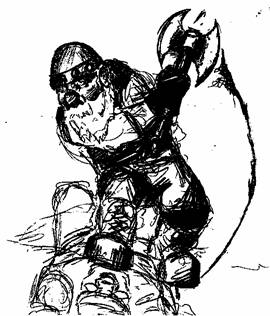
"Mostly dead or all dead? My guess would be all dead!"
Creatures immune to critical hits are also immune to the effects of massive damage.
If a nonlethal weapon deals enough damage to force a massive damage save, you must make the same Fortitude save vs. DC 15. If the save fails, you fall unconscious for 1d4+1 rounds.
|
Armor Bracers
The popularity of full plate armor has fallen steadily with time. Heavy armor is both a blessing and a curse; for all its protective power, the impediment to mobility is often too high a price to pay. A high-quality suit of armor can actually deflect or even stop a gunshot, but most fighting men don’t have access to such armor. And besides, the rusting, the clanking, the lingering smell… it’s just not fashionable. Why wear metal duds when you can have a frilly cravat, puffy sleeves, and a tri-corner hat to go with your pistol and saber?
The residents of Færith have a high demand for protective magical items that can take the place of armor. Bracers of armor are extremely common, and cost only a tenth the usual price to purchase or craft. The magic-users who craft armor bracers always make bracers of different power levels out of different materials so that they can be readily identified.
|
TABLE 1-3: ARMOR BRACERS |
|||
|
Armor Bracer |
Price |
Armor Bonus |
Damage Reduction |
|
Bronze bracer |
1,000ƒ |
+1 |
0 |
|
Iron bracer |
4,000ƒ |
+1 |
1/— |
|
Copper bracer |
9,000ƒ |
+2 |
1/— |
|
Silver bracer |
16,000ƒ |
+2 |
2/— |
|
Gold bracer |
25,000ƒ |
+3 |
2/— |
|
Platinum bracer |
36,000ƒ |
+3 |
3/— |
|
Mythril bracer |
49,000ƒ |
+4 |
3/— |
|
Adamantite bracer |
64,000ƒ |
+4 |
4/— |
DR from magic bracers doesn’t stack with DR granted by armor, but it will stack with the DR granted by a class ability, such as that of a berserker.
Any magical enhancement that a spellcaster can place on a normal suit of armor can also be placed on a bracer; however, the cost of the enhancement is twice normal.
Armor, Damage Reduction, and Speed
Even with a level bonus to AC, a few magic bracers lying around, and a small arsenal of musketry, armor has its place among adventurers. Dwarves are rather reluctant to give it up, and some scientists are convinced that the right alloys, if they can be found, will lead to a bullet-proof breastplate. In the meantime, clever mechanics have come up with clockwork and even steam-powered suits of armor that put flimsy elvish mythril to shame!
Armor now provides damage reduction in place of part of its armor bonus, as shown on table 1-4. Damage reduction from armor will not stack with DR granted by a magic bracer, but it will stack with the DR granted by a class ability, such as that of a berserker or dwarven defender.
Furthermore, the rules dealing with movement while wearing armor have been altered slightly and made more uniform for creatures of different sizes. Now all characters, be they small or medium-sized, slower or faster than normal, bipedal or quadrupedal, always lose exactly 1 square (5 feet) of movement in medium armor, and 2 squares (10 feet) of movement in heavy armor. Medium armor, meanwhile, now reduces a character's running speed somewhat, to three-and-a-half times normal, rather than four times normal. Thus, a human character has a base speed of 6 in light armor, 5 in medium armor, and 4 in heavy armor, and can run 24 squares, 17 squares, and 12 squares, respective to those types of armor.
|
TABLE 1-4: ARMOR |
|||
|
Armor Bracer |
Armor Bonus |
Damage Reduction |
Speed (Run) |
|
Light Armor |
|
|
|
|
Padded cloth |
+1 |
0 |
Base (×4) |
|
Leather jerkin |
+1 |
1/— |
Base (×4) |
|
Studded leather |
+2 |
1/— |
Base (×4) |
|
Chain shirt |
+2 |
2/— |
Base (×4) |
|
Medium Armor |
|
|
|
|
Hide jerkin |
+2 |
1/— |
-5 ft. (×3.5) |
|
Scale mail |
+2 |
2/— |
-5 ft. (×3.5) |
|
Chain mail |
+3 |
2/— |
-5 ft. (×3.5) |
|
Breast plate |
+3 |
2/— |
-5 ft. (×3.5) |
|
Heavy Armor |
|
|
|
|
Splint mail |
+3 |
3/— |
-10 ft. (×3) |
|
Banded mail |
+3 |
3/— |
-10 ft. (×3) |
|
Half plate |
+4 |
3/— |
-10 ft. (×3) |
|
Full plate |
+4 |
4/— |
-10 ft. (×3) |
To figure the DR for armor not listed on the table (and for unusual sources of armor bonuses, such as mage armor), divide the original armor bonus in half, rounding down. To find the new armor bonus, simply subtract the DR from the old armor bonus.
Shields do not grant any sort of DR.
Enhancement bonuses to armor, whether they’re magical or psionic, only increase the armor’s AC bonus. Technological enhancements and special materials are another matter entirely: making armor out of adamantite can raise its damage reduction by as much as +3, while the art of a metallurgist can possibly best that.
A character with the Run feat increases the running multipliers on the table below by 1 each, to ×5, ×4.5, and ×4.
Option:
Instead of using fixed DR for armor, you can roll a die for your DR whenever you take a hit (1d2, 1d4, 1d6, or 1d8), as if the armor's fixed DR was the "average" of the roll (like taking 10 on a d20 roll). Any bonus DR is added to the roll, so a 10th-level berserker wearing adamantite full plate has DR 1d8+5/– (rather than DR 9/–). It's even possible to have monsters roll their DR values, using 1d10, 1d20, and 1d30 instead of DR 5, 10, and 15. This variant only slows down play a little, but it makes DR more interactive (and leaves a chance that a dagger could find a chink in heavy armors and deal some damage).
|
Magic Weapons
In order to put some of the "oomph" back into magic weapons that have plain old enhancement bonuses rather than nifty special abilities, magical weapon bonuses are treated as equivalent to certain materials for bypassing certain forms of damage reduction.
|
TABLE 1-5: MAGICAL WEAPON EQUIVALENCES |
|
|
Weapon |
Bypasses DR against... |
|
Enhanced +1 |
Magic |
|
Enhanced +2 |
Piercing, Bludgeoning, or Slashing |
|
Enhanced +3 |
Silver or Cold Iron |
|
Enhanced +4 |
Adamantite |
|
Enhanced +5 |
Good, Evil, Honor, or Freedom |
Each category of magical weapon bypasses the DR of weapons beneath it, so a +5 weapon is treated as an adamantite, silver, cold iron, piercing, bludgeoning, slashing, good, evil, free, honorable, magical weapon to determine the DR it can ignore.
Special Materials
Two unique metals, mythril and adamantite, are rare treasures in Færith. Whether they're used to craft weapons or armors, items made from these special materials are as magical as those that are enchanted — though, like other enchanted objects, they lose their special properties within antimagic and null psionics fields.
Mythril: Weapons and armors made of mythril cost an additional 80,000ƒ to produce, on top of the normal cost for creating a masterwork weapon, armor, shield, or 50 rounds of ammunition. Any weapon can be made from mythril if the part used to deal damage can be made from metal, so you can have a mythril sword, a mythril-headed spear or arrows, or a mythril-shod quarterstaff; but crafting a rifle or pistol from mythril will confer little benefit. Likewise, armors can be made from mythril only if the protective part of the armor has some significant metal content — a coat of studded leather can be made from mythril, but a leather jerkin cannot.
Mythril weapons weigh half as much as other weapons of the same type. Weapons and ammunition crafted from mythril confer a +1 enhancement bonus to attack rolls and a +2 enhancement bonus to damage rolls. Mythril weapons bypass damage reduction as if they were +2 weapons crafted from silver.
Mythril armors, too, weigh half as much as normal, and this reduces its armor type by one step. In other words, heavy armors made of mythril are treated as medium, medium mythril armors are treated as light, and light mythril armors are treated as if they were clothes, or no armor at all. Mythril armors and shields add a +1 enhancement bonus to the wearer's AC, grant additional DR of 2/—, reduce spell failure chances by 10%, increase maximum Dexterity bonuses by 2, and reduce armor check penalties by 3.
Adamantite: Items made from adamantite cost an additional 180,000ƒ to craft, again on top of the price for a normal masterwork object. Any object that could be made from mythril can also be made of adamantite. Adamantite weapons have one-third more hit points than normal. Adamantite has 40 hit points per inch of thickness and hardness 20.
Weapons made of adamantite are especially good at sundering, able to ignore hardness of less than 20. Adamantite weapons and ammunition receive a +2 enhancement bonus to attack rolls and a +3 enhancement bonus to damage rolls. They have a damage-reduction category all to their own, too — adamantite weapons bypass DR vs. adamantite, as well as any other DR that can be ignored by a +3 magical weapon.
Adamantite armors grant a +2 enhancement bonus to AC and 3/— points of additional DR. Like all masterwork items, adamantite armors also reduce armor check penalties by 1.
Two-Weapon Fighting
Normally, fighting with a pair of weapons is a difficult style to learn that grants no real benefit to the warrior who spends feat slot after precious feat slot on the style. In Fæerith, though, dual-weapon styles are favored by adventuring warriors more often than sneaky thieves. Attacking with two-weapons is easier in this setting (as shown by the reduced penalties in the table below), and the feats that complement this fighting style have different effects.
The penalty for fighting with two weapons is -4 to all attacks if the off-hand weapon isn't light, or -2 to all attacks if it is light. This is in addition to the usual penalties associated for attacking with one's off-hand (-4 to the attack roll and one-half normal bonus damage from Strength with the off-hand weapon). The Ambidexterity feat (see Chapter 5) eliminates the penalties one suffers when using an off-hand weapon. The Two-Weapon Fighting feat allows a character to treat any weapon in his off-hand as light, and to make additional, iterative attacks with the off-hand weapon. Finally, the Dual-Strike feat allows a character to take an additional -2 penalty to hit with the off-hand in order to attack with both weapons as a standard action, rather than as a full-round action.
|
TABLE 1-6: TWO-WEAPON FIGHTING |
|||
|
Conditions |
Main Hand |
Off- Hand |
Multiple Attacks |
|
Attacking with two weapons |
-4 |
-8 |
Full attack with main hand only, single attack with off-hand |
|
Attacking with two weapons and off-hand weapon is light |
-2 |
-6 |
Full attack with main hand only, single attack with off-hand |
|
Ambidexterity feat |
-4 |
-4 |
Full attack with main hand only, single attack with off-hand |
|
Ambidexterity feat and off-hand weapon is light |
-2 |
-2 |
Full attack with main hand only, single attack with off-hand |
|
Ambidexterity and Two-Weapon Fighting feats |
-2 |
-2 |
Full attack with both hands |
|
Ambidexterity, Two-Weapon Fighting, and Dual-Strike feats |
-2 |
-2 (-4) |
Full attack with both hands (or single attack with both hands as standard action) |
Magic Points
Fire-and-forget magic doesn't have a place in this
setting. In Færith, all mages memorize the spells they want available that
day from their spellbooks, and cast them by spending magic points that
operate very much like the spontaneous spell-slots of Charisma-casters in the
core rules. Magic itself is a little different in this world, though.
The "arcane" arts in Færith encompass all the disciplines that use Intelligence
as a path to power, including technology, psionics, and black magic. The
"divine" arts, meanwhile, rely on Wisdom and Charisma, and this includes white
magic, chi, and such esoteric spell-like abilities as mimicry and sorcery.
All of these traditions are treated in
Chapter 6.
Craft Points
In the section of Chapter 6 that deals especially with technology, the rules for crafting items have been changed dramatically to speed play. Instead of taking several weeks of "downtime" between adventures in order to create magical or technological items, the players earn a supply of craft points at each level (and every time they take an item creation feat). Craft points are spent along with cash (and sometimes, experience points) as part of the normal cost to make an item—and after a simple check against the item's Craft DC, it's finished the next day, as if the character had already been working on it for weeks.
Experience Points
Relative Entropy uses the alternative, simplified experience point progression described in Unearthed Arcana.
|
Table 1-7: XP Progression |
|
|
Character Level |
Experience Points |
|
1st |
0 |
|
2nd |
1,000 |
|
3rd |
3,000 |
|
4th |
6,000 |
|
5th |
10,000 |
|
6th |
16,000 |
|
7th |
24,000 |
|
8th |
36,000 |
|
9th |
52,000 |
|
10th |
76,000 |
|
11th |
110,000 |
|
12th |
160,000 |
|
13th |
220,000 |
|
14th |
320,000 |
|
15th |
440,000 |
|
16th |
640,000 |
|
17th |
890,000 |
|
18th |
1,300,000 |
|
19th |
1,800,000 |
|
20th |
2,600,000 |
Instead of cross-referencing an enemy’s CR to the average party level, one can simply set an experience award to a given CR.
|
Table 1-8: XP Awards (Single Challenge) |
|
|
Challenge Rating |
Experience Point Award |
|
1 |
150 |
|
2 |
300 |
|
3 |
450 |
|
4 |
600 |
|
5 |
900 |
|
6 |
1,200 |
|
7 |
1,800 |
|
8 |
2,400 |
|
9 |
3,600 |
|
10 |
4,800 |
|
11 |
7,000 |
|
12 |
9,500 |
|
13 |
14,500 |
|
14 |
19,000 |
|
15 |
29,000 |
|
16 |
38,500 |
|
17 |
60,000 |
|
18 |
75,000 |
|
19 |
115,000 |
|
20 |
155,000 |
|
Spell Level |
Item Market Price (In Silver Guilders) |
EXP Cost Multiplier |
|
1st-3rd |
1ƒ-20,000ƒ |
×1 |
|
4th -6th |
20,001ƒ-200,000ƒ |
×2 |
|
7th -8th |
200,001ƒ-2,000,000ƒ |
×4 |
|
9th+ |
2,000,001ƒ+ |
×10 |
Use the EXP cost multiplier associated with item prices when
paying EXPs to craft magical or technological items.
Use the multiplier along with spell levels for EXP costs that come with casting
spells, or when using any special ability that comes with an EXP cost (in which
case, you should use one-half your class level as if that were the spell level).