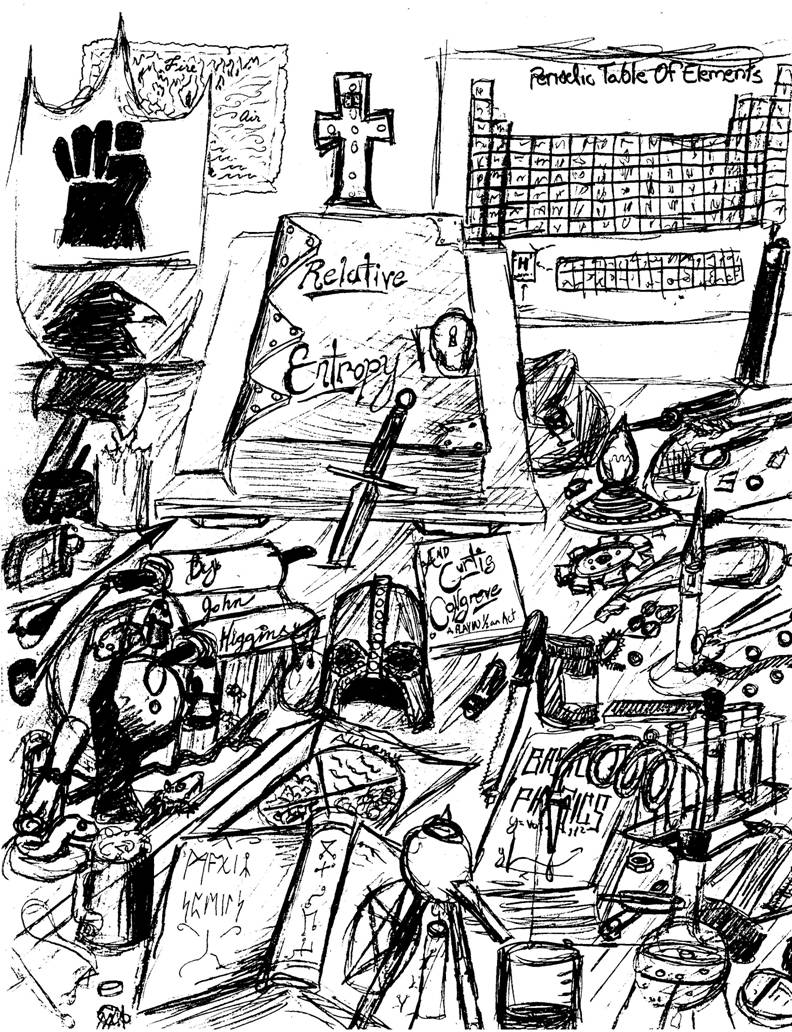
Relative
Entropy
Being a
role-playing game of
scientific
romance,
ſet
in a world of magic,
swashbuckling, and
steamWORKS
Written by:
John “Jack Daniel” Higgins
& Curtis “Old Jack” Congreve
Illustrations by Ben Dieck & Anders Bjonback
Old Jack’s Guild
of Rogues
© MMII
What's Required
In order to
play Relative Entropy, you'll
of course need the three core rulebooks for the D&D®
game – the Player’s Handbook, Dungeon Master’s Guide, and
Monster Manual. It also helps to have the Psionics Handbook, if
you intend to keep psionics in the setting.
Because of
the setting's steampunk nature, it might help you to take a look at Fantasy
Flight Games' Sorcery & Steam, Mongoose Publishing's OGL Steampunk,
and even WotC's d20 Past.
Though
they’re not required, Oriental Adventures (WotC) and Swashbuckling
Adventures (AEG) are excellent resources that can be used to flesh out
the world of Færith, and Unearthed Arcana is a good book to have if
you want to know where many of the rules particular to this game setting
come from.
Introduction
Greetings,
and welcome to Relative Entropy,
the new d20 System™
role-playing setting for use with the
Dungeons & Dragons® 3rd edition game rules. Thanks to that fantastic
Open Gaming License, innumerable settings compliant with the single best
role-playing system out there can be produced for your enjoyment -- and we
here at Old Jack’s Guild of Rogues certainly hope you enjoy them! (That’s
the plug, folks.)
About the OGL
First
thing’s first: the Open Gaming License. This license is put out by Wizards
of the Coast ® and allows us
to publish material for use with d20 Game System
™ games, like
Dungeons & Dragons®, all of
which I must apparently point out are registered trademarks of Wizards of
the Coast, and that our mentioning these names in no way constitutes
challenge of ownership.
The OGL
requires a work to distinguish between “Open Game Content,” which is stuff
you can copy out of this book and put in something you write, and “Product
Identity,” which is our stuff. This is outlined at the end, along with a
full copy of the OGL.
In general,
follow these guidelines: proper names, textual descriptions, and pictures
are our property and copyrighted (©) by Old Jack’s Guild of Rogues.
Anything that deals with game mechanics, such as a class or a feat, is
probably Open Game Content-- but its name may still be Product Identity, so
watch your bacon!
This
Setting is Science Fantasy (Not Steampunk)
The
Relative Entropy setting takes
place in a time well removed from your typical medieval fantasy world.
"Science fantasy" is typically described a fantasy genre that asks “what if”
about science and history. What if some technologies had been
invented earlier, and others later? What if history were changed by the
premature appearance of airships or analytical engines? Steampunk asks
many of the same questions, but it's important to remember that science
fantasy lacks the "punk" attitude that characterizes that genre -- the
player characters are not melancholy rebels without causes, nor are they
heroic defenders of magic and nature, fighting against the evils of progress
and technology. Science fantasy is about the optimism of
progress.
Relative Entropy asks
its own questions: what would a typical fantasy world be like as it left
its swashbuckling era and entered its steam-powered era? How would elves
and monsters and magic affect a dying Renaissance and a growing Age of
Reason? Would wizardry speed the Industrial Revolution? And above all,
what sort of world can we help you explore? You see, the planet Færith is
in many ways much more like Earth than any old fantasy world. I suppose
that leads to the theme question of our brand of fantasy: what if you
could explore a world that is like no other you’ve ever played a game in or
read a book about– and yet so like the world you know best by living there –
what if you could explore a fantastic alternate reality?
This Setting
is Fairy Tale (Not Mythology)
The vast
majority of fantasy settings are myth. Mythologies worldwide tell stories
of gods and monsters, of heroes with the blood of deities, of quests that
seek some ancient artifact. Pantheons squabble over creation in their
attempts to lord over one another and over mortals. The world is a dark
place filled with magic and devoid of learning. Such is the stuff of
legends, but it is not the stuff of
Relative Entropy. Instead of taking after the myths of the Greeks
and the Norse, the typical sources for fantasy worlds, Færith‘s inspiration
is drawn from other sources: the speculative fiction of such authors as H.G.
Wells and Jules Verne offer the “scientific romance” backdrop. Romantic
swashbuckling tales of past and modern action form the basis of the game’s
stylistic combat.
But where
does the fantasy come from? What makes the world of Færith seem magical?
In short, the so-called “modern fairy tales” of authors like C.S. Lewis and
L. Frank Baum contribute to the fantastic inspiration for this game. C.S.
Lewis, in his Narnia books, whisked us off to a world of fantasy that was
much like the mythical world of J.R.R. Tolkien’s books, but where Tolkien
drew on Norse legend, Lewis’ books were based on later fairy stories and
woven together as a sort of Christian metaphor. L. Frank Baum, whose Oz
stories were heralded as the first “modern American fairy tales,” is
especially appropriate: he did away with giants and elves and dwarves and
made a magical land filled with the dreams of the age of progress:
mechanical men, wireless telegraphy, and other scientific wonders of the
dawning 20th century. Now Faerith will take you to another magic
land, one that still has the fairies of old, one that draws upon the same
religion that Lewis did in Narnia, one that has only begun to see its age of
progress…
This Setting
is Cinematic!
The last
time you watched an Indiana Jones movie, did you think about how
similar his adventures were to most fantasy games? Go into some tomb, take
all the treasure, escape from the booby-traps and some supernatural threat
with your life… it’s no coincidence that the scientific archaeology of the
late 19th and early 20th centuries had its roots in
the earlier arts of grave-digging and tomb-robbing. Fantasy tends to call
it “dungeon-delving” when the heroes are the ones searching for treasure,
but the difference is aesthetic. What if you played a scholarly character
who meticulously documented every detail he found in a dungeon? Well, it
wouldn’t be much fun; it would make for a boring movie, and a boring game.
In a cinematic setting, one dispenses with the details just enough to say
that “the good guy hunting the treasure can be an archaeologist, but the bad
guy is a tomb robber!”
What about
everyone’s favorite part of action movies: the fight scenes? When two
reserved gentlemen draw rapiers and pistols and then suddenly try to kill
each other in an elegant dance of death, that’s the makings of a great
movie! When two combatants are done bantering and showing off their
fighting stances, and finally explode into a flurry of traded punches and
kicks, all the while shouting things like “chop suey fist!” and “pinky
finger of death!” that’s a really great movie! And who could ever
forget the classic shoot out scene at the end of any film involving
gunslingers, where two fighters duck behind their respective choices of
cover and try to blow each other’s heads off until the hero finally hits the
villain? You can have all of that and more in this world – what can I say?
Færith can be a dangerous place…
Main Contents
Forward
to Chapter I